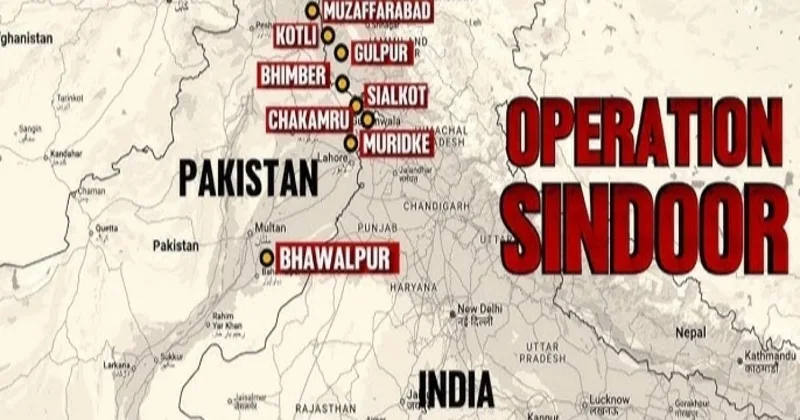
New Delhi: A year ago today, the Indian Air Force (IAF) led Operation Sindoor, launching a decisive response against Pakistan after 26 tourists were killed in the Pahalgam terror attack in J&K, allegedly carried out by terrorists backed and trained by the neighbouring country.
The aftermath reduced several key Pakistani military installations to ruins, leaving behind damaged airframes, shattered concrete hangars with gaping holes in their roofs, and the wreckage of advanced air defence radar systems, all reportedly hit by India’s sophisticated cruise missiles, drones, and precision-guided glide bombs.
The world watched as massive fireballs lit up the night sky across multiple locations deep inside Pakistan after India’s BrahMos cruise missiles targeted terror camps and military infrastructure. The powerful explosions, visible from miles away, delivered a strong message not only to Pakistan but to the entire world.
Operation Sindoor
Justice served.
Precise in action, eternal in memory—Operation Sindoor continues.
India forgets nothing-India forgives nothing.#operation #Sindoor #operationsindoor #IAF @PMOIndia@rajnathsingh@DefenceMinIndia@SpokespersonMoD@HQ_IDS_India@adgpi… pic.twitter.com/GWvnY9Udjl— Indian Air Force (@IAF_MCC) May 6, 2026
At 1:05 am on Thursday, the Indian Air Force shared a video on X showcasing striking visuals from crucial moments of Operation Sindoor. Significantly, it was at the exact same time — 1:05 am on May 7 last year- that India launched its first wave of strikes on terror and military targets inside Pakistan.
In the video released by the IAF, Prime Minister Narendra Modi is heard declaring, “India will identify, track, and punish every terrorist and their backers.
Alongside the video, the IAF posted a strong message warning that terrorists would find no safe haven, no matter where they hide. “Operation Sindoor. Justice served. Precise in action, eternal in memory — Operation Sindoor continues. India forgets nothing. India forgives nothing,” the post read.
Described as the Indian military’s largest multi-domain combat mission in nearly five decades, Operation Sindoor was launched in retaliation for Pakistan’s continued support for cross-border terrorism and signalled a major shift in India’s strategic and security doctrine.
The operation reportedly targeted multiple terror hubs, including the Jaish-e-Mohammed (JeM) headquarters in Bahawalpur, the Lashkar-e-Taiba base in Muridke, and terror infrastructure in Mehmoona Joya in Sialkot, Sawai Nala and Syed Na Bilal in Muzaffarabad, Gulpur and Abbas in Kotli, as well as Barnala in Bhimber and Sarjal.
The scale and effectiveness of the Indian Air Force strikes became evident when Pakistan moved towards ceasefire talks on the afternoon of May 9 last year, although hostilities continued for nearly two more days. The developments highlighted Pakistan’s inability to endure sustained Indian military pressure for an extended duration.