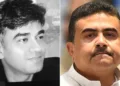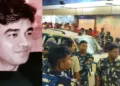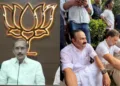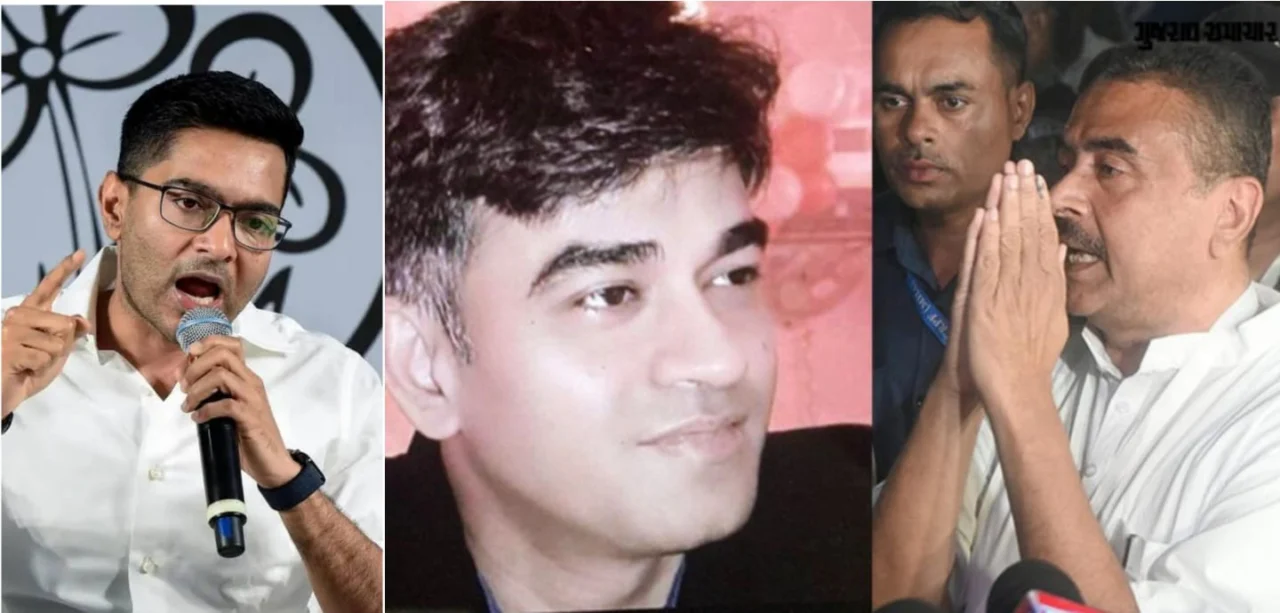
The murder of Chandranath Rath, close aide and executive assistant to senior BJP leader Suvendu Adhikari, has triggered a major political confrontation in West Bengal, with opposition leaders reviving controversial statements made earlier by Trinamool Congress General Secretary Abhishek Banerjee during the election campaign.
Rath was shot dead late Wednesday night near Madhyamgram in North 24 Parganas district after unidentified motorcycle-borne assailants allegedly intercepted his vehicle and opened fire at close range.
The killing, which BJP leaders described as a “targeted political assassination”, has now brought renewed focus on Abhishek Banerjee’s aggressive campaign speeches made before the Assembly election results.
What were Abhishek Banerjee’s ‘After May 4’ remarks?
A speech delivered by Abhishek Banerjee during a public rally before the election results has resurfaced online following Rath’s killing.
In the speech, the Trinamool Congress leader had issued a warning directed at BJP workers ahead of May 4, the day election results were declared.
“I spared you last time, this time I take full responsibility. After May 4, I’ll see whose father comes from Delhi to save you,” Abhishek Banerjee had said during the rally.
Another portion of the speech, which has now gone viral on social media after Rath’s murder, quoted him as saying:
“After May 4, I’ll personally see how much power these executioners have, and whose father comes from Delhi to save you.”
The remarks have now come under intense political scrutiny after BJP leaders alleged that the atmosphere created by such rhetoric contributed to rising political tensions and violence in the state.
BJP alleges ‘Climate of fear and intimidation’
Reacting strongly to Rath’s killing, BJP leaders accused the ruling Trinamool Congress of fostering a political environment marked by intimidation and violence.
A strongly worded reaction issued after the murder stated: “Bengal has had enough. Enough of intimidation in politics. Enough of normalising aggression. Enough of democracy feeling like something to endure instead of participate in.”
The statement further alleged that the aggressive language used by Abhishek Banerjee reflected “political desperation” ahead of the election outcome.
“The desperation in Abhishek Banerjee’s language reflects one thing, he knows they are staring at defeat. Instead of threatening people with repercussions, he should be worrying about his own political future,” BJP leaders alleged.
The statement concluded by claiming that Bengal’s voters would politically respond to such rhetoric.
“The people of Bengal will give him a reply that his seven generations will remember,” the statement added.
How was Chandranath Rath killed?
According to preliminary investigation details, Chandranath Rath was returning to his residence in Madhyamgram late Wednesday night when his Scorpio vehicle was allegedly intercepted near Doharia on Jessore Road.
Sources said another car blocked Rath’s vehicle moments before multiple motorcycle-borne assailants allegedly opened fire at close range.
Investigators suspect that at least eight attackers travelling on four motorcycles were involved in the attack. All of them were reportedly wearing helmets.
Police have also been probing the role of a suspicious vehicle carrying a Siliguri registration number (WB 74), which allegedly intercepted Rath’s vehicle moments before the firing. Officials later indicated that the number plate may have been fake.
Rath sustained multiple bullet injuries and was rushed to a private hospital, where doctors declared him dead.
His driver, Buddhadev Bera, also suffered multiple bullet injuries and remains under treatment.
Eyewitnesses described the attack as “point-blank firing” and said Rath was found bleeding heavily inside the vehicle after the assailants fled.
Investigation Intensifies
Following the murder, a team of the West Bengal CID reached Madhyamgram and began examining the crime scene.
According to sources, CID officials inspected CCTV footage from nearby areas, photographed the crime location and collected evidence linked to the attack.
Police have already recovered live rounds and empty cartridges from the spot, while forensic experts continue to examine material evidence gathered during the investigation.
Authorities have also seized a vehicle allegedly connected to the crime.
However, CID officials declined to issue any official statement while interacting with reporters at the scene.
Political reactions intensify across Bengal
The killing has sharply escalated political tensions in West Bengal, where incidents of post-poll violence have continued to surface after the Assembly election results declared on May 4.
Senior BJP leaders, including Suvendu Adhikari, termed the killing a “cold-blooded” and “pre-planned” murder and demanded strict action against those responsible.
The Trinamool Congress, meanwhile, condemned the incident and demanded a court-monitored CBI probe into Rath’s killing.
The ruling party also alleged that TMC workers had themselves been victims of political violence in recent days and called for a comprehensive investigation into all incidents linked to post-poll unrest.
Another BJP Worker, Rohit Roy was killed hours later
Hours after Chandranath Rath’s murder, another incident of violence was reported from Basirhat in North 24 Parganas district where BJP worker Rohit Roy alias Chintu was allegedly shot during a clash over the placement of BJP flags.
According to BJP leaders, the clash erupted in the Gotra area while BJP workers were installing party flags in the locality. BJP sources alleged that “TMC-sheltered miscreants” opened fire during the confrontation.
Roy sustained bullet injuries in the abdomen and was taken to Basirhat state-run hospital. Though initially stated to be in critical but stable condition, later reports confirmed that he succumbed to his injuries.
A video circulated by BJP’s media cell allegedly showed Roy accusing a group of 8 to 10 TMC workers of attacking him moments before the firing.
The back-to-back killings have further intensified the political blame game in Bengal, with allegations of targeted post-poll violence continuing to dominate the state’s political discourse.