Death of a Dying Dream: Communism fades from India
July 21, 2026
  • Read Ecopy
  • Circulation
  • Advertise
  • Careers
  • About Us
  • Contact Us
Android AppiPhone AppArattai
Organiser
  • ‌
  • Bharat
    • Assam
    • Bihar
    • Chhattisgarh
    • Jharkhand
    • Maharashtra
    • View All States
  • World
    • Asia
    • Europe
    • North America
    • South America
    • Africa
    • Australia
  • Editorial
  • International
  • Opinion
  • RSS @ 100
  • More
    • Op Sindoor
    • Analysis
    • Sports
    • Defence
    • Politics
    • Business
    • Economy
    • Culture
    • Special Report
    • Sci & Tech
    • Entertainment
    • G20
    • Azadi Ka Amrit Mahotsav
    • Vocal4Local
    • Web Stories
    • Education
    • Employment
    • Books
    • Interviews
    • Travel
    • Law
    • Health
    • Obituary
  • Subscribe
    • Subscribe Print Edition
    • Subscribe Ecopy
    • Read Ecopy
  • ‌
  • Bharat
    • Assam
    • Bihar
    • Chhattisgarh
    • Jharkhand
    • Maharashtra
    • View All States
  • World
    • Asia
    • Europe
    • North America
    • South America
    • Africa
    • Australia
  • Editorial
  • International
  • Opinion
  • RSS @ 100
  • More
    • Op Sindoor
    • Analysis
    • Sports
    • Defence
    • Politics
    • Business
    • Economy
    • Culture
    • Special Report
    • Sci & Tech
    • Entertainment
    • G20
    • Azadi Ka Amrit Mahotsav
    • Vocal4Local
    • Web Stories
    • Education
    • Employment
    • Books
    • Interviews
    • Travel
    • Law
    • Health
    • Obituary
  • Subscribe
    • Subscribe Print Edition
    • Subscribe Ecopy
    • Read Ecopy
Organiser
  • Home
  • Bharat
  • World
  • Operation Sindoor
  • Editorial
  • Analysis
  • Opinion
  • Culture
  • Defence
  • International Edition
  • RSS @ 100
  • Magazine
  • Read Ecopy
Home Politics

The Death of a Dying Dream: Communist ideology finally vanishes from the soul of the Indian mainstream

The 2026 fall CPI(M) in Keralam marks the final heartbeat of a dying ideology, turning the last fortress of Indian communism into a graveyard of lost relevance. What began as a defiance of the status quo has ended in total marginalisation, leaving a hollowed-out leadership to preside over the ruins of a century-old dream

Dr Vishnu AravindDr Vishnu Aravind
May 6, 2026, 11:30 am IST
in Politics, Bharat, Kerala
Follow on Google News
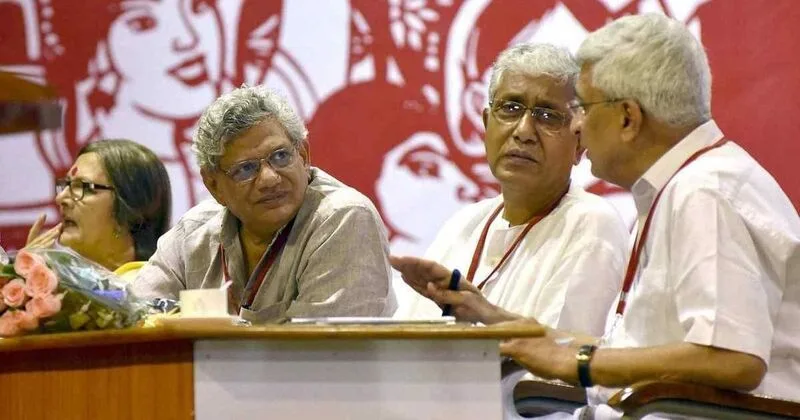
CPI(M) then-General Secretary Sitaram Yechury with Prakash Karat (right), Manik Sarkar (centre) and Brinda Karat (left) at the party’s 21st National Congress in 2015

CPI(M) then-General Secretary Sitaram Yechury with Prakash Karat (right), Manik Sarkar (centre) and Brinda Karat (left) at the party’s 21st National Congress in 2015

FacebookTwitterWhatsAppTelegramEmail

The 2026 Assembly elections in Keralam marked the end of the last major bastion of the communist movement in India. With the defeat of the CPI(M)-led Left Democratic Front (LDF) under the leadership of Pinarayi Vijayan, the party has effectively been pushed to the margins of national politics. A political force that once held the position of Leader of the Opposition in the Lok Sabha and later exercised decisive influence over the Congress-led UPA government has now entered a phase of complete decline.

There was a time when the political circumstances of the country even opened up the possibility of a CPI(M) leader occupying the Prime Minister’s chair. But as India increasingly embraced nationalism and moved away from foreign ideological frameworks, communist movements steadily lost relevance in the national mainstream. For nearly half a century, the CPI(M) remained in power in one state or another. Today, even returning to power in a single state appears to be a distant dream for the party. The Communist movement first came to power in India in 1957 in Kerala under the leadership of E. M. S. Namboodiripad. The irony is that the same state where communism first achieved electoral victory has now become the place where the CPI(M)’s national decline has reached its final stage. Following the 2026 defeat under Pinarayi Vijayan, the CPI(M) has been almost completely sidelined from national politics.

The party once had a strong organisational and electoral presence in nearly a dozen states, including Punjab, Maharashtra, Bihar, Andhra Pradesh, and Haryana. It ruled states such as Keralam, Tripura, and West Bengal for decades. Today, however, the CPI(M) finds itself fighting merely for survival. The responsibility of steering the party through this difficult phase has fallen upon the party’s General Secretary, M. A. Baby, a Malayali leader tasked with rebuilding a party that has lost both political momentum and organisational confidence. Even the party’s financial base is expected to weaken further after the electoral setback in Keralam.

From working-class politics to political elitism

The CPI(M), which once claimed to represent workers, peasants, and the oppressed, increasingly came to be viewed as a political elite disconnected from ordinary people. Critics argue that the party’s repeated positions against the national interests became one of the principal reasons for its decline at the national level. Successive governments led by the CPI(M) gradually pushed the party into political ruin. Although the CPI(M) governed Keralam for long periods, opponents argue that its rule ultimately pushed the state into a severe debt trap. The image of a party that once mobilised the working class transformed over time into that of an entrenched political establishment.

The decline of the communist movement became most visible in West Bengal. The CPI(M), led by Jyoti Basu, came to power after the Emergency in the 1977 Assembly elections. Basu continued to rule the state until his retirement, making the Left Front government one of the longest-serving elected communist administrations in the world. However, corruption, cadre dominance, and “cell rule” increasingly weakened the government’s credibility. The major protests in Singur and Nandigram eventually brought an end to 34 years of uninterrupted communist rule in the state. In the 2011 Assembly elections, the Left Front was defeated by the Mamata Banerjee-led Trinamool Congress. By the 2021 West Bengal Assembly elections, the CPI(M) and the Left Front had failed to win even a single seat.

Also Read: West Bengal Post-poll violence 2026: BJP worker killed in Rajarhat-New Town, 6 party workers stabbed in Jalpaiguri

The Tripura collapse and electoral marginalisation

The CPI(M) faced a similar political collapse in Tripura. The rise of the Bharatiya Janata Party (BJP) in the state ended decades of communist dominance in 2018. After ruling Bengal for more than three decades, the CPI(M) first became an opposition party and was eventually pushed almost entirely out of the political picture. The same pattern repeated itself in Tripura.

In the most recent elections, the CPI(M) entered into an open alliance with the Indian National Congress (INC) in an attempt to challenge the BJP. Despite the alliance, the party suffered a major defeat. With the BJP’s rise, the CPI(M) even lost the position of Leader of the Opposition in the state.

The erosion of the CPI(M)’s strength is also reflected in its parliamentary performance. In the 2024 Lok Sabha elections, the party secured only 1.76 per cent of the national vote share. It managed to retain its national party status only because it won 4 parliamentary seats from Rajasthan, Tamil Nadu, Keralam with Congress and DMK support. At the state level, the CPI(M)’s presence had shrunk dramatically. The party held only 81 Assembly seats across India, of which 62 were from Kerala and 11 from Tripura. It had two MLAs in Tamil Nadu and one seat each in Maharashtra and Jammu and Kashmir. The continuation of its national party status depended largely on its recognition as a state party in Keralam, Tripura, and Tamil Nadu, along with its lone parliamentary seat from Rajasthan. Following the heavy setback in Keralam, even that status may now come under question.

The “Historical Blunder” revisited

The decline of the CPI(M) also revives memories of a major political turning point in 1996. After the Lok Sabha elections produced a fractured mandate, the name of Jyoti Basu emerged as the leading candidate for the post of Prime Minister during coalition negotiations. However, the CPI(M) leadership refused to allow Basu to accept the position. Basu himself later described the decision as a “historical Blunder.”

Many critics believe the leadership that later aligned with the Congress-led political front gradually reduced the CPI(M) into a subordinate force within broader anti-BJP coalitions. Today, that leadership line continues under M. A. Baby.

Communism is steadily disappearing from India’s political map. The CPI(M), which once shaped national debates and controlled powerful state governments, is now struggling to retain relevance. The future of the party, and the ability of M. A. Baby to lead a weakened organisation without power or broad public support, remains uncertain.




Topics: West Bengal politicsIndian CommunismKerala Politics 2026Indian Political DeclinePinarayi VijayanCPIM
ShareTweetSendShareSend
✮ Subscribe Organiser YouTube Channel. ✮
✮ Join Organiser's WhatsApp channel for Nationalist views beyond the news. ✮
Previous News

TMC in Bengal admits ground failure: ‘Local extortion, dadagiri, anti-incumbency’ behind defeat, says Saugata Roy

Next News

Who is Kalita Majhi, a domestic worker earning Rs 2,500 now become BJP’s new MLA in Bengal

Related News

'Cockroach' Drama at Jantar Mantar: SFI-AISF Rats, Foreign Funds, Beijing's 'Gifts'– Behind Chinese Embassy Episode

‘Cockroach’ Drama at Jantar Mantar: SFI-AISF-AISA Rats, Foreign Funds, Beijing’s ‘Gifts’–Behind Chinese Embassy Episode

Kalyan Banerjee Blames Abhishek Banerjee’s ‘Camac Street Ecosystem’, I-PAC for TMC’s 2026 Poll Defeat

‘Camac street finished TMC’: Kalyan Banerjee blames Abhishek Banerjee, I-PAC for Bengal poll debacle and party split

Veena Vijayan and Mohammed Riaz (file photo)

CMRL–Exalogic probe widens: After Veena Vijayan, ED turns focus to Pinarayi Vijayan’s son-in-law Mohammed Riaz

West Bengal CM Suvendu Adhikari (Left) and Former West Bengal Chief Minister Mamata Banerjee (Right)

West Bengal’s OBC Amendment Bill: How Suvendu government seeks to end Mamata’s Muslim reservation framework

Keralam: CPM reviews collapse in Assembly but avoids leadership accountability

Thiruvananthapuram court rejects bail pleas of 11 CPM activists accused of attacking ED officials

Keralam: Court refuses bail to CPM cadres accused of attacking ED officials after raid at Pinarayi Vijayan’s residence

Load More

Latest News

Karnataka HC pulls up Congress govt for chasing tweets instead of criminals, stays FIR probe

Viral social media posts falsely claimed that India's first hydrogen-powered train suffered a technical failure

Fact Check: Routine servicing of India’s Hydrogen train misconstrued as indigenous tech failure in viral video

ABVP demands immediate INSPIRE SHE scholarship release, flags delay affecting thousands of science students

A CJP protest in Delhi turned violent, injuring police personnel, damaging government property, and triggering an investigation

CJP Protest in Delhi Turns Violent: Police injured, government property damaged; Investigation underway

Britain's market opens wider as India's textile sector gains a long-awaited competitive edge

India-UK CETA: Duty-Free access set to double textile exports, adding $1.6 billion, challenging China and Bangladesh

Representative Image

Pune Horror: 4 Muslim men Farhan, Fazal, Rehan & Sahil arrested for year long rape and blackmail of college student

Congress supremo Rahul Gandhi

If Rahul Gandhi backed Sonam Wangchuk, why did he never visit the CJP protest at Jantar Mantar?

Senior IPS officer G S Rao

Tripura govt appoints G S Rao as in-charge DGP after Anurag Dhankar found dead at police headquarters

Dipke was at NCP-SP leader Anish Gawande's house when Delhi Police detained him

Who is Anish Gawande? NCP (SP) spokesperson at whose house CJP founder Abhijeet Dipke was staying during Delhi protest

When Indira Gandhi government killed hundreds of Sadhus and Gau rakshaks

Do you know, Indira Govt killed thousands of sadhus & Gaurakshaks? Revisiting Jantar Mantar to Parliament march of 1966

Load More
  • Privacy
  • Terms
  • Cookie Policy
  • Refund and Cancellation
  • Delivery and Shipping

© Bharat Prakashan (Delhi) Limited.
Tech-enabled by Ananthapuri Technologies

  • Home
  • Search Organiser
  • Bharat
    • Assam
    • Bihar
    • Chhattisgarh
    • Jharkhand
    • Maharashtra
    • View All States
  • World
    • Asia
    • Africa
    • North America
    • South America
    • Europe
    • Australia
  • Editorial
  • Operation Sindoor
  • Opinion
  • Analysis
  • Defence
  • Culture
  • Sports
  • Business
  • RSS @ 100
  • Entertainment
  • More ..
    • Sci & Tech
    • Vocal4Local
    • Special Report
    • Education
    • Employment
    • Books
    • Interviews
    • Travel
    • Health
    • Politics
    • Law
    • Economy
    • Obituary
  • Subscribe Magazine
  • Read Ecopy
  • Advertise
  • Circulation
  • Careers
  • About Us
  • Contact Us
  • Policies & Terms
    • Privacy Policy
    • Cookie Policy
    • Refund and Cancellation
    • Terms of Use

© Bharat Prakashan (Delhi) Limited.
Tech-enabled by Ananthapuri Technologies