
Bengal’s Big Bang: 2026 verdict and rise of a new political identity
June 23, 2026
  • Read Ecopy
  • Circulation
  • Advertise
  • Careers
  • About Us
  • Contact Us
Android AppiPhone AppArattai
Organiser
  • ‌
  • Bharat
    • Assam
    • Bihar
    • Chhattisgarh
    • Jharkhand
    • Maharashtra
    • View All States
  • World
    • Asia
    • Europe
    • North America
    • South America
    • Africa
    • Australia
  • Editorial
  • International
  • Opinion
  • RSS @ 100
  • More
    • Op Sindoor
    • Analysis
    • Sports
    • Defence
    • Politics
    • Business
    • Economy
    • Culture
    • Special Report
    • Sci & Tech
    • Entertainment
    • G20
    • Azadi Ka Amrit Mahotsav
    • Vocal4Local
    • Web Stories
    • Education
    • Employment
    • Books
    • Interviews
    • Travel
    • Law
    • Health
    • Obituary
  • Subscribe
    • Subscribe Print Edition
    • Subscribe Ecopy
    • Read Ecopy
  • ‌
  • Bharat
    • Assam
    • Bihar
    • Chhattisgarh
    • Jharkhand
    • Maharashtra
    • View All States
  • World
    • Asia
    • Europe
    • North America
    • South America
    • Africa
    • Australia
  • Editorial
  • International
  • Opinion
  • RSS @ 100
  • More
    • Op Sindoor
    • Analysis
    • Sports
    • Defence
    • Politics
    • Business
    • Economy
    • Culture
    • Special Report
    • Sci & Tech
    • Entertainment
    • G20
    • Azadi Ka Amrit Mahotsav
    • Vocal4Local
    • Web Stories
    • Education
    • Employment
    • Books
    • Interviews
    • Travel
    • Law
    • Health
    • Obituary
  • Subscribe
    • Subscribe Print Edition
    • Subscribe Ecopy
    • Read Ecopy
Organiser
  • Home
  • Bharat
  • World
  • Operation Sindoor
  • Editorial
  • Analysis
  • Opinion
  • Culture
  • Defence
  • International Edition
  • RSS @ 100
  • Magazine
  • Read Ecopy
Home Politics

Bengal’s Big Bang: The 2026 verdict and rise of a new political identity

Counting trends point to a structural realignment where consolidation, electoral revision, and narrative politics reshape West Bengal’s future

Dr Prosenjit NathDr Prosenjit Nath
May 5, 2026, 09:00 pm IST
in Politics, Bharat, West Bengal
Follow on Google News
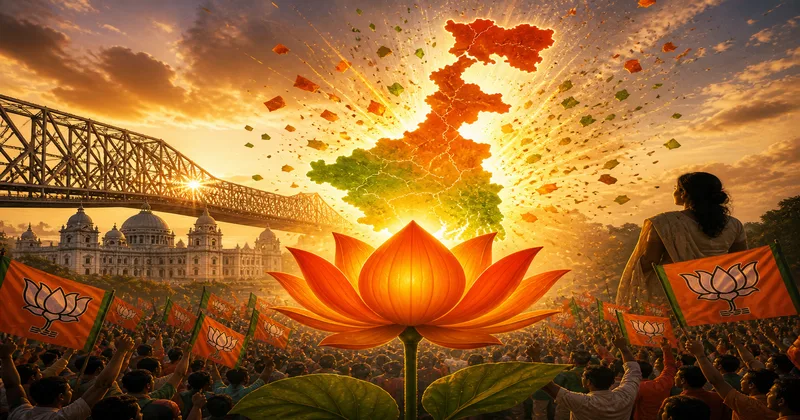
Lotus blooms in west Bengal (This is an AI generated image)

Lotus blooms in west Bengal (This is an AI generated image)

FacebookTwitterWhatsAppTelegramEmail

As Electronic Voting Machines (EVMs) are unsealed across 294 counting centres in West Bengal, the unfolding trends of the 2026 Assembly elections suggest something far deeper than a routine change of guard. What is emerging is not merely an electoral upset but a tectonic shift in the political sociology of the state. With the Bharatiya Janata Party (BJP) leading in more than half the seats and the Trinamool Congress (TMC) trailing significantly, Bengal appears poised on the brink of a historic transformation.

For decades, West Bengal was perceived as an outlier in India’s political landscape a state where class politics, cultural syncretism, and ‘Bhadralok’ secularism insulated it from the religious polarisation witnessed elsewhere. The long dominance of the Left Front, followed by the populist yet regionally rooted politics of Mamata Banerjee, reinforced this belief. However, the 2026 counting trends challenge that assumption decisively. What is taking shape is a large-scale consolidation of Hindu voters that transcends caste, class, and linguistic divisions a phenomenon unprecedented in Bengal’s electoral history.

The BJP’s rise in the state has often been framed as incremental, but the current trends suggest a “Big Bang” moment. The party appears to have succeeded in unifying diverse Hindu communities from the Matua population in border districts to the urban middle classes of Kolkata under a single political and cultural narrative. This consolidation has effectively countered the TMC’s long-standing strategy of combining minority support with welfare-driven populism, particularly schemes targeted at women voters.

Read More: Identity, Culture & Governance: Reclaiming the soul of Uttar Pradesh under Yogi Adityanath government

This shift did not occur overnight. It is the culmination of sustained grassroots mobilisation, particularly by organisations like the Rashtriya Swayamsevak Sangh (RSS), coupled with a carefully crafted narrative that positioned the TMC as selectively accommodative. Over time, this narrative appears to have gained traction among sections of the electorate who felt excluded or insecure. The developments in neighbouring Bangladesh, especially political instability and concerns over minority safety, have further amplified these sentiments, feeding into a broader perception of cultural and demographic anxiety.

Equally significant in this election is the role of the Special Intensive Revision (SIR) of electoral rolls a factor that may well prove to be the silent game-changer. The deletion of over 9.1 million voters has dramatically altered the electoral landscape. While the BJP has framed the exercise as a necessary corrective to address alleged infiltration and bogus voting, the TMC has criticised it as a politically motivated attempt to disenfranchise its support base.

Regardless of the competing narratives, the impact of the SIR is evident in the changing arithmetic of constituencies. In districts such as Malda and Murshidabad, traditionally seen as TMC strongholds due to demographic composition, high voter turnout has coincided with a more competitive electoral environment. The tribunal processes and heightened scrutiny appear to have diluted the predictability of outcomes in these regions.

Beyond numbers, the SIR has also influenced voter psychology. The very act of revising electoral rolls of inclusion and exclusion has injected a new urgency into participation. Voters are no longer merely exercising a democratic right; many are asserting their identity and legitimacy within the system. This shift in motivation has disrupted established voting patterns, making the electorate more fluid and less bound by traditional loyalties.

The interplay between consolidation and fragmentation further explains the emerging trends. On one side, a relatively unified voting bloc can decisively influence outcomes in closely contested seats. On the other, any fragmentation among opposing votes magnifies this advantage. The data from early counting rounds suggest that this dynamic is playing out across multiple constituencies, where even marginal shifts in voter alignment are producing disproportionate electoral gains.

At the same time, it would be simplistic to view this election solely through the prism of religious polarisation. Governance, development, and perceptions of administrative fairness have also played a crucial role. Years of allegations surrounding political violence, localised corruption, and the weakening of opposition space appear to have contributed to a desire for systemic change. For many voters, this election represents not just a choice between parties, but a referendum on governance standards and institutional integrity.

The statements of former senior police officials and political analysts reinforce this interpretation. They point to a broader churn within Bengali society—one that blends identity concerns with aspirations for development and equitable governance. The electorate, in this reading, is not abandoning its past but recalibrating its priorities in response to contemporary challenges.

Historical memory, too, cannot be discounted. Bengal’s experience of Partition, communal tensions, and migration continues to shape its political consciousness. Events in the region, whether within India or across the border, resonate deeply with voters. The BJP’s ability to weave these historical and contemporary threads into a coherent narrative appears to have strengthened its appeal among sections of the electorate.

Yet, the implications of this shift extend beyond the immediate electoral outcome. If the current trends hold, West Bengal may be entering a new phase where identity politics once mediated by class and culture becomes more directly articulated. This does not necessarily mean the end of Bengal’s pluralistic ethos, but it does signal a reconfiguration of how that ethos is expressed politically.

For the TMC, the challenge will be to reassess its strategies in a rapidly changing environment. Reliance on traditional vote banks and welfare schemes may no longer suffice in the face of a more consolidated and assertive विपक्ष. For the BJP, sustaining this momentum will require translating electoral gains into governance outcomes that meet the expectations it has helped create.

As counting continues, one thing is already clear: the 2026 Assembly elections mark a watershed moment in West Bengal’s political journey. What is unfolding is not just a shift in power, but a redefinition of identity, participation, and political imagination in one of India’s most historically distinct states.


Topics: SIRWest Bengal elections 2026TMCBJPWest BengalRashtriya Swayamsevak Sangh
Dr Prosenjit Nath
Dr Prosenjit Nath
The writer is a technocrat, political analyst, and author. [Read more]
ShareTweetSendShareSend
✮ Subscribe Organiser YouTube Channel. ✮
✮ Join Organiser's WhatsApp channel for Nationalist views beyond the news. ✮
Previous News

‘AAP behaves like jilted Ex’: Raghav Chadha meets President Murmu, alleges vendetta politics in Punjab

Next News

Nagaland: BJP wins bye-election in Koridang; Congress humiliated, barely beats NOTA by 96 votes

Related News

Dr Syama Prasad Mookerjee: A Life That Still Guides Bharat’s National Resolve

Delhi Chief Minister Rekha Gupta paid tribute to Bharatiya Jana Sangh founder Syama Prasad Mookerjee on his death anniversary

Article 370 abrogation was the greatest tribute to Syama Prasad Mookerjee: Delhi CM Rekha Gupta

Prime Minister Narendra Modi

Viksit Bharat: PM Modi slams Congress — ‘Blocks development, claims credit’

Functionaries of Akhil Bharatiya Rashtriya Seva Bharati on the stage release Rashtriya Seva Sadhana–2026

Tamil Nadu: Seva Bharati reviews service initiatives, charts roadmap for future expansion

PM Modi Pays Homage to Jan Sangh Founder Syama Prasad Mookerjee

Balidan Diwas: PM Modi pays tribute to Jan Sangh founder Syama Prasad Mookerjee, hails his nationalist legacy

Odisha Legislative Assembly Speaker Surama Padhy conducting proceedings of the State Assembly in Bhubaneswar. (File Photo)

Odisha Speaker rejects BJD and Congress petitions seeking disqualification of 11 MLAs over Rajya Sabha cross-voting

Load More

Latest News

Saleem and Jaleel arrested in forced religious conversion case

Karnataka Conversion Case: Forced conversion of Hindu woman and minor son sparks outrage; Saleem and Jaleel arrested

Bareilly Cantonment Emerges as Model for Sustainable Urban Development in India (Image Source X)

Uttar Pradesh: Bareilly Cantonment becomes India’s first carbon-negative cantonment

CM Yogi Adityanath making industry, investment and the connectivity revolution in Eastern Uttar Pradesh

The Purvanchal Growth Story: How industry, infrastructure, tourism & exports are fueling development in eastern UP

(Left) Fire at the coaching centre in Lucknow (Right) Members of ABVP extending all possible help

Lucknow Coaching Centre Fire tragedy is heartbreaking and deeply unfortunate: ABVP seeks action against culprits

Andhra Pradesh Minister and TDP National General Secretary Nara Lokesh

Nara Lokesh dismisses rumours of TDP sabotaging Modi government, reaffirms unconditional NDA support

With new military deployments, export opportunities and potential Russian production, BrahMos is entering a new era of strategic relevance

BrahMos enters high-volume production as military demand and global export orders surge

Dr Mahrang Baloch

Pakistan: Mahrang Baloch gets life sentence, Balochistan erupts in protest; BYC calls for shutdown

Prime Minister Narendra Modi

‘Maoism is breathing its last’: PM Modi highlights crackdown on red terror in last 12 years and growth in tribal areas

(Left) Dr Shyama Prasad Mookerjee (Right) West Bengal CM Suvendu Adhikari

Syama Prasad Mookerjee was instrumental in creation of West Bengal’: CM Suvendu Adhikari

Female recruitment in Jihadist networks emerges as major security concern

Khadija Terror Case: Female recruitment, online radicalisation in Jihadi networks poses major security concern

Load More
  • Privacy
  • Terms
  • Cookie Policy
  • Refund and Cancellation
  • Delivery and Shipping

© Bharat Prakashan (Delhi) Limited.
Tech-enabled by Ananthapuri Technologies

  • Home
  • Search Organiser
  • Bharat
    • Assam
    • Bihar
    • Chhattisgarh
    • Jharkhand
    • Maharashtra
    • View All States
  • World
    • Asia
    • Africa
    • North America
    • South America
    • Europe
    • Australia
  • Editorial
  • Operation Sindoor
  • Opinion
  • Analysis
  • Defence
  • Culture
  • Sports
  • Business
  • RSS @ 100
  • Entertainment
  • More ..
    • Sci & Tech
    • Vocal4Local
    • Special Report
    • Education
    • Employment
    • Books
    • Interviews
    • Travel
    • Health
    • Politics
    • Law
    • Economy
    • Obituary
  • Subscribe Magazine
  • Read Ecopy
  • Advertise
  • Circulation
  • Careers
  • About Us
  • Contact Us
  • Policies & Terms
    • Privacy Policy
    • Cookie Policy
    • Refund and Cancellation
    • Terms of Use

© Bharat Prakashan (Delhi) Limited.
Tech-enabled by Ananthapuri Technologies