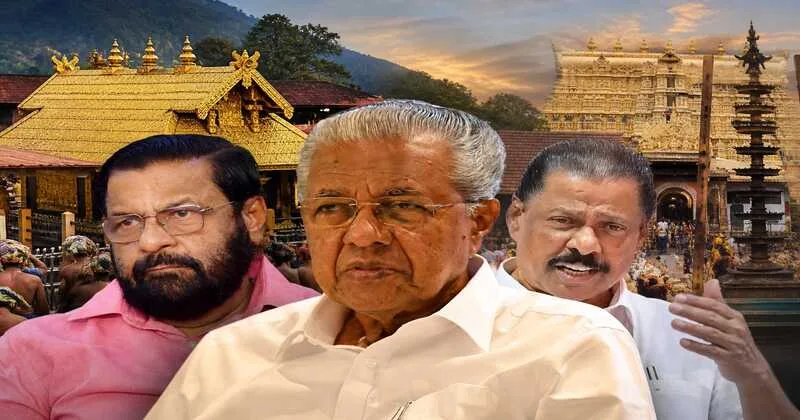
Thiruvananthapuram: The CPI(M) has suffered a severe electoral setback, widely seen as a historic political punishment for repeatedly insulting and provoking Hindu sentiments in Keralam. Chief Minister Pinarayi Vijayan and his leadership have been accused of actions that alienated large sections of Hindu voters. Former Devaswom ministers Kadakampally Surendran and V. N. Vasavan faced sharp criticism for their conduct at Sabarimala and other major Mandirs, where they were seen standing with folded hands in a manner that allegedly obstructed devotees’ view of the murti.
Sabarimala row and growing Hindu backlash
The roots of the backlash trace back to the first Pinarayi government’s handling of the Sabarimala issue. The decision to allow women entry into Sabarimala, coupled with the refusal to permit hartals, triggered widespread protests and left a deep sense of anger among Hindu devotees. The filing of cases against tens of thousands of devotees, including women who participated in chanting, further intensified this resentment. Chief Minister Pinarayi Vijayan’s remark in the Guruvayur Mandir, “Is Krishna sitting where that lamp is burning?”, was widely perceived as contemptuous and hurt Hindu religious sentiments. Critics argued that such remarks reinforced a perception that the leadership repeatedly disrespected Hindu beliefs. Supporters within the party cadre, along with the Islamist elements that had entered the party’s support base, were seen as endorsing such actions.
In the run-up to the elections, Kadakampally Surendran’s visit to a Bhadrakali Mandir became a major controversy. He was accused of insulting the priest and throwing tirtha and prasadam onto the ground. The fallout was immediate, as he suffered defeat in Kazhakoottam constituency, once considered a stronghold of the CPI(M). Adding to the discontent was the shocking revelation that gold ornaments of Sabarimala Shasta had been stolen, leading to a growing perception among devotees that those responsible were linked to the party.
Political fallout and electoral collapse of the CPI(M)
The political consequences extended beyond religious issues. Following an interview by Pinarayi Vijayan, in which he cited statistics suggesting that many of those arrested in a gold smuggling case were from Malappuram district, several Muslim organisations reacted strongly, sparking controversy. Groups such as Jamaat-e-Islami and PFI-linked SDPI were seen as distancing themselves, creating further complications for the CPI(M). In response, the party attempted to recalibrate its strategy, seeking to regain Hindu support. It propagated claims that if the UDF came to power, Jamaat-e-Islami would control the Home Department and that incidents like the Marad Hindu Massacre would return. However, many voters viewed this as a tactical shift rather than a genuine position. The Hindu community, recognising this as a political manoeuvre, rejected what was seen as the party’s last attempt to regain lost ground.
The result was a decisive and heavy defeat for the CPI(M) and the LDF. The election outcome reflected a broader rejection of the party’s governance style and internal functioning. From a dominant position of 99 seats, the sharp decline symbolised the erosion of its support base. The perception of Chief Minister Pinarayi Vijayan’s political invincibility has been significantly weakened. Public anger was also directed at internal decisions, including the nomination of the party secretary’s wife as a candidate and the expulsion of a leader who had accused the party of diverting funds meant for a martyr’s family. These developments contributed to the growing perception of arrogance and disconnect within the leadership.
Kannur, long considered the CPI(M)’s strongest bastion, showed signs of shifting political alignment, with potential implications for neighbouring districts such as Kozhikode.
The shock of Pinarayi Vijayan trailing in Dharmadam during multiple rounds of counting, despite having previously secured a margin of over fifty thousand votes, remains one of the most striking symbols of this electoral setback. Questions are now being raised about both his leadership and the role of party secretary M. V. Govindan.
While the Congress-led UDF has come to power, the BJP has also made notable gains, reopening its account and marking a significant comeback. Rajeev Chandrasekhar won in Nemom, V. Muraleedharan secured victory in Kazhakoottam, and B. B. Gopakumar emerged victorious in Chathannur. The party also finished second in 11 constituencies, including Ottapalam, Thiruvalla, and Thrissur, and gained approximately 30,000 additional votes in around 30 constituencies. The NDA’s vote share rose to 19 per cent (Unofficial). This election in Keralam stands as a historic turning point, with a significant section of Hindu voters moving away from the CPI(M), contributing decisively to one of the party’s most severe defeats.