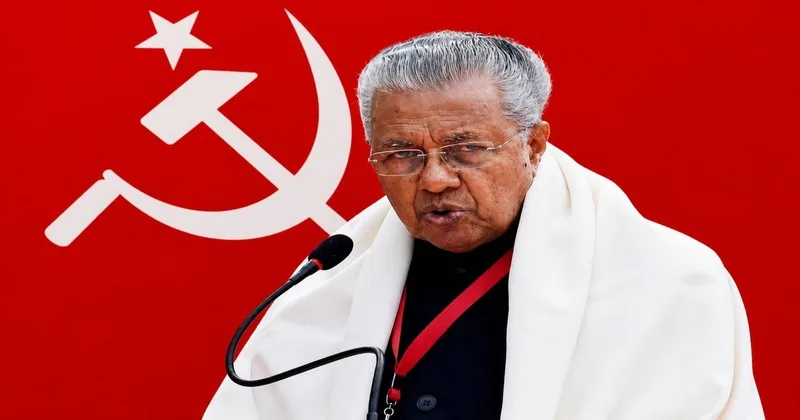
Thiruvananthapuram: In a dramatic political turn, CPI(M) leader Pinarayi Vijayan has stepped down as Chief Minister of Keralam following a crushing electoral defeat, marking the fall of the last Communist-led government in India. The resignation came swiftly on the day of the results, signalling both the scale of the setback and the urgency within the leadership to respond to the verdict.
The Chief Minister, who has remained at his residence in Kannur district since the results began unfolding, did not travel to Thiruvananthapuram, the state capital. Instead, he submitted his resignation to the Raj Bhavan through a special envoy. Governor Rajendra Vishwanath Arlekar accepted the resignation and directed him to continue as caretaker Chief Minister until a new government assumes office. Despite the historic nature of the moment, Vijayan has not addressed the media, maintaining silence since the electoral outcome became clear. Party sources had earlier indicated that he would resign the day after the results, but the decision to step down immediately reflects the gravity of the situation.
Electoral verdict ends a decade of LDF rule
The 2026 Keralam Assembly elections delivered a decisive mandate against the Left Democratic Front (LDF), which had sought an unprecedented third consecutive term. The United Democratic Front (UDF) surged to power with a commanding 102 seats, while the LDF was reduced to just 35, and the BJP gained 3 seats. The scale of the defeat was underlined by the collapse of ministerial strongholds. Of the 21 ministers who contested, 13 were defeated, indicating a deep anti-incumbency wave across Keralam. Long-held Left bastions fell, and senior leaders struggled to retain their political ground.
Even as Vijayan faced a tough fight in his own constituency of Dharmadam, the broader electoral landscape reflected a systemic rejection of the government. The results mark the end of a decade-long Left rule and a significant shift in Keralam’s political trajectory.
From weaver’s son to the pinnacle of power
Born in 1944 in Kannur district’s Pinarayi village, then part of the Madras Presidency, Pinarayi Vijayan rose from humble beginnings to become one of the most powerful figures in Keralam’s political history. He was the 14th child of Mundayil Koran and Kalyani, a family that faced severe economic hardship. Following the early death of his father, Vijayan took up handloom weaving as a teenager after completing his schooling.
His academic journey led him to Government Brennen College in Thalassery, where he pursued a pre-university course and later earned a Bachelor’s degree in Economics. It was here that he first engaged with student politics. His political career began with the Kerala Students’ Federation, the precursor to the Students’ Federation of India (SFI), where he served as both president and secretary. He later led the Kerala Socialist Youth Federation, participating actively in the agitational politics of the communist movement during a formative phase in Keralam’s political evolution.
Rapid rise within CPI(M)
Vijayan’s ascent within the Communist Party of India (Marxist) was swift and decisive. At just 24, he became a member of the Kannur district committee, and by 28, he was part of the district secretariat. His electoral journey began in 1970 when he contested from Kuthuparamba and won. He repeated his victories in 1977, 1991, and 1996, each time with increasing margins.
A significant milestone came in 1996 when he was appointed electricity minister in the cabinet led by E. K. Nayanar. His administrative role during this period brought him into the centre of governance and policy implementation.
In 1998, Vijayan became the state secretary of the CPI(M), a position he held until 2015. This period saw the party achieve major electoral successes, including a significant victory in the 2006 assembly elections and a notable performance in the 2014 Lok Sabha elections.
In 2002, he was elevated to the CPI(M) politburo, cementing his status as a national-level leader. His elevation to Chief Minister in May 2016 marked the culmination of decades of political work, as he became Keralam’s 12th Chief Minister. Supporters of Vijayan often highlight his role during the Emergency in India (1975–1977) as a defining moment in his political life. During this period, when civil liberties were suspended under then Prime Minister Indira Gandhi, Vijayan was subsequently arrested. This phase became central to his political narrative and helped consolidate his position within the Left movement.
Recent controversies and criticism
Vijayan’s tenure as Chief Minister (2016–2026) was marked by several controversies that shaped public perception of his leadership. One of the most prominent was the SNC-Lavalin case, linked to his tenure as electricity minister. The case involved allegations of a Rs 375 crore loss to the state exchequer in a deal with a Canadian firm for repairing generators. The handling of the Sabarimala issue (2018–2019) also generated widespread backlash. Following a Supreme Court verdict allowing women of all ages to enter the mandir, the government’s approach was criticised by devotees and opposition parties as insensitive to religious sentiments and administratively heavy-handed. During his second term, allegations linked to a gold smuggling case further intensified political opposition. Critics, including leaders from the BJP and Congress, accused the administration of presiding over a “10-year corruption streak,”
During his second term, the political challenges facing Pinarayi Vijayan were further intensified by a high-profile financial investigation involving his daughter, Veena Vijayan. The Serious Fraud Investigation Office (SFIO) examined payments made to her IT firm, Exalogic Solutions, by a private mining company, Cochin Minerals and Rutile Limited (CMRL). According to the SFIO charge sheet, the probe pointed to alleged financial irregularities amounting to Rs 182 crores linked to the firm’s transactions. The findings became a major point of political contention, with opposition parties raising serious questions about financial propriety and governance standards during Vijayan’s tenure.
Vijayan also faced criticism for corruption and an authoritarian leadership style. Allegations of centralised decision-making and reliance on a close group of police officials led to concerns about governance practices.
Labour-related issues, including the persistence of “nokkukooli”, the practice of extracting payment without performing work by the left trade union CITU, continued to draw complaints from business communities, despite assurances of reform. Additionally, a controversy surrounding government expenditure on public relations and a documentary project between 2024 and 2025 sparked debate about the alignment of such initiatives with communist principles of collective leadership.
The resignation of Pinarayi Vijayan marks the end of a significant chapter in Keralam’s political history. As the last serving Communist Chief Minister in India steps down, the electoral verdict signals not just a change in government but a broader shift in political mood.
With the UDF set to assume power after a decade with a strong presence of NDA in the state assembly , the transition underscores the unusual nature of Keralam’s politics, even as it closes the chapter on one of the most dominant and controversial leaders of the state’s contemporary era.