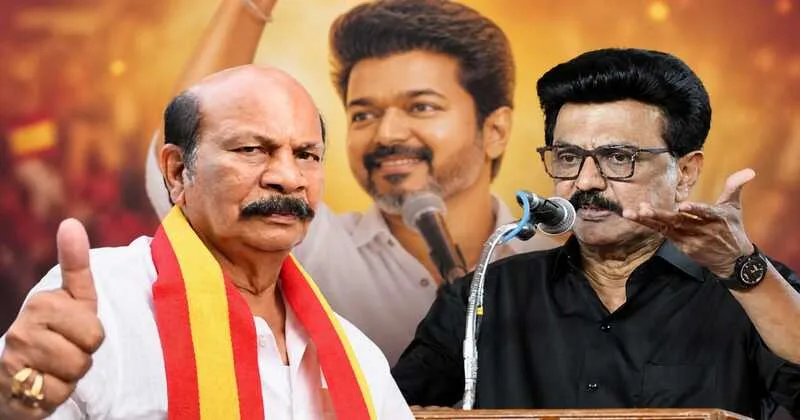
Chennai: All the ingredients for another blockbuster political drama were in place in the Tamil Nadu Assembly elections, and nowhere was this more evident than in Kolathur on May 5. In a stunning upset, actor Vijay’s Tamilaga Vetri Kazhagam (TVK) candidate VS Babu defeated DMK chief and Chief Minister MK Stalin in his own stronghold of Kolathur. Babu secured victory by a margin of 9,192 votes over Stalin, rewriting the political narrative of one of Tamil Nadu’s most secure constituencies.
The Kolathur constituency itself came into existence following the delimitation exercise ahead of the 2011 Assembly elections. That year, Stalin, then serving as Deputy Chief Minister, contested from Kolathur and defeated AIADMK’s Saidai Duraisamy by 2,734 votes. However, what began as a relatively narrow victory soon transformed into an unassailable bastion. In the subsequent elections of 2016 and 2021, Stalin consolidated his dominance, defeating AIADMK candidates by massive margins of 37,730 and 70,384 votes respectively. Kolathur came to symbolise what political observers often describe as a “strong fortress.” On Monday, however, that fortress fell.
From stronghold to shock defeat
In the 2011 elections, the DMK leadership made a strategic decision to shift Stalin from Thousand Lights, a constituency where he had won four out of six previous contests, to the newly carved Kolathur. Though he emerged victorious, the contest in North Chennai proved tougher than anticipated. The narrow margin raised concerns within the party leadership, which believed that such a modest victory was inadequate for a leader being groomed as the party’s future face.
Responsibility for this perceived setback was placed on V.S. Babu, who had been overseeing Stalin’s campaign at the time. Babu, then serving as the overall district in-charge of North Chennai, had been entrusted with the additional responsibility of managing Stalin’s electoral strategy. The DMK had placed considerable trust in his organisational abilities. However, the outcome did not meet expectations. What made this episode particularly striking was that Stalin’s electoral history had not always been defined by overwhelming victories. In fact, he had crossed the 10,000-vote margin only five times in his political career prior to 2011. The only significantly large victory before that came in 1996, when he won the Thousand Lights seat by an impressive margin of 44,877 votes. Despite this context, the 2011 result led to Babu’s removal from his influential position.
Political fallout and realignment
Following the 2011 elections, the DMK sidelined V.S. Babu and appointed P. K. Sekar Babu as the North Chennai District Secretary. This decision triggered discontent. In protest against his marginalisation, Babu joined the AIADMK in June 2016, marking a significant shift in his political trajectory. Years later, in February 2026, Babu joined Vijay’s Tamilaga Vetri Kazhagam. From the moment he entered the party, he began working with clear focus and intent. His efforts culminated in what can now be seen as one of the most consequential victories of the election. Tasked with challenging one of the most entrenched leaders in Tamil Nadu politics, Babu executed his campaign with precision, ultimately delivering a result that stunned both supporters and critics.
The emergence of TVK itself was unexpected. For over six decades, Tamil Nadu’s political landscape had been dominated exclusively by the Dravidian majors, the DMK and AIADMK. The last time a non-Dravidian party held power in the state was in 1962, when the Congress under K. Kamaraj secured victory. Since then, power had alternated between the two Dravidian giants without exception.
A new political chapter in Tamil Nadu
Going into the 2026 elections, Stalin and the DMK were widely regarded as clear favourites. Their dominant performance in the 2019 and 2024 Lok Sabha elections, winning 38 seats in the former and 39 in the latter, had reinforced their position as frontrunners. In addition, the DMK alliance had achieved a sweeping victory in the 2021 Assembly elections, securing 159 out of 234 seats.
On the other side, the AIADMK was struggling to regain its footing following the death of its iconic leader J. Jayalalithaa in December 2016. Questions persisted over the leadership of former Chief Minister Edappadi K. Palaniswami, and the party appeared weakened. Despite these challenges, the general consensus remained that even a diminished AIADMK would still be a stronger force than Vijay’s newly formed TVK.
As campaigning progressed, the DMK remained confident of retaining power. Just days before the results, Stalin had asserted that there was “no doubt about victory,” emphasising that his confidence stemmed not from exit polls but from the sentiments of party workers. However, the electorate had a different vision. In a political environment where voters had long been presented with only two dominant options representing Dravidian identity, Vijay introduced something fundamentally different, what many described as a genuine electoral choice. The people of Tamil Nadu embraced this alternative with remarkable enthusiasm. In his very first political contest, Vijay led his party to a resounding victory. The result marks a historic shift in Tamil Nadu’s political landscape. The decades-long dominance of the DMK has been disrupted, and a new force has emerged at the centre of power. With this victory, Vijay steps into his new role as the Chief Minister of Tamil Nadu, signalling the beginning of a new era in the state’s politics.