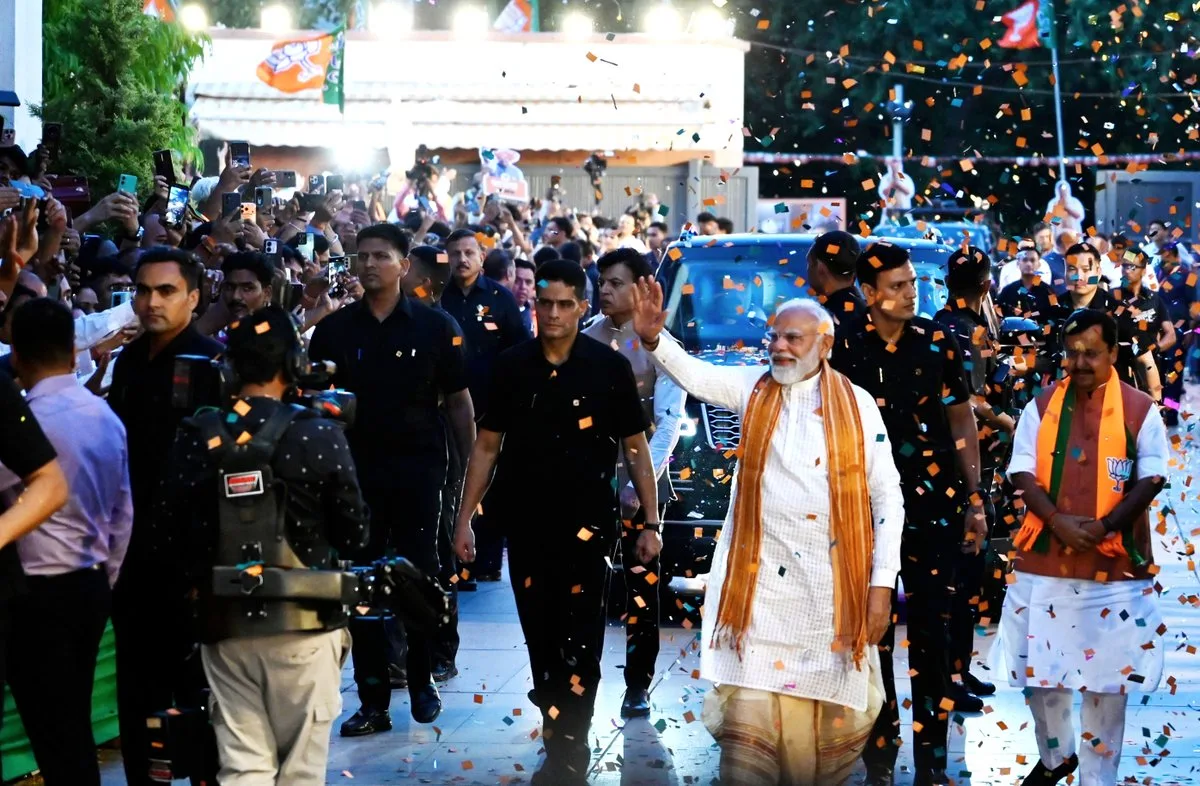
When Narendra Modi walked into the Bharatiya Janata Party headquarters in New Delhi on the evening of May 4, the political messaging had already been delivered through election results. But what followed was something far more striking.
Instead of his usual kurta-jacket or formal attire, Modi appeared in a crisp white dhoti, styled in the unmistakable Bengali fashion. As he entered, the party’s Bengal campaign anthem “Paltano Dorkar Chai BJP Sarkar” echoed through the venue, creating a moment where politics, culture, and symbolism converged.
It was not just a wardrobe choice. It was a carefully crafted visual statement.
Observers noted that in that instant, the distance between Delhi and Bengal seemed to collapse. The attire, the music, and the timing together created an image that conveyed a deeper narrative: that the BJP’s victory in West Bengal was not merely political, but cultural.
The political context behind the gesture
The significance of this moment becomes clearer when viewed against the backdrop of the 2026 West Bengal Assembly elections.
For years, the BJP had struggled to break the perception of being an “outsider” party in a state dominated by the All India Trinamool Congress. Critics frequently argued that the party lacked cultural rootedness in Bengal’s social and political fabric.
The 2026 results, however, marked a decisive shift. With a strong electoral performance that dismantled the long-standing dominance of the ruling party, the BJP not only gained political ground but also sought to reshape its image in the state.
Modi’s choice of attire on victory night must be understood within this context. It was not an isolated gesture but the culmination of a broader campaign strategy aimed at cultural integration.
The meaning of the Bengali dhoti
The dhoti, particularly in Bengal, is far more than a piece of clothing. It is a symbol of identity, tradition, and cultural continuity.
Traditionally worn by men across eastern India, the Bengali dhoti is distinct in its draping style, characterised by precise pleats and a structured wrap that allows ease of movement. It is typically paired with a “panjabi,” the regional term for a kurta.
Worn during festivals like Durga Puja, weddings, and religious ceremonies, the dhoti carries emotional and cultural weight in Bengali society. It represents heritage, simplicity, and a connection to tradition.
The fabric itself also holds significance. Many Bengali dhotis are made from “tant,” a lightweight cotton known for its breathability, making it ideal for the region’s humid climate. For special occasions, finer versions crafted from Bengal muslin, once among the most prized textiles in the world, are used.
By choosing this attire, Modi was not merely adopting a regional dress code. He was aligning himself with a deeply rooted cultural symbol.
Carefully choreographed moment
The symbolism of the dhoti was amplified by the setting in which it appeared.
As Modi entered the BJP headquarters, the campaign anthem “Paltano Dorkar Chai BJP Sarkar” played in the background. The phrase, which translates to “We need change, we need a BJP government,” had been the rallying cry of the party throughout the Bengal campaign.
Hearing it played in Delhi, on the night of victory, while Modi walked in dressed in traditional Bengali attire, created a powerful visual narrative.
It was a moment that fused campaign messaging with cultural identity, reinforcing the idea that the BJP’s victory was both political and emotional.
Pattern in Modi’s political communication
This was not the first time Modi has used attire as a form of political messaging.
Over the years, he has consistently adopted regional clothing during visits and campaigns across India. During the 2026 Kerala elections, for instance, he wore a traditional mundu and kasavu stole while campaigning in Palakkad. On another occasion, he donned a veshti while hosting Chinese President Xi Jinping in Tamil Nadu’s Mahabalipuram.
These choices are part of a broader pattern. Modi’s use of regional attire serves as a symbolic gesture of cultural acknowledgement, allowing him to connect with local identities in a visible and immediate way.
The Bengali dhoti on May 4 can thus be seen as part of this ongoing strategy, adapted to the specific political moment of the Bengal victory.
Addressing the ‘Outsider’ narrative
One of the central challenges for the BJP in West Bengal has been the perception that it is not rooted in the state’s culture.
During the campaign, senior leaders repeatedly addressed this issue. Assurances were made that leadership in the state would reflect local identity, language, and culture.
Modi’s appearance in a Bengali dhoti on victory night can be interpreted as a visual response to that narrative.
It signalled an attempt to bridge the cultural gap that critics had long highlighted. By adopting one of Bengal’s most intimate and recognisable traditions, Modi projected a message of respect and inclusion.
Political reports indicate that such gestures, while symbolic, can have a significant impact in shaping public perception, particularly in states where cultural identity plays a central role in politics.
Cultural symbolism meets political messaging
The power of Modi’s dhoti moment lies in its ability to operate on multiple levels simultaneously.
On one level, it was a celebration of victory. On another, it was a gesture of respect toward Bengal’s cultural heritage. And on a third level, it was a strategic communication aimed at reinforcing the BJP’s integration into the state’s socio-political fabric.
This layered messaging is characteristic of Modi’s political style, where symbolism is often used to complement policy and rhetoric.
The fact that the gesture required no explanation only added to its impact. The visual itself conveyed the message.
Role of cultural identity in modern politics
The episode also highlights the growing importance of cultural identity in Indian politics.
Elections are no longer fought solely on issues of governance and development. Cultural representation, symbolism, and emotional connection have become equally significant.
In states like West Bengal, where cultural pride is deeply embedded in public consciousness, such gestures carry particular weight.
By choosing to wear a dhoti, Modi tapped into this cultural sentiment, reinforcing the idea that political leadership must also engage with cultural identity.
Gesture of respect or strategic messaging?
While supporters viewed the gesture as a mark of respect toward Bengal, critics argued that it was a calculated political move.
However, in contemporary politics, the line between symbolism and strategy is often blurred. Gestures can be both genuine and strategic, serving multiple purposes at once.
In this case, the dhoti moment achieved what political messaging often aims to do: it created a lasting image that encapsulated a complex narrative in a single frame.
The image of Modi in a Bengali dhoti quickly gained traction across social media and news platforms, becoming one of the most discussed visuals of the election results day.
For BJP supporters, it symbolised the party’s successful integration into Bengal’s political and cultural landscape. For others, it raised questions about the role of symbolism in politics.
Regardless of interpretation, the impact was undeniable. The image became a reference point in discussions about the 2026 elections, illustrating how visual communication can shape political narratives.
When attire becomes a statement
The evening of May 4, 2026, will be remembered not just for the electoral results but for the imagery that accompanied them.
Narendra Modi’s decision to wear a Bengali dhoti transformed a routine victory appearance into a moment of cultural and political significance.
In a single gesture, he acknowledged Bengal’s identity, addressed a longstanding political narrative, and reinforced the message of transformation that defined the BJP’s campaign.
In modern politics, where images often speak louder than speeches, this was a moment that did exactly that.