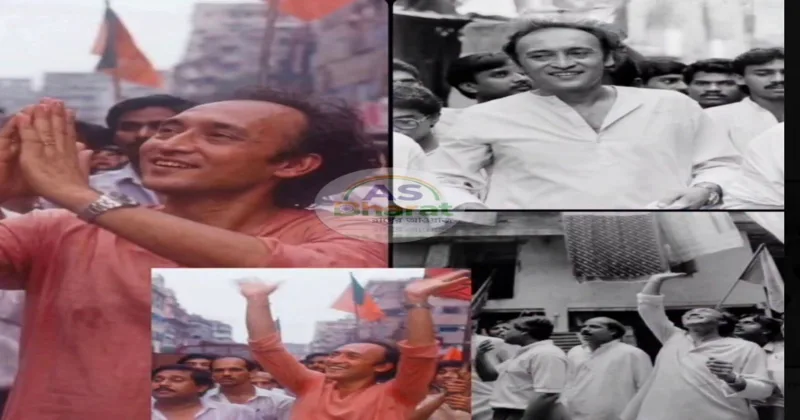
Kolkata: Today, as the BJP has evolved into a formidable political force in West Bengal, the early enablers who braved a hostile ideological climate deserve recall. Among them stands Victor Banerjee, an acclaimed actor whose brief but bold political foray in 1991 remains a striking footnote in Bengal’s political history.
Best known to wider audiences for films like “A Passage to India” and “Ghare Baire”, and later for “Joggers Park”, Banerjee brought both cultural stature and intellectual heft to a political experiment few in his fraternity would dare.
1991: Contesting Against the Tide
Banerjee contested the 1991 Lok Sabha elections from the then Calcutta North West constituency on a BJP ticket, at a time when the party had negligible presence in the state.
West Bengal’s political landscape was firmly controlled by the Communist Party of India (Marxist)-led Left Front, with the Congress as the only other significant player. The BJP, still a marginal force nationally, was virtually non-existent in Bengal’s electoral arithmetic.
Against this backdrop, Banerjee’s decision was not just unconventional, it was politically risky and socially isolating.
Shoestring Campaign, Strong Conviction
Banerjee’s campaign was modest to the point of being symbolic. He reportedly addressed street-corner meetings with barely half a dozen supporters, a reflection of both the BJP’s organisational weakness in Bengal at the time and his personal commitment.
This was not a celebrity parachuting into politics with fanfare, it was a conscious ideological plunge
The Verdict: Defeat, But Not Insignificance
The electoral outcome was predictable. Banerjee finished third, securing around 89,155 votes, roughly 21–22% of the vote share.
While he did not win, the numbers carried significance. In a political climate where the BJP struggled for visibility, crossing the 20% mark in an urban constituency was seen as a psychological breakthrough.
Why This Candidacy Mattered
Banerjee’s 1991 run was less about victory and more about signalling.
It was a time when aligning with the BJP could invite ostracism within Bengal’s intellectual and cultural circles, and Victor Banerjee’s bold move reflected a rare ideological conviction. His stature as a respected actor lent the party a degree of legitimacy it otherwise lacked in the state.
He continued to be associated with the BJP for some years, participating in events and speaking on national issues, including concerns around kar sevaks, indicating that his engagement was not merely symbolic.
A Rare Political Voice Among Cultural Elites
Unlike many public figures who shift affiliations with changing political winds, Banerjee did not chase electoral convenience. Even after stepping back from active politics, he maintained a consistent ideological voice.
In a 2022 interview, he offered a nuanced assessment of Bengal politics, arguing that regional pride and resistance to perceived “outsiders” would make a sweeping BJP victory difficult. The comment reflected both candour and a deep understanding of Bengali socio-political psychology.
Legacy: A Footnote That Foreshadowed a Shift
Banerjee’s nearly forgotten 1991 campaign stands today as an early marker of the BJP’s long and difficult journey in West Bengal, from the fringes to a principal challenger.
His candidature may not have altered the electoral map then, but it helped plant a flag, quietly, almost alone, at a time when few were willing to
In hindsight, Victor Banerjee’s political gamble reads less like an electoral misadventure and more like a solitary act of ideological assertion, one that predated, by decades, the BJP’s eventual rise in Bengal’s fiercely contested political arena.