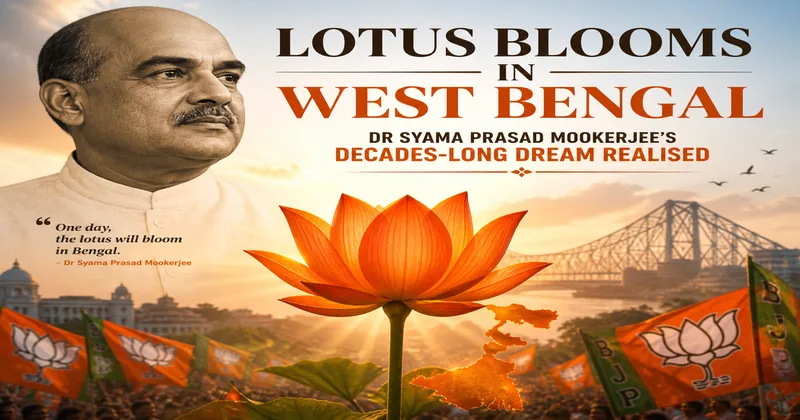
The transformation visible in West Bengal’s politics today has its roots in October 21, 1951, when Dr. Syama Prasad Mookerjee founded the Bharatiya Jana Sangh. At the time, this was not merely the formation of a political party; rather, it marked the inception of an ideological stream running parallel to the policies of the Congress, one grounded in the concepts of national unity, cultural nationalism and a strong central government. Mookerjee envisioned an India where national identity would be paramount, and where no form of regional separatism could ever challenge the country’s unity.
भय OUT ❌
भरोसा IN ✅जय श्री राम 🚩 pic.twitter.com/8ToOIr86mW
— BJP (@BJP4India) May 4, 2026
The Kashmir Movement: A Decisive Expression of Nationalism
The most emphatic aspect of Dr. Mookerjee’s politics was his movement against the special status accorded to Jammu and Kashmir- a region where, under Article 370, provisions existed for a separate constitution and a separate flag. His slogan- “One Nation, One Constitution, One Flag” (Ek Desh, Ek Vidhan, Ek Nishan), constituted a bold intervention in the political discourse of that era. In 1953, he was arrested while attempting to enter Kashmir without a permit and he subsequently passed away while in custody. In a profound sense, his sacrifice, precipitated by the issue of Jammu and Kashmir was made in the supreme interest of the nation.
On 21.10.1951, Dr Shyam Prasad Mukherjee of West Bengal founded the Bharatiya JanaSangh, a political party based on national Hinduism, and became its founder president.
Nehru went to Kashmir shouting slogans like "One Constitution, One Law, One Flag for One Country" in protest… pic.twitter.com/Ai82rNz4R6
— महावीर, ಮಹಾವೀರ, Mahavir (@Mahaveer_VJ) May 4, 2026
From Jana Sangh to BJP: The Expansion of an Ideology
Dr. Mookerjee’s ideological legacy did not fade away following his demise. In 1977, the Bharatiya Jana Sangh merged into the Janata Party, which emerged as the focal point of anti-Congress politics in the aftermath of the Emergency. In 1980, this ideological stream re-emerged as a distinct entity; the Bharatiya Janata Party (BJP). Over time, the BJP refined its ideological framework, placing national consciousness and development at its core, thereby establishing itself as a formidable force within the national political landscape.
From Limited Influence to Resurgence: The Struggle in Bengal
Ironically, the very land from which this ideology originated, Bengal was precisely where it failed to garner significant public support for a prolonged period. From 1977 to 2011, the Left Front held sway, anchoring the state’s politics firmly around leftist ideology. Subsequently, the Trinamool Congress, under the leadership of Mamata Banerjee, rose to power. During these decades, the BJP’s influence remained limited, fostering the perception that its roots in Bengal were weak.
सुन लो TMC वालों, बंगाल की जनता का ये ऐलान…
एक ही नारा, एक ही नाम… जय श्री राम 🚩 pic.twitter.com/ul16x9P7X3
— BJP (@BJP4India) May 4, 2026
A New Political Equation: The BJP’s Expansion
The impact of the political shifts that occurred at the national level after 2014 became clearly visible in Bengal as well. Under the leadership of Prime Minister Narendra Modi and Amit Shah, the BJP strengthened its organizational structure within the state and expanded its reach down to the grassroots level. The journey, which began with just two seats in the 2014 Lok Sabha elections, reached a tally of 18 seats in 2019, while in the 2021 Assembly elections, the BJP emerged as the principal opposition party. This transformation signifies not merely a change in statistics, but also a shift in the state’s political consciousness.
𝐅𝐫𝐨𝐦 𝐭𝐡𝐞 𝐡𝐞𝐚𝐫𝐭𝐥𝐚𝐧𝐝 𝐭𝐨 𝐁𝐞𝐧𝐠𝐚𝐥, 𝐭𝐡𝐞 𝐦𝐚𝐩 𝐢𝐬𝐧’𝐭 𝐣𝐮𝐬𝐭 𝐞𝐱𝐩𝐚𝐧𝐝𝐢𝐧𝐠, 𝐢𝐭’𝐬 𝐭𝐡𝐞 𝐛𝐞𝐥𝐢𝐞𝐟 𝐨𝐟 𝐚 𝐧𝐚𝐭𝐢𝐨𝐧 𝐝𝐞𝐭𝐞𝐫𝐦𝐢𝐧𝐞𝐝 𝐭𝐨 𝐩𝐫𝐨𝐠𝐫𝐞𝐬𝐬.
North to Northeast, the colour shift is no longer subtle. Bengal is simply the… pic.twitter.com/QODKYqCyU1
— BJP (@BJP4India) May 4, 2026
Bengal: Moving from Dream to Reality
Today, with the BJP firmly established as a formidable political force in Bengal, this can be viewed as a significant step toward realizing the long-cherished dream of Dr. Syama Prasad Mookerjee- a dream in which he envisioned his ideology garnering widespread public support on this very soil.
अंधेरा छटेगा,
सूरज निकलेगा,
कमल खिलेगा…🪷#BJPSweepsBengal pic.twitter.com/EK9ygBgRhe— BJP (@BJP4India) May 4, 2026
Although complete political success remains a dynamic and evolving process, it is indisputable that the seed he sowed in 1951 has today blossomed into a powerful political presence, steering Bengal’s politics in a new direction.