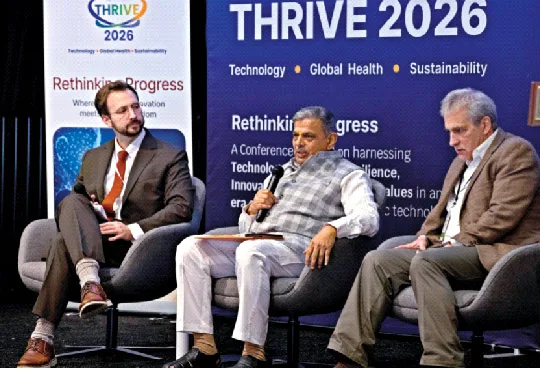
“In our tradition, the roots of knowledge have been both sensory and super-sensory. That which is based on perception and reasoning, and also that which goes beyond the limits of human knowledge. There has never been a segregation between the spiritual and the secular. What is called spiritual knowledge in our traditions also includes what today would be understood as scientific knowledge,” said Rashtriya Swayamsevak Sangh Sarkaryavah Dattatreya Hosabale, at the Global Science Innovation Forum’s Thrive-2026 Summit in Silicon Valley on April 17, 2026.
He articulated a compelling vision for scientific progress with the revival of Bharatiya gyan parampara, emphasising that true technological innovation must be anchored in economy, ecology, and ethics. He remarked, “There are sutras (texts), which explain human anatomy, mind sciences, the functioning of the human body, action and inaction, why the body acts and why it doesn’t. These explanations are detailed and analytical, yet they are considered as spiritual texts. But in essence, they are scientific. Over a long period of history, particularly due to continuous invasions and foreign rule, many of these traditions were disrupted or destroyed. During those troubled times, we were made to forget much of our scientific heritage. Now, we are in a phase where there is a conscious effort to revive that knowledge. The new Government has adopted a policy of education where the
Indic knowledge systems are being reintroduced.”
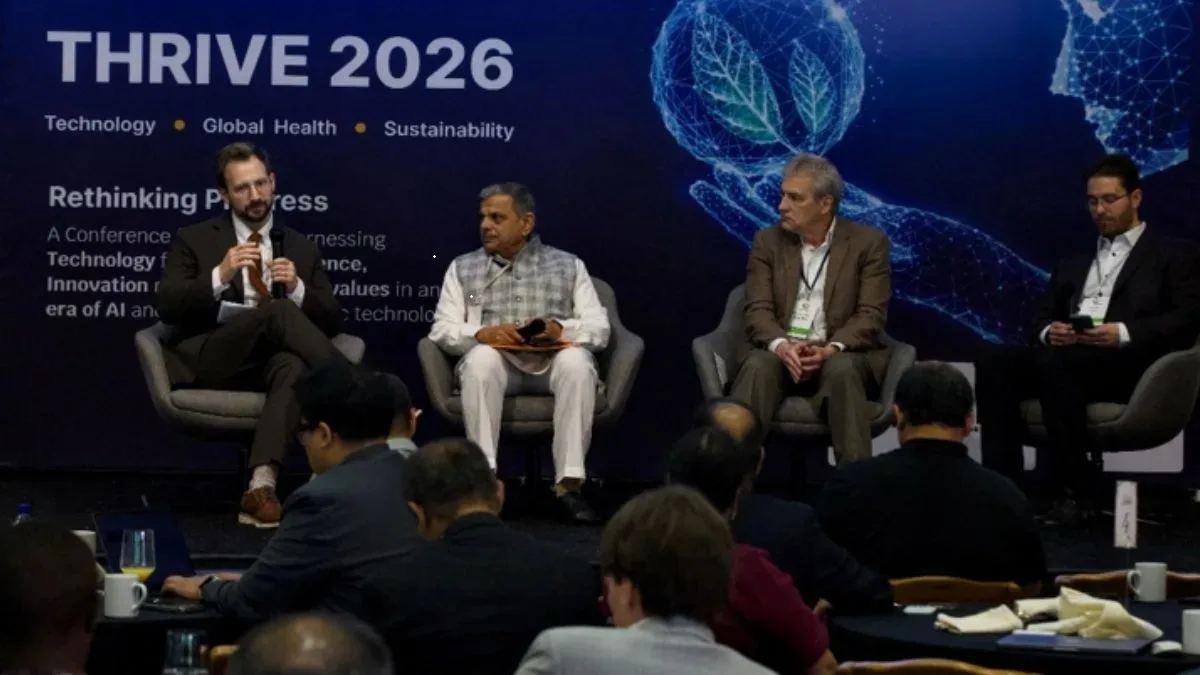
Addressing the framework for evaluating innovation, he urged that every scientific development be assessed against three core touchstones —ethics, equality, and economy—cautioning that the absence of these principles could intensify inequality and social instability. His observations resonated with experts, scholars, and technologists present, as he connected civilisational wisdom with contemporary scientific concerns. On the task of rediscovering scientific traditions, Hosabale Ji underscored the need to re-establish the intellectual heritage shaped across centuries, noting, “For nearly a thousand years of struggle and foreign domination, much of this knowledge was sidelined. One important task before us today is to rediscover and re-establish that scientific tradition which existed in our civilisational history. Our tradition is rich with cosmic inquiry. The cosmos has always been a source of fascination. Dialogues and debates are present throughout our texts. There is continuous discussion about the relationship between the microcosm and the macrocosm in the scientific and technological texts of our civilisation in terms of physical world manifestations.”
Science, Spirituality, and the Search for Truth
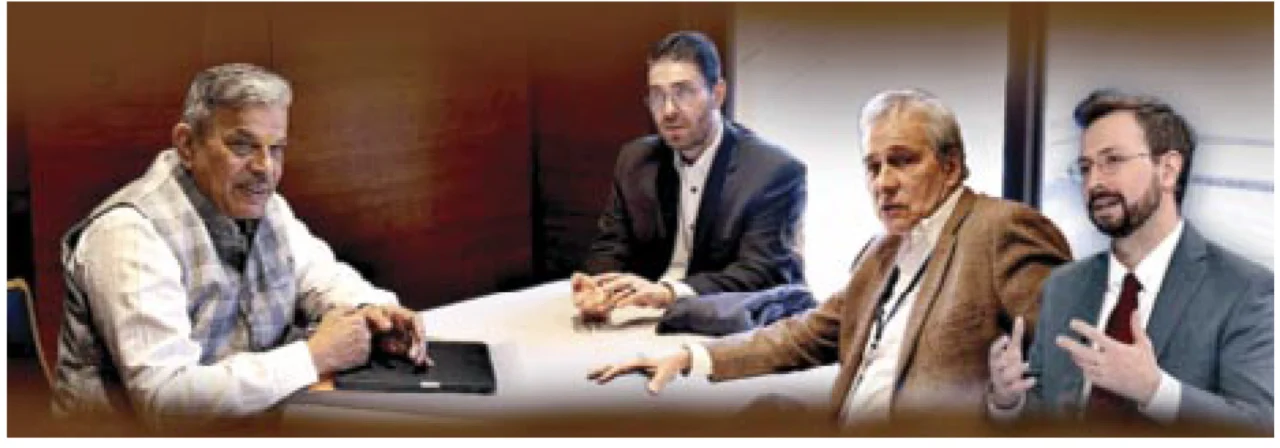
California: At Thrive 2026 conference, an informal yet intellectually rich conversation, brought together Dattatreya Hosabale, Bill Drexel, Ben Olsen, and William B. Hurlbut. In the beginning of the discussion, Hurlbut noted, humanity still understands only a fraction of how the brain truly works. This gap between confidence and comprehension, he suggested, reveals a troubling paradox: even as technological capability accelerates, foundational understanding remains limited.
Picking up on this theme, Hosabale Ji cautioned against what he described as the growing “arrogance of knowledge.” In an age where artificial intelligence is increasingly discussed in terms of consciousness, he argued that humanity risks overestimating its grasp of reality. “We do not yet understand human intelligence itself,” the underlying sentiment suggested, “so how can we so easily claim to replicate or surpass it?”
For Hosabale Ji, the deeper issue lies in the way modern discourse often frames science and spirituality as opposing domains. This, he argued, is fundamentally flawed. “Science is not against spirituality,” he asserted. “It is an instrument, one among many, to understand and experience it.” By placing the two in conflict, contemporary thought narrows the scope of inquiry rather than expanding it.
This argument found resonance in historical precedent. Hosabale pointed to figures like Isaac Newton, who devoted significant effort to theological inquiry alongside scientific work. Such examples, he implied, reflect an earlier intellectual tradition where knowledge was seen as unified rather than compartmentalised.
Olsen extended this line of thought by introducing the idea of “remembering” as central to wisdom. In his formulation, human intelligence often forgets its deeper roots, what he referred to as divine intelligence or the inherited wisdom of civilisation. The conversation gradually shifted toward a central philosophical question: how does one approach truth? Here, Hosabale Ji drew upon Indian philosophical traditions to argue that truth is not confined to a single method of discovery. Science, with its reliance on empirical validation, offers one pathway. But it is not the only one.
“Truth is one,” he emphasised, “but there are many ways of approaching it.” This perspective challenges the modern tendency to equate truth exclusively with what can be measured or experimentally verified. While scientific inquiry has yielded extraordinary insights, it does not exhaust the domain of human experience.
Drexel contributed to this theme by distinguishing between what he described as “small truths” and the larger, overarching Truth toward which they point. Scientific discoveries, in this view, accumulate incrementally, building layers of understanding. Yet the ultimate reality, the “capital T” Truth, remains something deeper, perhaps experiential rather than purely analytical.
This line of discussion naturally led into one of the oldest debates in philosophy: the relationship between mind and matter. Are human beings primarily material entities, with consciousness emerging from physical processes? Or is consciousness itself more fundamental?
Drawing again from Bharatiya thought, Hosabale Ji invoked the concept of Maya – the idea that the material world is not the ultimate reality but a transient manifestation. Within this framework, consciousness or mind is not merely a byproduct of matter but holds a higher ontological status. The ability of the mind to transcend material constraints, he explained, is encapsulated in the concept of Samadhi.
Hosabale Ji then emphasised that the real danger lies not in technology itself but in the intentions guiding its use. If science and technology are driven solely by commercial interests or power considerations, they risk becoming tools of exploitation rather than instruments of human welfare.
As the discussion progressed, a shared concern emerged about the trajectory of global civilisation. In this context, Hosabale Ji articulated a compelling ideal: the integration of scientific inquiry with spiritual wisdom. “The real scientist should become a sage,” he remarked, suggesting that at the highest level of understanding, the distinction between the two dissolves.
Reflecting on historical achievements, he pointed to the advanced state of agrarian systems, town planning, universities, and civil engineering, observing, “When we look at these expressions, we find remarkable achievements. There was highly developed agrarian systems thousands of years ago. Town planning existed at an advanced level. Universities were established. There was significant development in civil engineering. All this reflects a deep understanding of material sciences. This understanding was not exploitative. The approach was to understand nature, analyse it, make the best use of it, and at the same time protect it. That balance was central to the scientific approach and innovations and experimentation in our traditions.”
On the issue of education and its relationship with science and spirituality, the Sarkaryavah emphasised the need for integration rather than separation, stating, “In our society, priority has been given to scientific education, but it is important to ensure that there is no separation between scientific outlook and spirituality. These are not two different things. In many parts of the world, religion and science have often been seen at odds. But in our tradition, both have been integrated. The same individuals and groups have engaged in scientific inquiry as well as in deep spiritual practices. This tradition has integrated into civilisational wisdom. This combined approach provided a foundation that addressed not only ethical questions but also practical aspects of life like security, livelihood, and day-to-day issues. Scientific inquiry was not abstract; it was connected to the needs of society. In order to bring greater power for humankind, these things have to flow.”
Turning to the interplay between economic growth, education, and quality of life, he highlighted their interdependence, noting, “If education does not progress at the same pace as technology, society tends to become more unequal. When scientific and technological advancement moves ahead while the social or educational systems lag behind, inequality increases. Therefore, governance today must seriously consider this balance. On one side, we must address inequalities and prejudices. On the other, we must ensure scientific advancement continues. Both are necessary. However, there is also a challenge before education systems. If they do not properly convey the scientific aspects of our traditional knowledge, then these traditions may be dismissed as superstition. It becomes necessary to distinguish clearly between what is scientific and what is not. This is an important responsibility. In our society, this has been a challenge, but there have also been many efforts to demonstrate how scientific inquiry existed in traditional systems and how it was transmitted through education over centuries. Today, there is a renewed effort to bring this Indic knowledge system into the forefront of education.” On the broader idea of humanity and coexistence, Hosabale Ji emphasised the civilisational principle of universal oneness, stating, “As far as the broader question of humanity and its approach is concerned, one fundamental idea in our tradition is that we are all part of the same original source of energy. Unless this understanding is deeply embedded in the minds of people, you get one-upmanship or hegemonisation of thoughts; the sense of oneness does not develop. If nature is presented as something that exists only to serve human needs and desires, then exploitation begins. When we treat nature as a slave, meant only for fulfilling our requirements, we start disturbing the natural balance. But if we understand that the same source of energy exists in all of us—in every human being, in animals, in plants, in all of nature—then a different attitude emerges.”
A Century of Sangh, A Global Conversation
In the Shatabdi Varsh of the Rashtriya Swayamsevak Sangh, Mananiya Sarkaryavah Dattatreya Hosabale Ji, accompanied by Mananiya Akhil Bharatiya Prachar Pramukh Sunil Ambekar Ji, visited the United Kingdom from 10 to 15 April 2026. The centenary year is being observed as a period of rededication to the cause of social harmony, nation-building, and service to society. In this spirit, the Sarkaryavah engaged with a wide cross-section of British public life over the course of the visit.
Chatham House, the Royal Institute of International Affairs, hosted a private roundtable discussion titled “RSS View of the World.” The Sarkaryavah described the Sangh as a civic movement for social transformation, noting that swayamsevaks are “drawn from all walks of life – students, farmers, professionals – all sections of society,” and that the organisation runs “over 129,000 service activities, from small tutorials to large hospitals,” entirely through volunteers. Discussion covered a range of subjects including India’s foreign policy, the engagement of youth, and the relationship between cultural identity and civic life.
The International Centre for Sustainability in the City of London hosted an interaction titled “Understanding India from the Grassroots,” joined by the Director, Fellows and Researchers of the Centre. The conversation explored the idea of Bharat as a civilisational entity, with the Sarkaryavah drawing a distinction between Rashtra and the modern nation state: “A nation comes into existence because of land, common cultural values and history, and its people – Rashtra is time immemorial, whereas the nation state is a concept that comes after the French Revolution.” The discussion also touched on the role of self-correction within Hindu society as the basis on which the Sangh approaches systemic change.
Leaders from the business community gathered to hear the Sarkaryavah’s thoughts on the “Global Vision of RSS in the Present Geopolitical Situation.” He spoke about the Sangh’s growth over a hundred years into a broad-based people’s movement, and described the shakha model as working on two layers: “character building at an individual level of virtues, and in addition, social awareness,” explaining that swayamsevaks “may not always have the means, but they find a way to give back to society.” Particular interest was shown in the Sangh’s sewa activities, including the work of organisations such as Sewa Bharati in education, healthcare, and tribal welfare, and the role of philanthropy in supporting these efforts.
A roundtable with leading academics from the UK’s top institutions – including Oxford, Cambridge, UCL, SOAS, LSE, and Sussex – was held on the theme “RSS and Civic Institutions.” Scholars included Prof. Gavin Flood of Oxford’s Centre for Hindu Studies, Prof. Matthew Nelson, Head of the Department of Politics at SOAS, and Prof. Lucia Michelutti of UCL. The discussion examined the organisational character of the Sangh, and the meaning of voluntarism at mass scale. An open invitation was extended to scholars to visit Sangh projects in Bharat. A cross-party group of parliamentarians from the House of Commons and the House of Lords had a private dinner and interaction on the theme “RSS’s Role in Shaping India’s Future.” Representatives from the Conservative Party including Bob Blackman CBE MP, Chair of the 1922 Committee, and the Labour Party attended. The conversation touched on the Sangh’s foundational principles, its grassroots work in education, healthcare, tribal welfare, and disaster relief, and its perspective on India’s future. The role of the Indian diaspora in strengthening the UK-India relationship was also discussed.
A separate session was held with community leaders and representatives of community organisations from across the United Kingdom, providing an opportunity for informal interaction and dialogue on matters of shared concern. The Sarkaryavah also attended a Karyakarta Mandal of Hindu Swayamsevak Sangh UK in Rugby.
Elaborating on this principle, he highlighted its ethical implications, noting, “In the Hindu tradition, this idea is central. Every other creature must be respected because the same energy that is present in me is present in you and is present in all living beings. This concept of universal oneness shapes how we treat others. It promotes respect, humility, and harmony—not just among humans but across the entire ecosystem. We are not separate from nature; we are part of it. This understanding should guide our actions, including how we develop and use technology.”
On the role and responsibility of technology, Hosabale Ji outlined a threefold evaluative framework, stating, “Technology, like any tool, must be evaluated carefully. In our understanding, it must pass three important tests. The first is economy. Does the technology contribute to balanced economic growth, or does it create inequality in society? The second is ecology. Does the technology respect nature, or does it lead to exploitation and imbalance? The third is ethics. Is the technology morally sound? Does it align with values that support human well-being? If a technology disturbs the economy by creating inequality, if it harms the ecological balance by exploiting nature, or if it lacks ethical grounding, then it becomes problematic. Therefore, any technology must be tested against these three touchstones—economy, ecology, and ethics. The purpose of technology should always be human welfare. It should enhance life without causing harm to society or nature.”
Building Sustainable Societies at every Level
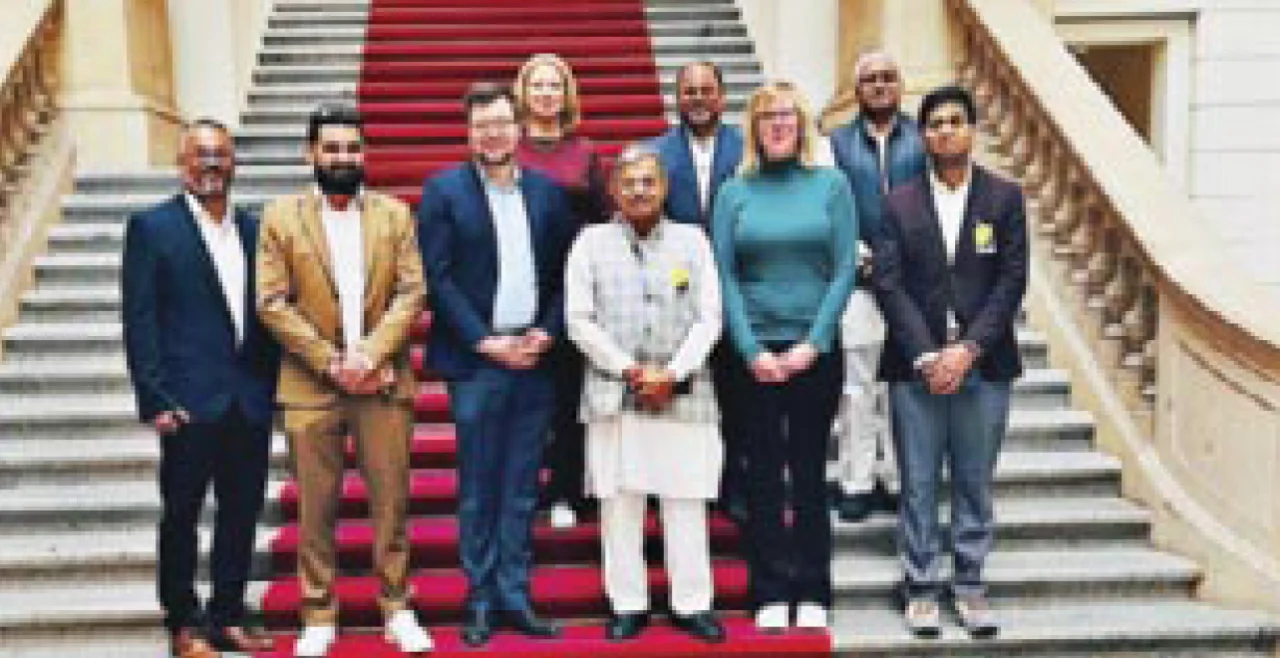
RSS Sarkaryavah Dattatreya Hosabale during his Berlin visit on April 28-29, explained what RSS would be doing in the next 100 years while engaging with German Policy institutions & Indian diaspora.
Hosabale Ji held discussions with senior representatives from prominent German institutions, including Stiftung Wissenschaft und Politik (German Institute for International and Security Affairs), Konrad-Adenauer-Stiftung (Konrad Adenauer Foundation), and members associated with the Abgeordnetenhaus of Berlin (Berlin House of Representatives). These engagements formed part of an exploratory exchange aimed at strengthening mutual understanding. During these discussions, participants acknowledged the important role of the Indian diaspora in Germany, noting its highly educated and skilled profile, strong economic participation, and among the highest household income levels. The diaspora profile has translated into a significant contribution to the German economy, including high levels of tax contribution within diaspora communities. Sarkaryavah also extended an invitation to German counterparts to continue dialogue through future visits to India.
During these interactions, Hosabale Ji said, “The RSS’s vision for the next 100 years is to contribute to building sustainable societies at every level, from families to societies and environmental responsibility, grounded in shared universal values.”
A consistent theme across all interactions was that Indian and German societies share structural similarities, particularly in their emphasis on community orientation, social organisation, and evolving family systems. Discussions also explored sustainability across cultural and policy contexts, approaches to maintaining social cohesion, and the broader role of civil society institutions.
Hosabale Ji emphasised that the Indian diaspora living in Germany has a responsibility to participate constructively in the country’s social and economic fabric. He also outlined the role of the RSS as one of the world’s largest volunteer-driven civil society organisations, engaged in community development, social cohesion, and grassroots mobilisation across sectors such as education, service activities, and cultural initiatives. As part of the visit, he addressed a community gathering organised by the Hindu Swayamsevak Sangh (HSS) in Berlin, commemorating 100 years of the RSS, attended by over 200 volunteers. He highlighted the global outreach of Indian culture through civilisational and societal exchanges, emphasising peaceful engagement and cultural continuity.
On the distinction between knowledge and wisdom, Sarkaryavah drew attention to their differing roles, observing, “In our tradition, there is a clear distinction between knowledge and wisdom. Knowledge, or what we call jnana, is the understanding or awareness of things. It is the accumulation of information and learning. But wisdom, or what we call vijnana, is the ability to use that knowledge properly. It is the discernment of how much knowledge to apply, where to apply it, and for what purpose. Knowledge alone is not sufficient. If it is not guided by wisdom, it can lead to ego and arrogance. It can be misused. Our tradition has a vast body of literature that emphasises this distinction. Knowledge must always be accompanied by wisdom. Only then does it become purposeful and beneficial. When knowledge is guided by wisdom, it becomes useful not only for the individual but also for society and humanity as a whole.” Addressing the democratisation of knowledge, Hosabale Ji emphasised the importance of accessibility and free flow, stating, “The democratisation of knowledge is extremely important. Today, knowledge creation is happening, but it does not always flow freely. It is necessary to create conditions where knowledge can flow freely across communities, societies, nations, and civilisations. It should be accessible to all so that there is an equal footing for everyone.” On the risks of restricted access and the need for rational clarity, he cautioned, “At the same time, we must be careful about the monopolisation of knowledge, where access is restricted. There are some traditions that are full of superstition, this must be distinguished from genuine knowledge. Rationality should not be the monopoly of any one group. It must be available to all. When knowledge is democratised, individuals become empowered. Communities become stronger. Society progresses in a more balanced and equitable way. This equal access to knowledge ensures that scientific inquiry and technological benefits reach everyone, not just a few. Arrogance is not only about one community, nation, or society placing itself above others. When humans consider themselves superior to nature and the Creator, and act without humility, that is also a form of arrogance”. The conference focused on a singular, urgent mission: ensuring that the rapid evolution of artificial intelligence, health, and sustainability serves the broader interests of humanity rather than just economic bottom lines.
Silicon Giants on the Future of AI
The proceedings opened at the Computer History Museum with a high-stakes fireside chat.
Ram Shriram, American businessman, Founding Board Member Google, USA predicted a revolution in education, noting that AI would make knowledge “free and democratised” through adaptive learning customised to every individual. “Knowledge is going to be free and democratised and widely available, some of it happened with internet but with AI, now it will happen at a greater pace and its adaptive learning customised to each user,” he stated.
Vinod Khosla, founder of Khosla Ventures and pioneering technology investor emphasised the necessity of making the “cheapest technology also the most sustainable,” asserting that environmental goals are achievable through focused innovation. “My general view is we should strive for the cheapest technology to also be the most sustainable and that’s achievable if we put our mind to it,” he noted.
Prof Steven Chu, Nobel Laureate and former US Secretary of Energy, addressed the looming labour crisis, questioning how society will marry the “technology revolution” of AI replacing jobs with a declining global population. “AI is going to replace many, many jobs; how do you marry replacing jobs with a declining population? This transition is a huge challenge.”
Conference Chair Prof Anurag Mairal emphasised that GSIF’s mission is to anchor global solutions in the cultural and civilisational contexts of local communities. This sentiment was echoed by Dr Yashodhan Agalgaonkar, Co-chair, who noted the overwhelming international response, including engagement with Consuls General from over 20 countries.
“Thrive 2026 conference was conceived as a global convening of scientists, technologists, and policymakers to advance international cooperation in technology and promote the harmonisation of policy frameworks. The 20+ white papers coming out of the conference are evidence of that cooperation,” Dr Yashodhan Agalgaonkar stated.
The conference received significant support from the Global Indian Scientists and Technocrats Forum (GIST Forum USA) and industry leaders like Palo Alto Networks. Dr Yelloji Rao Mirajkar of GIST USA described the event as a “remarkable synthesis of ancient wisdom and modern science.”
“The Global Science Innovation Forum – Thrive 2026 conference brought together global leaders in technology and policy to address critical governance challenges across AI, health, and sustainability. As a sponsor, Palo Alto Networks is proud to contribute to advancing important conversations on the societal values shaping technology policy,” said Kelly Waldher, Chief Marketing Officer of Palo Alto Networks.