The counting of votes for 293 assembly constituencies in West Bengal began at 8 am on Monday under tight security, with initial trends suggesting a high-voltage contest between the Bharatiya Janata Party and the ruling All India Trinamool Congress.
According to data from the Election Commission of India, as of 10.39 am, the BJP was leading in 83 seats, while the TMC trailed at 44. These early figures, though preliminary, point to a strong opening for the BJP in what is being seen as a decisive electoral battle.
Officials confirmed that the counting process began with postal ballots in accordance with established norms, followed by the counting of Electronic Voting Machine votes from 8.30 am onwards. As the rounds progress, clearer trends are expected to emerge through the day.
Jhalmuri effect in Jhargram
One of the most closely watched constituencies in the early rounds is Jhargram, where BJP candidate Lakshmi Kanta Sau surged ahead with 5,156 votes, leading TMC’s Mongal Saren, who secured 4,180 votes. The margin stood at 976 votes in the initial round.
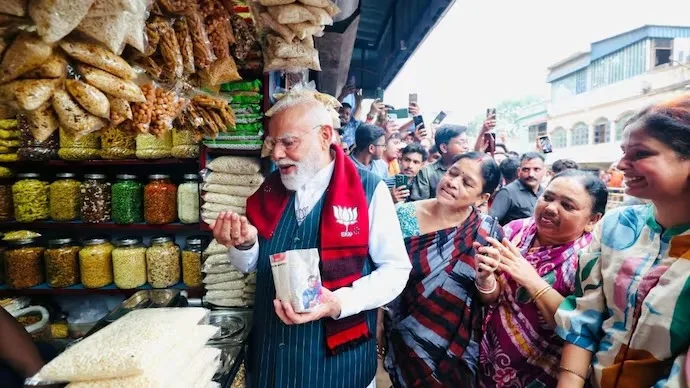
The early lead in Jhargram has triggered political chatter around what is being dubbed the “Jhalmuri effect”, a reference to Prime Minister Narendra Modi’s widely publicised stop at a roadside stall in the region during the campaign.
The moment, where Modi was seen interacting with locals and sharing the popular Bengali snack, quickly went viral and was projected as a symbol of grassroots connect in the tribal-dominated Junglemahal belt. Analysts now suggest that such symbolic outreach may have contributed to shifting voter sentiment in favour of the BJP.
Modi’s campaign optics and Junglemahal strategy
During his visit to Jhargram, Prime Minister Modi paused at College Mor after addressing a rally, drawing large crowds of supporters. The scene, marked by chants of “Jai Shri Ram” and “Bharat Mata ki Jai”, reinforced the BJP’s attempt to build emotional and cultural resonance in the region.
The Junglemahal area, which includes tribal-dominated districts like Jhargram and Purulia, has been a key focus of the BJP’s expansion strategy in West Bengal. The party has sought to consolidate support by combining development promises with strong political messaging against the TMC.
Modi later shared images of the interaction on social media, describing the jhalmuri as “delicious” and highlighting the moment as part of his packed campaign schedule.
Exit polls and trends indicate BJP momentum
Television projections have further fuelled speculation of a BJP surge, with some channels indicating leads in as many as 171 seats for the party, just short of the majority mark of 148.
In contrast, the TMC was shown leading in around 100 seats in these projections, suggesting a significant shift from the 2021 election, where the party secured a dominant victory.
The current trends, if sustained, could mark a historic breakthrough for the BJP in a state where it has traditionally struggled for political dominance.
West Bengal Leader of Opposition and BJP candidate Suvendu Adhikari expressed strong confidence in his party’s performance as counting progressed.
“BJP is forming the government. Initial trends show BJP as 135 plus and approximately 100 to TMC,” he said, indicating that the party was on track for a decisive mandate.
Adhikari also addressed the contest in Bhabanipur, suggesting that while early rounds might appear close, the BJP would gain ground in later stages of counting.
He pointed to changing voting patterns, claiming that traditional vote banks had shown signs of fragmentation. According to him, there has been consolidation in favour of the BJP, coupled with what he described as a split in sections of the TMC’s support base in districts like Malda, Murshidabad, and Uttar Dinajpur.
Record voter turnout adds weight to outcome
The 2026 West Bengal Assembly election recorded one of the highest voter turnouts in the state’s history. Phase I saw a turnout of 93.19 percent, while Phase II recorded 91.66 percent, taking the combined turnout to an impressive 92.47 percent.
Such high participation levels are often seen as an indicator of strong voter engagement and can significantly influence electoral outcomes. In Bengal’s case, the turnout reflects the intensity of the contest and the high stakes involved for both major parties.
The current election is being closely compared to the 2021 Assembly polls, where the TMC, led by Chief Minister Mamata Banerjee, secured a sweeping victory with 213 seats and a vote share of around 48 percent.
The BJP, however, emerged as the principal opposition with 77 seats and nearly 38 percent vote share, marking a sharp rise in its political presence.
In contrast, the Left-Congress alliance failed to win a single seat, highlighting the shift towards a bipolar contest in the state.
The 2026 election is therefore being seen as a critical test for Mamata Banerjee, who is aiming for a fourth consecutive term, while the BJP is attempting to convert its growing vote base into a governing mandate.
A crucial day for Bengal’s political future
As counting continues, all eyes remain on whether the early momentum seen by the BJP will translate into a full-fledged electoral victory or whether the TMC will recover ground in later rounds.
The “Jhalmuri effect” in Jhargram may be symbolic, but it underscores a larger narrative of changing political dynamics in West Bengal. From campaign optics to voter turnout and shifting alliances, multiple factors are shaping what could be one of the most consequential elections in the state’s history.
With trends still evolving, the final verdict will determine not just the next government in Bengal but also the broader trajectory of politics in eastern India.