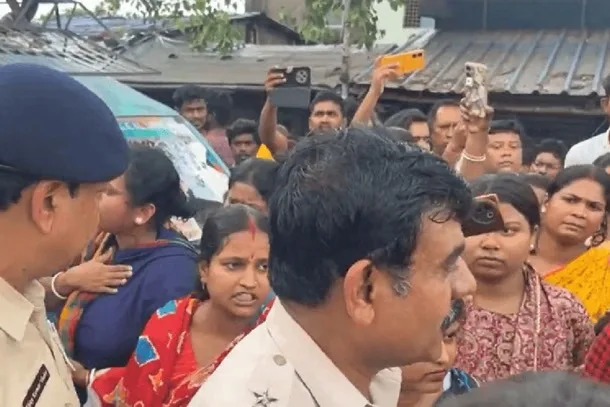
As West Bengal awaits the outcome of the 2026 Assembly elections, the spotlight has sharply turned to Falta, where the Election Commission of India ordered a complete repoll across the constituency. Such a move is exceptionally rare in Indian electoral history and was necessitated after authorities found that the “integrity of the recorded votes” had been compromised in more than twenty one percent of polling booths.
The scale of the intervention itself signals how deeply flawed the electoral process had become in that constituency. Even more concerning is the fact that this breakdown occurred despite the presence of one of the highest deployments of Central Armed Police Forces and Union oversight in recent times.
While the final result of Falta may not dramatically alter the overall mandate in a 294-seat assembly, its symbolic significance is far greater. It reinforces a long-standing reality that political violence in West Bengal is not episodic but systemic.
Not an exception, but a pattern
The events in Falta are not an aberration. They are part of a deeply entrenched political culture in West Bengal where violence has historically been used as a tool for electoral dominance.
From booth capturing and voter intimidation to organised extortion networks, Bengal’s political ecosystem has evolved into one where power is often sustained through coercion rather than consent. The 2026 election, though described as relatively peaceful compared to past cycles, still carried the shadow of this violent legacy.
The BJP repeatedly raised concerns during campaigning that a return of the All India Trinamool Congress could revive the same patterns of intimidation and suppression seen in previous elections.
To understand the present, one must examine the past. Political violence in Bengal did not emerge overnight. Its roots can be traced back to the early twentieth century, particularly after the 1905 Partition of Bengal ordered by Lord Curzon.
While protests in most parts of India remained within constitutional limits, Bengal witnessed the rise of militant nationalism. Revolutionary groups such as Anushilan Samiti and Jugantar normalised the use of violence for political ends.
This phase created a cultural acceptance of violence as a legitimate tool in pursuit of a cause. Over time, this mindset seeped into mainstream politics, blurring the line between ideological struggle and brute force.
The violent 1940s
The 1940s marked one of the most turbulent periods in Bengal’s history. The Direct Action Day led to widespread communal riots and targeted killings, culminating in what came to be known as the Great Calcutta Killings.
Simultaneously, agrarian unrest like the Tebhaga movement pushed peasants into violent confrontation with landlords. These movements were further intensified by the devastating Bengal Famine of 1943, which destroyed the economic and social fabric of the region.
The collapse of trust in institutions during this period created fertile ground for the rise of armed political groups, many of which later transformed into organised networks aligned with political parties.
Congress Era: Institutionalising repression
The period under Congress leader Siddhartha Shankar Ray in the early 1970s is often remembered as one of the most repressive phases in the state’s history.
In an attempt to crush the Naxalite movement, the administration resorted to aggressive crackdowns, including allegations of extra-judicial killings and widespread targeting of dissenters. While aimed at restoring order, these actions further entrenched the use of violence as an accepted political instrument.
Left Front Rule: Cadre control and ‘Party society’
When the Communist Party of India (Marxist) led Left Front came to power in 1977 under Jyoti Basu, there was initial hope for stability. However, over time, the regime developed what critics describe as a “party society” model.
Under this system, the party’s influence extended deep into everyday life. Local party workers often acted as arbiters in disputes, replacing formal governance structures. While the Left maintained a degree of internal discipline, it also normalised cadre-based control and political patronage.
This system blurred the lines between governance and party authority, laying the groundwork for future regimes to inherit and expand this structure.
TMC Era: From control to collapse
When Mamata Banerjee and the All India Trinamool Congress came to power in 2011, they inherited this deeply entrenched political machinery. Instead of dismantling it, critics argue, the TMC allowed it to mutate into a far more unrestrained and decentralised system of power.
Unlike the Left, which exercised tight central control over its cadre, the TMC era has been marked by the rise of local strongmen operating with significant autonomy. This has led to widespread allegations of extortion, land grabbing, syndicate operations, and intimidation of political opponents.
The absence of strict oversight has, according to critics, turned political networks into parallel power structures driven by money and muscle rather than ideology or governance.
One of the major issues that surfaced during the 2026 election campaign was the alleged prevalence of extortion networks. Local businesses have frequently reported being forced to comply with “advice” from politically connected intermediaries, often at the cost of their autonomy and profitability.
This climate of fear has contributed to the migration of capital, labour, and talent out of the state. Investors have remained cautious, citing concerns over law and order and regulatory unpredictability.
The BJP sought to capitalise on this sentiment, framing the election as a choice between continued exploitation and a fresh start.
Falta as a mirror to Bengal’s political reality
The events in Falta encapsulate this entire trajectory. A constituency where over one-fifth of polling booths saw compromised voting is not just an administrative failure. It is a reflection of a deeper malaise where democratic processes are vulnerable to manipulation.
The fact that such an incident occurred despite unprecedented security arrangements suggests that entrenched networks of influence continue to operate with significant capacity.
It also raises critical questions about the effectiveness of institutional safeguards in ensuring free and fair elections in regions with a history of political violence.
As the results of the 2026 elections unfold, the larger question remains whether West Bengal can finally break free from this cycle of violence.
Regardless of which party forms the government, the challenge will be to dismantle the entrenched structures that perpetuate intimidation and coercion. This would require not just administrative reforms but also a cultural shift in how politics is practiced in the state.
For decades, violence has been embedded in Bengal’s political DNA, evolving from revolutionary zeal to organised coercion. The tragedy lies in how a region known for its intellectual and cultural richness has been repeatedly overshadowed by this darker reality.
The Falta repoll serves as a stark reminder that the issue is far from resolved. It is now up to the next government to decide whether it will confront this legacy or continue to operate within it.