“Devi Sureshwari Bhagavati Gange, Tribhuvan-tarini Tarala-tarange”, this Sanskrit shloka has echoed across centuries of Indian civilisation invoking the Ganga as the liberator of all three worlds. Prime Minister Narendra Modi gave those ancient words with a modern resonance. Pressing a remote button on a dais surrounded by more than a hundred thousand citizens in Hardoi on April 29, 2026, he inaugurated the Ganga Expressway a 594-kilometre, six-lane access-controlled highway that now stands as the longest expressway in Uttar Pradesh and one of the longest green-field expressways in the entire country. “Just as Mother Ganga has been the lifeline of Uttar Pradesh and this nation for thousands of years,” PM Modi told the gathering, “This expressway will become the new lifeline of UP’s development”. The occasion was not a ribbon-cutting ceremony it was the unveiling of a philosophy that infuses infrastructure with prosperity.
A monument of modern engineering
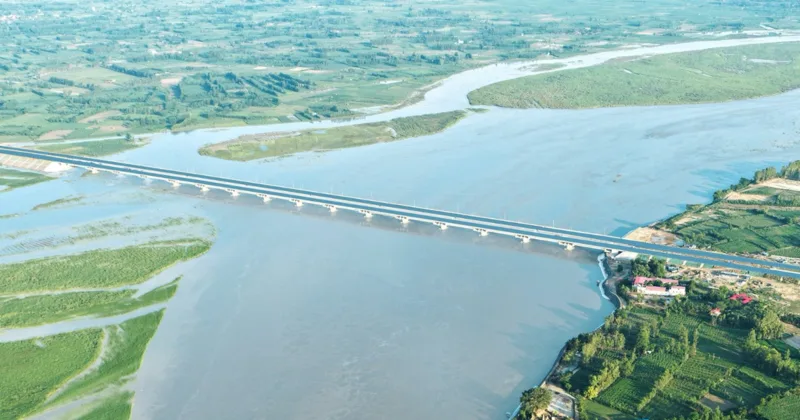
Stretching from Village Bichhauli in Meerut to Village Chudapur Dadu in Prayagraj, the Ganga Expressway traverses 12 districts Meerut, Hapur, Bulandshahr, Amroha, Sambhal, Badaun, Shahjahanpur, Hardoi, Unnao, Raebareli, Pratapgarh and Prayagraj. It passes through 518 villages. Designed for a maximum speed of 120 km/h, it incorporates 14 major bridges, 165 minor bridges, 7 ROBs (Rail Over Bridges), 32 flyovers, 453 underpasses and 795 box culverts. There are 21 interchanges connecting it to major arterial roads and nine Wayside Amenity Complexes for travellers. Flanking the main carriageway are 737 km of service roads, ensuring last-mile connectivity for rural communities along the corridor. The total project cost stands at approximately ₹36,230 crore an investment that the government estimates will generate economic returns many times over within the next decade.
From Establishment to Inauguration: A promise kept
The project’s timeline is itself a statement. Prime Minister Modi laid the foundation stone at Shahjahanpur in December 2021 during the height of the COVID-19 pandemic, when global supply chains were fractured and construction activity had ground to a halt across much of the world. Land acquisition covering over 18,000 acres was pursued simultaneously, with more than one lakh (100,000) farmers from the 12 affected districts voluntarily participating in the process. From groundbreaking to inauguration took less than five years a pace virtually unheard of in Indian expressway construction history, where projects routinely languish for a decade or more. “The era when a single road required decades of waiting is over,” PM Modi declared at the launch. “Under the Double Engine Government, what is inaugurated also gets dedicated to the nation on time.”
The Strategic Ace: Air strips and smart surveillance
Beyond its civilian utility, the Ganga Expressway has been engineered with a critical strategic dimension. A dedicated air strip has been constructed along the expressway to enable emergency landing and take-off operations for Indian Air Force fighter aircraft. A feature that transforms the highway into a secondary tactical asset during times of national security exigency.
Uttar Pradesh has now become the state with the highest number of air strips on expressways in the entire country. The security infrastructure is equally impressive on the civilian side, solar-powered high-definition smart surveillance cameras have been installed every single kilometre along the full length of the expressway, enabling real-time monitoring, traffic management and rapid emergency response. They reflect a deliberate integration of defence preparedness into civilian infrastructure planning.
An expressway for the farmer
The districts through which the Ganga Expressway passes have long been blessed by the fertile alluvial soil of the Ganga and its tributaries, yet their agricultural prosperity has consistently been undermined by one factor i.e. poor connectivity. Farmers in Hardoi, Unnao and Raebareli could grow excellent sugarcane, wheat and vegetables, but could not move their produce to the large consumer markets of the National Capital Region or Prayagraj without losing significant value to spoilage and middlemen. Cold-storage facilities were scarce, logistics costs were prohibitive.
The Ganga Expressway will addresses this structural failure head-on. With high-speed access to major urban markets now available, perishable produce can reach Noida, Delhi or Prayagraj within hours of harvest. The government is simultaneously developing agri-logistics infrastructure along the corridor for cold chains, warehousing and food-processing units. It will reduce post-harvest losses, estimated nationally at around 16% of total agricultural output. For over one lakh farmer families who contributed land to the project, the expressway is not an abstraction, it is the road their children will travel to a better future.
Industrial Corridors: Manufacturing India
Expressways do not only move people they attract capital. Along the Ganga Expressway, 27 Integrated Industrial Cluster and Logistics Hub sites are being developed across the 12 districts, with approximately 7,000 additional acres earmarked for industrial use. These clusters are designed to absorb investment in sectors aligned with each district’s existing economic identity. Meerut’s world-renowned sports goods industry, which exports cricket bats, hockey sticks and boxing equipment worth over ₹700 crore annually. It will gain scale and reach.
Sambhal handicrafts, Bulandshahr ceramic industry, Hardoi handloom sector, Unnao leather goods(the district is home to one of India’s major leather clusters) and Pratapgarh amla-based products will all benefit from reduced logistics costs and improved access to ports and airports. The broader vision is ambitious to make Uttar Pradesh, which recently surpassed Maharashtra to become India’s second-largest economy by GSDP in 2023-24 with a figure crossing ₹25 lakh crore, is targeting a $1 trillion economy. Chief Minister Yogi Adityanath government has attracted investment commitments of over ₹40 lakh crore at successive Global Investor Summits. The Ganga Expressway is not peripheral to this ambition it is its spinal cord of Industrial corridor.
Defence Manufacturing: UP as India’s Arsenal
Ganga Expressway has industrial vision which links to the Uttar Pradesh Defence Industrial Corridor, one of only two such corridors in India (the other being in Tamil Nadu). Major defence manufacturers including BrahMos Aerospace, Bharat Dynamics Limited and dozens of private sector companies have set up or are setting up facilities along this corridor. The BrahMos supersonic cruise missile, a joint Indo-Russian venture with a range of 400 km and a speed of Mach 2.8, which has attracted export interest from multiple countries is now being manufactured in Lucknow.
MSME across Uttar Pradesh are being integrated as component suppliers into this defence production ecosystem, creating high-quality employment in districts far from traditional industrial centres. The Ganga Expressway logistics infrastructure will ensure that defence components manufactured at various cluster nodes can be rapidly moved to assembly facilities, reducing lead times and strengthening Indian indigenous defence capabilities.
Culture, pilgrimage and the tourism dividend
Uttar Pradesh is India’s spiritual heartland. The state is home to Prayagraj site of the Maha Kumbh, the world’s largest human gathering, Varanasi Kashi Vishwanath temple, Mathura-Vrindavan, Ayodhya Ram Temple and dozens of other pilgrimage sites that collectively draw hundreds of millions of visitors annually. The Ganga Expressway will reduces travel time across this sacred geography. A journey from Meerut to Prayagraj that once required the better part of a day can now be completed in approximately five to six hours.
Devotees in western UP can make a day-trip to the Prayagraj Sangam and return the same evening. The expressway thus unlocks an enormous latent tourism economy, generating demand for hotels, dhabas, handicrafts and other services along the corridor. Inauguration day itself carried symbolic spiritual weight: Prime Minister Modi noted that he had been in the presence of the Ganga at multiple points in the preceding days in Bengal, Kashi and that the inauguration of an expressway in the Ganga name felt like the river’s own blessing.
UP Expressway Revolution: A state transforming under double engine government
The Ganga Expressway development has to be understood through the baseline from which Uttar Pradesh has travelled. As recently as 2016, the state was known for the poor roads, power cuts, crime and industrial stagnation. It had fewer expressway kilometres than many far smaller states. Today with the addition of the Ganga Expressway, Uttar Pradesh has secured the largest share of India total expressway network among all states. The state now has 21 airports, including five international airports and the newly inaugurated Noida International Airport at Jewar which is itself connected to the Ganga Expressway within a few hours drive.
A 4-lakh-kilometre road network links every district headquarters to four-lane roads and every block and tehsil to two or four-lane connectivity. Seven cities have metro rail. The Delhi-Meerut Regional Rapid Transit System (RRTS) India’s first rapid rail corridor that connects the national capital to western UP at speeds of up to 180 km/h. The Dedicated Freight Corridor passes through the state. This is not one project, it is a systemic reimagining of a state economic geography. And the Ganga Expressway, named for the river that has nurtured civilisation along its banks for millennia, is the achievement of that transformation.