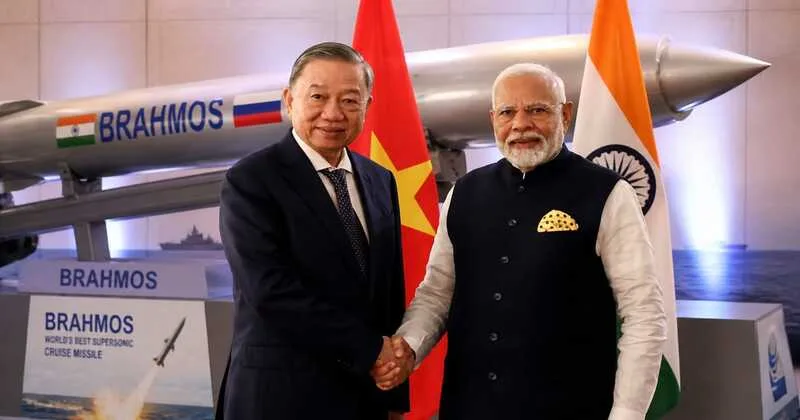
New Delhi: Vietnam’s President To Lam will undertake his first major foreign visit since assuming office with a three-day trip to India from May 5 to 7, marking a significant moment in the evolving strategic partnership between the two countries. The visit, at the invitation of Prime Minister Narendra Modi, is expected to focus on strengthening bilateral cooperation across defence, economic engagement and regional security. Lam, who also serves as the General Secretary of the Central Committee of the Communist Party of Vietnam, will be accompanied by a high-level delegation comprising ministers, senior officials, and business leaders.
The presence of both political and economic stakeholders reflects the comprehensive nature of the engagement, aimed at expanding cooperation across multiple sectors. According to India’s Ministry of External Affairs (MEA), Lam will be accorded a ceremonial welcome at the forecourt of Rashtrapati Bhavan on 6 May. Prime Minister Modi is scheduled to hold wide-ranging talks with the Vietnamese leader, covering bilateral relations as well as key regional and global developments. President Droupadi Murmu is also expected to meet Lam, while other Indian dignitaries are likely to call on him during the visit. Beyond official engagements in New Delhi, Lam will also travel to Bodh Gaya and Mumbai, underscoring both the cultural and economic dimensions of India-Vietnam relations.
The visit coincides with the 10th anniversary of the elevation of ties to a Comprehensive Strategic Partnership, agreed during Prime Minister Modi’s 2016 visit to Vietnam, adding symbolic significance to the engagement.
Maritime security, regional tensions to dominate talks
A major thrust of the discussions is expected to centre on regional security developments. The two leaders are likely to deliberate on the situation in West Asia and the evolving dynamics in the South China Sea, where tensions have escalated due to increased Chinese military activity and competing territorial claims. The South China Sea remains a focal point of geopolitical contestation, given its vast reserves of hydrocarbons and strategic maritime significance. China’s sweeping claims of sovereignty over almost the entire region have triggered concerns among neighbouring countries, including Vietnam, the Philippines, and Brunei, all of which have counterclaims. The region has also witnessed increased Chinese naval and aerial patrols, further heightening tensions. India, along with several other countries, has consistently called for a peaceful resolution of disputes in accordance with international law. New Delhi has emphasised adherence to the United Nations Convention on the Law of the Sea as the basis for resolving competing claims and ensuring stability in the region. These issues are expected to feature prominently in the high-level discussions between the two sides.
Defence cooperation and strategic engagement deepen
A central pillar of India-Vietnam relations continues to be defence cooperation, particularly in the maritime domain. The upcoming talks are expected to explore ways to further strengthen collaboration, building on momentum from recent agreements. In the previous year, the two countries signed a pact to establish a framework for submarine search, rescue, and support mechanisms. They also concluded a letter of intent aimed at enhancing bilateral defence industry cooperation. Maritime security is expected to remain a key focus area, with both sides seeking to expand cooperation in areas such as capacity building, operational coordination, and defence technology engagement. Strategic dialogues during the visit will involve high-level interactions between political and military leadership, reflecting the growing convergence in security interests.
Among the issues likely to be discussed is a potential deal involving the BrahMos missile. The proposed package is understood to include shore-based missile batteries for coastal defence, along with training, logistics support, and an initial supply of missiles. Estimated at around ₹5,800 crore, the deal would be among Vietnam’s largest defence acquisitions in recent years if finalised. It would also make Vietnam the third Southeast Asian country to deploy the BrahMos system, significantly enhancing its maritime deterrence capabilities.
The timing of the visit, marking a decade of the Comprehensive Strategic Partnership, lends additional diplomatic weight. According to the MEA, the engagement is designed to inject fresh momentum into an already robust bilateral relationship and to identify new avenues for cooperation across sectors.
“The engagement between leaders is expected to provide fresh momentum to the robust bilateral relations and open new avenues for cooperation between India and Vietnam”, the MEA said.
As India and Vietnam navigate a complex regional environment marked by shifting geopolitical dynamics, the visit underscores their shared commitment to strengthening strategic ties, deepening defence cooperation, and promoting stability in the Indo-Pacific.