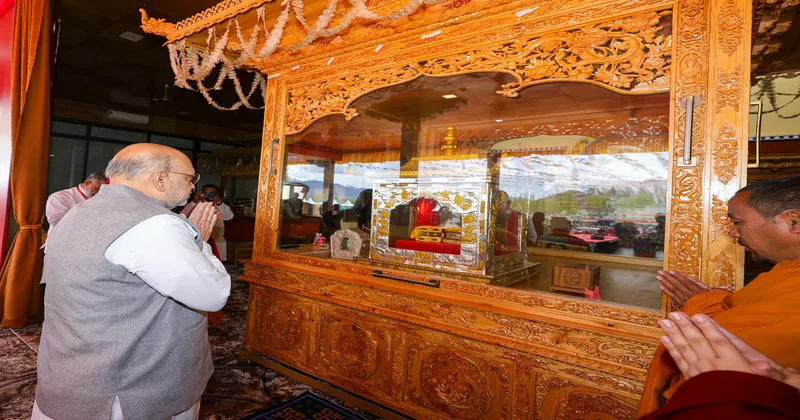
LADAKH: In a post on X on the auspicious occasion of Buddha Purnima, Union Home Minister Amit Shah talked of the four major sects of Buddhism that are prevalent among Ladakhis. He said: Ladakh’s spiritual identity is rooted in four major traditions – Nyingma, Kagyu (also written as Kagyud), Sakya and Gelug (also written as Gelugpa). It teaches us to see reality as it truly is. In this sense, right vision represents a deep understanding of life itself. The Guru’s grace, along with continuous self-reflection through meditation, serves as the pathway to liberation.
On a two-day visit to Leh, Shah had reached there a day earlier to pay his respects to the Piprawa relics now in Ladakh for display among the faithful. These relics from Piprawa had arrived in New Delhi barely a couple of months ago. These are yet to be taken to Buddhist centres like Karnataka, Sanchi and Nalanda. The Buddhists at these places, established centres of Buddhism, are eagerly awaiting the arrival of these relics associated with prince Siddarth Gautam of Kapilvastu who later became Buddha after renouncing the worldly pleasures, his family and kingship included.
One reason for the Central government organising the exhibition of these relics at Ladakh now is because travelling to far off places, even Delhi, is a huge burden on the pockets of average Ladakhis. However, within Ladakh, all sections of the society, affluent and the poor, can visit the exhibition and treasure that spiritual experience.
Inaugurating the exhibition of Pipraw relics some months ago, Prime Minister Narendra Modi had said that these relics will become a sacred pilgrimage centre for Buddhists globally. For the Ladakh Buddhists, to begin with, the display of these relics is once in a life time sort of spiritual journey. The closest thing to this is the periodical organisation of Kala Chakra by the Dalai Lama.
Relics from Rai Pithora Cultural Complex
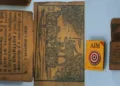
The relics at display in Leh are part of the exhibition called “The Light & The Lotus: Relics of the Awakened One” which Mr Modi had inaugurated at Rai Pithora Cultural Complex in New Delhi. These relics were discovered in 1898 by a British named William Claxton Peppe. The reliquaries his family possessed for over a century included bone fragments and jewels believed to belong to Buddha himself.
The Brahmi inscription on one of the reliquaries with the Peppe family identified them as belonging to Buddha. For over a century, these priceless jewels remained in possession of the British as they refused to hand them over to the Buddhists, claiming ownership under the Indian Treasure Trove Act of 1878.
The descendants of Peppe had kept significant parts of these relics with them as a private collection and tried to auction them via Southby’s at Hong Kong. However, philanthropist Pirozsha Godrej played a very important role in acquiring the collection to facilitate the return of “Piprawa Jewels’’ to the country. It became possible only because of timely intervention by the Union Ministry of Culture.
Gelgupa, Order of Excellence, Yellow Caps
The Gelugpa sect, the last named in Mr Shah’s post, was founded in the late 14th century by scholar philosopher Tsong-Khapa. It later became a significant part of Tibetan religious practices and is today a very visible sect in Ladakh, even though it is in minority. It was initially called the Gandanpa, but later transformed to the Gelugpa or the Order of Excellence, also known as the Virtuous One.
The great prayer festival of Lasa (or Lhasa) was started by monks of this sect in 1413. Over two centuries later, the Gelugpa Sect gained political power in Tibet in 1640 under the leadership of the Fifth Dalai Lama. Ever since then, the sect has received the blessings of the Dalai Lama. This Buddhist tradition requires its adherents to strictly follow its discipline. Gelug monks typically wear yellow hats, earning the sect its nickname, the Yellow Sect.
The traditional headgear which the present Dalai Lama wears during religious ceremonies is the conical cap. All Lamas of this Gelugpa sect also wear the same headgear.
Tsong-Khapa wanted to reform Buddhism after noticing decline in monastic life. This tradition lays stress on strictly adhering to a spiritual monastic lifestyle. Numerous monasteries were built in places such as Spituk, Nubra and Zanskar.
Dugpa Kargyud, Majority Sect in Ladakh, Yellow Caps
The majority of Buddhist followers in Ladakh belong to the Dugpa Kargyud (or Drugpa), called Kargyu by Shah in his post. He said: While knowledge can be gained through the Guru’s blessings, it must be internalised through meditation and absorbed within; without this, liberation remains unattainable.
According to some scholars, the Kagyu lineage (also called Red hats) traces its lineage directly from buddhahood. In fact, the Dharmakaya Buddha is the source of all the manifestations of enlightenment. Concluding his post, Mr Shah wrote: Knowledge without practice is incomplete, and practice without knowledge is blind. Therefore, the true path lies in the union of both. Finally, even with all these elements, a life of wisdom cannot be realised without moral discipline. It is the very foundation of a truly wise life.
The most famous monastery of this Drukpa sect or school in Ladakh is the Hemis Monastery, located 40 km north east of Leh, on the way to Karu, and thence onwards to Manali. This monastery, located on the left bank of Indus river, is hugely popular among tourists. The reason of popularity is the observance of an annual festival in June and this year, it is scheduled on June 24 and 25. It is believed to have been re-established in 1672 by the Ladakhi King Senge Namgyal.
Stakna Monastery or Stakna Gompa is another monastery of the Drugpa sect in Leh district, but it is Bhuatanese in its lineage. This is barely 15 km from the main monastery of the sect in Ladakh.
Kung Fu Nuns of Drukpa sect
Another interesting fact about this sect was brought forth in 2018 by BBC which reported on the Kung Fu Nuns from the Drukpa Kagyu school who are mostly black belts in kung fu, the martial art. After a visit to Vietnam where the Gyalwang Drukpa saw nuns receiving combat training, he implemented the idea in Nepal by encouraging nuns to learn self-defence.
His motive appeared to be fairly simple as to promote gender equality and empower young women (ordained as nuns) from poor backgrounds in India and Tibet. Kung-Fu Nuns also learn skills that are available only to monks (not nuns) in other lineages, such as plumbing, driving, and electrical fitting.