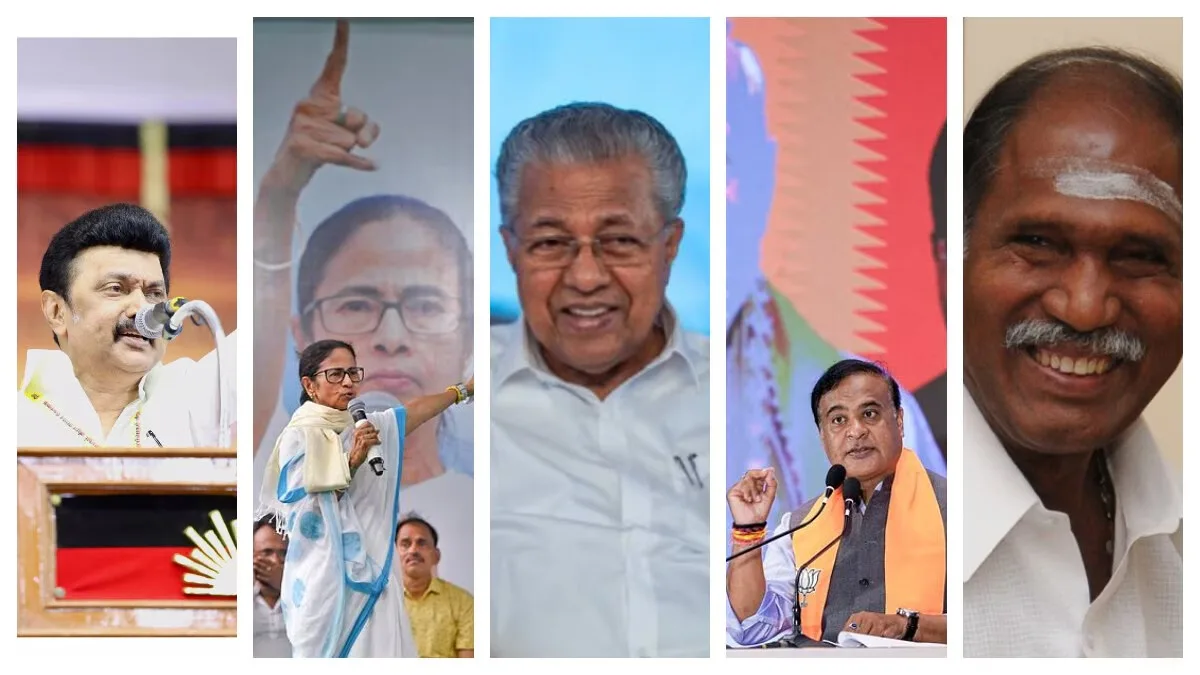
With the final phase of polling completed, the 2026 Assembly elections across West Bengal, Tamil Nadu, Kerala, Assam, and the Union Territory of Puducherry have entered a decisive phase. Exit polls released on Wednesday provide the first comprehensive glimpse into voter sentiment after weeks of intense campaigning, high voter turnout, and sharp political contestation.
A “poll of polls” analysis, aggregating projections from major agencies, indicates a mixed political verdict. While the National Democratic Alliance (NDA) appears comfortably placed in some regions, states like West Bengal and Tamil Nadu are witnessing highly competitive battles with no clear consensus among pollsters.
West Bengal: A high-stakes battle with no clear winner
The electoral contest in West Bengal has emerged as one of the most closely watched in the country. With a record voter turnout of over 93 percent, the state has signalled intense public engagement and a potentially decisive shift in political preferences.
Exit polls suggest that the Bharatiya Janata Party may have significantly expanded its support base after years of sustained groundwork. Agencies such as Poll Diary and Matrize project the BJP crossing or nearing the majority mark of 148 seats, with estimates ranging between 146 and 161 seats.
Other projections, including those by ABP-CVoter and Chanakya Strategies, also indicate an edge for the BJP, placing it within the 150 to 160 seat range.
However, the picture remains far from settled. People’s Pulse, an outlier among pollsters, forecasts a comfortable victory for the All India Trinamool Congress led by Mamata Banerjee, projecting between 177 and 187 seats.
This divergence highlights the uncertainty surrounding key regions such as South 24 Parganas and the Diamond Harbour belt, where the so-called “silent voter” could ultimately determine the outcome. The final result is expected to hinge on these unpredictable voting patterns.
Tamil Nadu: A new political force disrupts traditional equations
In Tamil Nadu, the electoral contest has taken an unexpected turn with the emergence of actor-turned-politician Vijay and his party, Tamilaga Vettri Kazhagam.
Traditionally dominated by a bipolar contest between the DMK and AIADMK alliances, the entry of Vijay—popularly referred to as “Thalapathy”—has introduced a new dynamic, particularly among younger voters.
Exit polls suggest that the Dravida Munnetra Kazhagam-led alliance remains in the lead, with projections ranging from 145 to 160 seats. However, this represents a decline compared to its previous dominance.
The AIADMK-BJP alliance is expected to perform moderately well, especially in the western Kongu region, with projections between 65 and 75 seats.
Analysts believe that the rise of the Tamilaga Vettri Kazhagam, along with its alignment with smaller regional players, has fragmented the vote share. This fragmentation, particularly among urban youth and first-time voters, appears to have reduced the margin of victory for the leading alliance.
Kerala: Signs of a political shift as UDF gains ground
In Kerala, exit polls indicate a potential return to the state’s traditional pattern of alternating governments.
The ruling Left Democratic Front (LDF), led by Chief Minister Pinarayi Vijayan, appears to be facing strong anti-incumbency after two consecutive terms.
Most major agencies, including Axis My India, project a clear lead for the United Democratic Front (UDF), led by the Congress party. The UDF is expected to secure between 78 and 88 seats in the 140-member assembly, comfortably crossing the majority mark of 71.
The LDF, on the other hand, is projected to fall back to around 55 to 65 seats.
Factors such as governance fatigue, local-level issues, and controversies related to voter rolls in certain urban constituencies are believed to have influenced voter sentiment. If these projections hold, Kerala could witness a significant political shift after a decade of Left rule.
Assam: NDA to retain stronghold
In Assam, the electoral outcome appears relatively clear, with exit polls strongly favouring the NDA government led by Chief Minister Himanta Biswa Sarma.
Projections by agencies such as Axis My India and Matrize suggest a decisive victory for the NDA, with seat estimates ranging between 88 and 100 in the 126-member assembly.
The Congress-led opposition, despite mounting an energetic campaign and attempting to capitalise on post-delimitation dynamics, is expected to remain far behind, with projections between 24 and 36 seats.
The results indicate continued voter confidence in the incumbent government and its governance model in the state.
Puducherry: NDA alliance set to continue in power
In the Union Territory of Puducherry, exit polls suggest that the All India N.R. Congress (AINRC)-BJP alliance is likely to retain power.
The government led by N. Rangaswamy is projected to secure between 18 and 22 seats in the 30-member assembly, ensuring a comfortable majority.
The Congress-DMK alliance is expected to lag behind with an estimated 8 to 11 seats, indicating limited gains despite their campaign efforts.
A fragmented yet defining electoral verdict
The 2026 exit polls collectively suggest a fragmented yet decisive moment in India’s regional politics. While states like Assam and Puducherry point towards continuity, others such as West Bengal and Tamil Nadu remain highly competitive, with evolving political equations.
Kerala, meanwhile, appears poised for a potential shift in power, reflecting voter inclination towards change.
However, it is important to note that exit polls, despite their analytical depth, have historically produced mixed results in India. Variations in sampling, demographic diversity, and the presence of silent voters often lead to outcomes that differ from projections.
As the country awaits the official results, the exit polls have set the stage for an intense political showdown. Parties across the spectrum are preparing for both victory and recalibration, depending on the final mandate.
The coming days will not only determine government formations in these key states but also shape the broader national political narrative heading into future electoral battles.