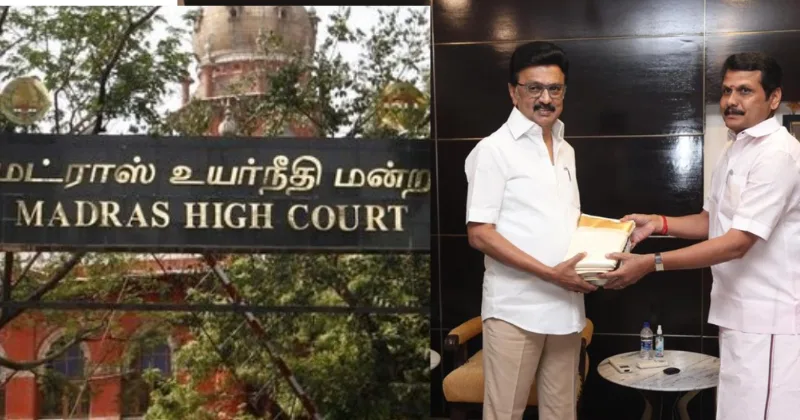
In a significant development, the Madras High Court on April 29 ordered a Central Bureau of Investigation (CBI) probe into alleged ₹397 crore tender irregularities in transformer procurement by TANGEDCO during 2021–23, when DMK leader V Senthil Balaji held the Electricity portfolio. Balaji, who is currently contesting from Coimbatore South and is already facing a PMLA case, faces fresh scrutiny following the order.
The verdict was delivered by a bench comprising Chief Justice Sushrut Arvind Dharmadhikari and Justice G Arul Murugan on petitions filed by anti-corruption NGO Arappor Iyakkam and AIADMK advocate E Saravanan.
Well done @Arappor . Your persistent efforts have led to this.
BTW, not a single media house spoke about this, not even after all the evidence was put out in the public domain. https://t.co/1tOOfVm5v7
— Sumanth Raman (@sumanthraman) April 29, 2026
Arappor Iyakkam and another filed a petition seeking issuance of a writ of mandamus directing the 1st respondent Director, DVAC, to register an FIR on the basis of the petitioner’s complaint dated 06.07.2023 and to constitute a Special Investigation Team by this Court, and consequently direct that the Special Investigation Team conduct a time-bound independent, High Court-monitored investigation under the Prevention of Corruption Act, 1988, the Indian Penal Code, and other connected Acts.
Arappor Iyakkam had alleged that the tender irregularities for purchasing 45,800 transformers for the TANGEDCO, currently Tamil Nadu Power Distribution Corporation (TNPDCL), have caused a loss of Rs 397 crore to the Exchequer and prayed for setting up a special investigation team to probe the matter. The bench has transferred the investigation from the Directorate of Vigilance and Anti-Corruption of the Tamil Nadu Police to the CBI.
The bench said, “It is asserted that the non-registration of FIR shows the active involvement of political powers. The complaint points out the active involvement of members of the ruling party who were involved in committing irregularities/corruption while allotting tenders for laying of transformers.”
The petitioners said, “The entire process was in violation of the Tamil Nadu Transparency in Tenders Act, 1998, in collusion with the bidders, and the process reeks of cartelisation. Certain persons, including the then Minister for Tamil Nadu Electricity, Prohibition and Excise Department during the period 2021 to 2023, had accorded sanction for floating tenders for distribution of transformers with certain specifications across Tamil Nadu.”
2021 முதல் 2023 வரையிலான காலகட்டத்தில், செந்தில் பாலாஜி மின்துறை அமைச்சராக இருந்தபோது டிரான்ஸ்பார்மர்கள் கொள்முதல் செய்ததில் சுமார் ரூ. 397 கோடி மக்கள் வரிப்பணம் கொள்ளையடிக்கப்பட்டது தொடர்பாக சிபிஐ விசாரணை செய்ய சென்னை உயர்நீதிமன்றம் உத்தரவிட்டுள்ளது. pic.twitter.com/Da29wHRysF
— BJP Tamilnadu (@BJP4TamilNadu) April 29, 2026
The court observed, “These actions create a reasonable suspicion of a cover-up designed to shield high-ranking officials and political figures, thereby undermining the integrity of a free, independent, and fair investigation.”
Adding further, the bench said, “The excessive and unjustified delay in granting permission, coupled with the decision to downgrade the investigation from a detailed enquiry (without registration of an FIR) to a preliminary enquiry and limit its scope solely to Kasi, strongly suggests an attempt by the government and relevant authorities to suppress the truth. These actions create a reasonable suspicion of a cover-up designed to shield high-ranking officials and political figures, thereby undermining the integrity of a free, independent, and fair investigation.”
The bench’s 115-page verdict said, “In a 73-page preliminary enquiry report, the DVAC holds that there is insufficient oral and documentary evidence to substantiate the allegations against Kasi and further action is dropped. Under the guise of preliminary enquiry, the DVAC ex facie appears to have conducted a detailed enquiry. In any event, the scope of a preliminary enquiry is inherently narrow and must not be permitted to escalate into a ‘mini-trial’ prior to the formal registration of an offence.”
The court further said, “It is also seen from the complaint of Arappor Iyakkam that allegations were levelled against the Minister, Senthil Balaji, to the effect that V. Kasi, the key conspirator of corruption, appears to be a close associate of Senthil Balaji and is known to have carried out his daily work from the residence of the Minister, and this prima facie indicates that V. Kasi has carried out the illegalities at the behest/influence of the then Minister Senthil Balaji.”
The judges added, “The nearly 20-month delay in granting approval, left entirely unexplained by the authorities, constitutes a significant procedural lapse that cannot be overlooked or treated as inconsequential. Such a prolonged period of inaction without justification raises serious concerns regarding the legitimacy of the process and must be given substantial weight in evaluating the case. Further, the lack of any justification for failing to initiate action against the other individuals named in the complaint strongly suggests that the matter was handled improperly. This unexplained omission makes it clear that the procedural integrity of the investigation was compromised, indicating that the complaint was not dealt with in a transparent or lawful manner.”
The court pointed out, “We also notice that the complaint was pending from 2023. The petitioner, Arappor Iyakkam, participated in the enquiry on 1.4.2026 and submitted documents on 2.4.2026, when the matter was being finally heard by this court. It is seen that, all of a sudden, on 4.4.2026, the so-called preliminary enquiry was concluded, rendering a finding that there is no material to substantiate the allegations against Kasi and, therefore, further action is dropped. The fact that a complaint languishing for nearly three years was suddenly concluded while the matter was already under final hearing before the court is highly suspicious. This abrupt haste to close the proceedings at such a critical legal juncture further intensifies doubts regarding the transparency and impartial functioning of the DVAC.”