Bishkek /New Delhi: Defence Minister Rajnath Singh on April 28 asserted that “terrorism epicentres are no longer immune to justifiable punishment,” while calling for an end to “double standards” in counter-terror efforts. He made these remarks at the Shanghai Cooperation Organisation (SCO) Defence Ministers’ Meeting in Bishkek, in the presence of Pakistan’s Defence Minister Khawaja Asif. Using the regional platform to reinforce India’s long-standing concerns on cross-border terrorism, Singh emphasised that SCO member states must take decisive action against countries, organisations and networks that “abet, shelter and provide safe havens to terrorists.”
Strong message on cross-border terrorism
According to an official government statement issued after his address, Singh underlined that state-sponsored cross-border terrorism targeting the sovereignty and territorial integrity of nations cannot be ignored under any circumstances. “Operation Sindoor demonstrated India’s firm resolve that terrorism epicentres are no longer immune to justifiable punishment,” he said, linking India’s military response with its diplomatic messaging at a multilateral forum that includes both Pakistan and China. Without directly naming Pakistan, Singh reiterated that “terrorism has no nationality and no theology,” stressing that the credibility of regional groupings like the SCO depends on consistency rather than selective responses. His remarks clearly reflected India’s expectation that all member states adopt a uniform and uncompromising stance against terrorism.
‘ऑपरेशन सिंदूर’ के दौरान हमने स्पष्ट कर दिया कि आतंकवाद के केंद्र अब सज़ा पाने से किसी भी तरह बच नहीं सकते। यह ऑपरेशन आतंकवाद और उसके समर्थकों के प्रति हमारे ‘zero tolerance’ दृष्टिकोण का प्रमाण है। pic.twitter.com/Qg2vA2sv9d
— Rajnath Singh (@rajnathsingh) April 28, 2026
The Defence Minister’s comments also came in the context of last year’s SCO Defence Ministers’ meeting in Qingdao, China. At that meeting, India had refused to sign the joint communique, citing inadequate reflection of its concerns on terrorism. It was then learnt that New Delhi had objected to the omission of the Pahalgam terror attack from the final document, even as references aligned with Pakistan’s concerns, including Balochistan, were retained. India subsequently clarified that the communique failed to address its core concerns effectively. At Qingdao, Singh had also highlighted that connectivity and economic cooperation initiatives must respect sovereignty and territorial integrity. This statement was widely interpreted as a reference to India’s objections to the China-Pakistan Economic Corridor, which passes through Pakistan-occupied Kashmir.
Bilateral engagements with China and Russia
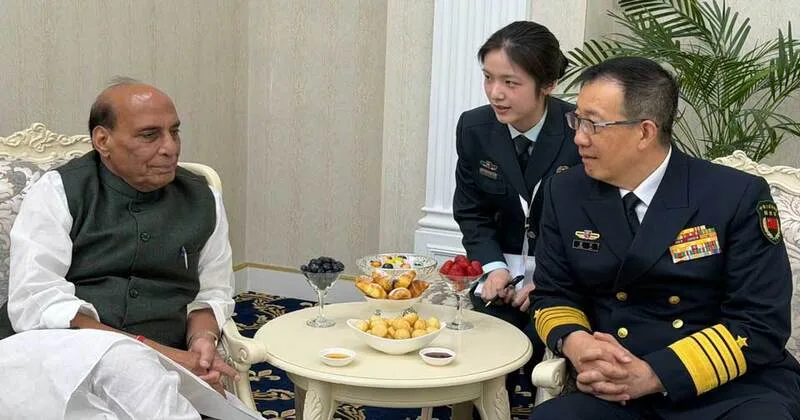
On the sidelines of the SCO meeting, Singh held bilateral talks with Chinese Defence Minister Dong Jun, an interaction closely watched in the backdrop of recent developments in India-China relations. The two sides discussed regional security, stability, and measures to strengthen military communication channels.
The meeting comes after India and China completed disengagement at Depsang and Demchok last year, a step that helped ease immediate military tensions along the Line of Actual Control (LAC). While this breakthrough led to renewed diplomatic engagement, New Delhi has consistently maintained that broader normalisation of ties will depend on sustained peace and tranquillity along the LAC.
Great interaction with Russian Defence Minister, Andrei Belousov during the SCO Defence Ministers’ Meet in Bishkek. pic.twitter.com/eeJ6P7airr
— Rajnath Singh (@rajnathsingh) April 28, 2026
Singh also met Russian Defence Minister Andrei Belousov ahead of the formal session. The interaction underlined Russia’s continuing strategic relevance as a key defence partner for India, particularly in the context of long-standing military cooperation and procurement ties. The Defence Minister, who has been in office since 2019, arrived in Bishkek on Monday, where he was received by officials. His visit included plans for multiple bilateral meetings with defence ministers of SCO member states, as well as engagement with the Indian community in the Kyrgyz capital.
Broader strategic context and India’s position
Ahead of the SCO proceedings, Singh had stated that he would highlight India’s commitment to global peace amid prevailing security challenges. In a post on X, he said he would convey India’s consistent stance of “zero tolerance for terrorism and extremism.”
This year’s SCO Defence Ministers’ meeting is taking place against the backdrop of heightened global tensions, including conflicts involving the United States, Israel and Iran. The discussions are expected to focus on addressing regional instability and preventing wider spillover effects.
India has consistently maintained that disputes must be resolved through dialogue and diplomacy. Prime Minister Narendra Modi has also actively engaged with global leaders, advocating de-escalation and peaceful resolution of conflicts across regions.
Singh’s remarks in Bishkek reflect a calibrated attempt by India to align its military posture with diplomatic messaging, while reinforcing its long-standing demand for a uniform global approach to counter-terrorism. By raising these issues at a multilateral forum that includes key regional players, New Delhi has once again signalled that combating terrorism remains central to its foreign and security policy priorities.