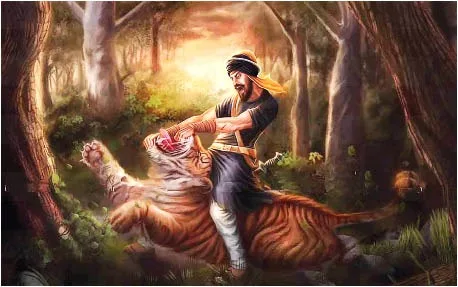
Hari Singh Nalwa was an exceptional general under Maharaja Ranjit Singh. His greatest achievement was restoring Punjab’s old boundaries, lost to Muslim invaders 800 years ago. Led by Maharaja Ranjit Singh, Hari Singh Nalwa closed the Khyber Pass, blocking foreign invaders from entering India.
The great general was born on April 29,1791 to Gurdayal Singh in Gujranwala (Pakistan). After his father’s death, his maternal uncle raised him. He had no formal education or military training. At 15, Hari Singh learned warfare by observation and became proficient in Punjabi and Persian. Baba Prem Singh writes, “In ancient times, Emperor Nala was a benevolent king and an unmatched warrior. He was renowned for killing a lion, and from the name ‘Nala,’ he became known as Nalwa.”
First interaction with Ranjit Singh
Maharaja Ranjit Singh held an annual Basanti Darbar in the spring. In 1805, Hari Singh first demonstrated his military skills. Impressed, Ranjit Singh recruited him. Soon after, Hari Singh fought a lion, earning command of the ‘Sherdil’ regiment. In 1807, after winning the battle of Kashmir, he received a large estate.
Battle of Multan and the Governor of Kashmir
During the Battle of Multan in 1801, Nawab Muzaffar Khan resisted and stopped the Khalsa troops’ advance. Maharaja Ranjit Singh chose Hari Singh Nalwa to demolish the Multan fort wall. The wall was destroyed, but Hari Singh was injured.
In 1818, Hari Singh won the Battle of Multan and captured Kashmir. His bravery expanded the Khalsa Kingdom. Ranjit Singh allowed him to mint his own coin in Kashmir, inscribed with the image of Guru Nanak Dev Ji and the Lahore state. Historian Alexander Barnes wrote, “Such achievements cause world powers anxiety.”
Freedom to Peshawar
In 1834, Maharaja Ranjit Singh declared that Punjab and India could not be free from invasions until Peshawar and its border province joined the Khalsa Kingdom. He decided to capture Peshawar from Afghanistan.
On 27-4-1834, Maharaja Ranjit Singh ordered S. Hari Singh Nalwa and Kanwar Naunihal Singh to advance to Peshawar. Hari Singh led his army across the Indus River using a chain bridge. Peshawar’s commanders tried to stop the Khalsa army with cannons at the Chamkani border. The Afghans fought bravely but were overwhelmed by the Khalsa’s advance. Peshawar was captured, and the Khalsa flag flew. History records that Hindus and Muslims of Peshawar celebrated after gaining freedom from oppressive rule. [Book- Punjab: The Saga of Triumphs, Page -77]
After capturing Peshawar, Hari Singh Nalwa abolished the Jaziya Tax imposed by Aurangzeb on Hindus and Sikhs. Recognising his skills, Maharaja again allowed him to mint coins, honouring him a second time.
Hari Singh Nalwa later built a strong fort in Jamrod, in the hills of the Khyber Pass between Peshawar and Kabul. The fort, ‘Fatehgarh Qila of Jamrod,’ shook the throne of Afghanistan, making Kabul the Khalsa army’s next target. The Afghans declared Jihad, making it a fight for survival.
Under Hari Singh Nalwa, the Khalsa Army captured the border area around Kabul, returning it to Indian territory after 800 years. Fatehgarh Qila, under Jamrod, became a stronghold. Militants feared Sardar Singh Nalwa’s arrival, while Kabul women scared their children with his name: “Be quiet and sleep, lest Hari Singh comes.”
Battle of Jamrod
The Khalsa Army challenged Afghanistan’s sovereignty. General Mahmud Akbar led 30,000 soldiers and forty cannons to Shankargarh. Most Khalsa troops had left Peshawar for Lahore for Kanwar Naunihal’s wedding. Fort Jamrod was commanded by S. Maha Singh Mirpuri with only 800 infantry, 200 cavalry, 80 artillerymen, 10 large cannons, and 12 hill cannons.
On April 21, 1837, the Afghan army attacked Fort Jamrod. The Khalsa troops coordinated their defence, stopping the Afghans from entering, but by evening, the Afghan army breached a section of the fort’s wall. Maha Singh gathered the Chiefs, ordered overnight wall repairs, and sent a young messenger to Peshawar to inform Hari Singh Nalwa. Bibi Harsharan Kaur delivered the letter to Hari Singh Nalwa ji.
After reading the letter, Hari Singh Nalwa, with 6,000 infantry, 18 cannons, and cavalry, arrived at Jamrod before the Pathans could renew their assault and launched a fierce counterattack.
Initially, Pathans resisted. When they learned Nalwa had joined the battle, they fled to nearby hills. All 3,000 soldiers disappeared. Hari Singh captured fourteen Pathan cannons, including the mountain cannon ‘pahad-tod.’ Afghans used guerrilla warfare, and Sardar Hari Singh Nalwa was shot and wounded. Realising his condition, he instructed his companions to defend the Khalsa flag’s honour till their last breath. Sardar Maha Singh performed Sardar Nalwa’s last rites on 30 April 1837.
Sardar Hari Singh Nalwa sacrificed his life for the prestige of Mother India. He ended 800 years of subjugation and brought freedom. Hari Singh achieved worldwide fame by expanding Punjab’s boundaries. Even world victors like Napoleon Bonaparte could not match him. Maharaja Ranjit Singh grieved his loss and fulfilled Nalwa’s mission, hoisting the Khalsa flag up to Kabul.