The need for women’s reservation and increase in constituencies must be studied carefully. Instead of doing so, Congress and I.N.D.I. Alliance are trying to create divisions between North and South India due to political frustration, thereby harming South India.
Due to Congress and I.N.D.I. Alliance actions, women lost approximately 100 additional MP opportunities and SC and ST communities lost increased representation. Congress alliance does not want to see women in large numbers as Members of Lok Sabha and has deceived women across all regions and sections of the country.
When a proposal was made to increase seats by 50 per cent without reducing the existing percentage representation of States in the present 543 Lok Sabha seats, Congress alliance reacted negatively.
Telangana CM Revanth Reddy’s logic’s suggestion to allocate seats based on GSDP is against democratic principles. For example, Kerala and Haryana have similar populations and GSDP. Currently, Kerala has 20 seats, while Haryana has 10 seats. After the increase, Kerala would have had 30 seats, Haryana would have had 15. If decisions were made based on political benefit, would BJP increase seats in Kerala where it has less presence?
If GSDP basis is followed, Kerala’s seats could reduce significantly. Similarly, other Southern States would also suffer for some other reason – Is it acceptable for us? Therefore, the focus should be that representation percentage should not decrease. Increasing seats by 50 per cent ensures this.
During the Emergency in 1976, through the 42nd Constitutional Amendment, Parliament and Assembly seats were frozen based on the 1970 census until 2000. Later, in 2001, through the 84th Constitutional Amendment, the same policy was extended until 2026. The main reason behind this was to ensure that States which followed population control are not disadvantaged.
As per the Constitution of India, delimitation must be carried out in 2026. Since delimitation has to be done after the census, the Central Government decided to complete the process through a Constitutional Amendment.
Due to Congress and I.N.D.I. Alliance actions, women lost approximately 100 additional MP opportunities and SC and ST communities lost increased representation. Congress alliance does not want to see women in large numbers as Members of Lok Sabha
At the same time, through the 106th Constitutional Amendment in 2023, one-third reservation for women in Lok Sabha and State Assemblies was enacted, to be implemented after the first census conducted after 2023, meaning the ongoing census. This implies that women’s reservation would come into effect from 2029.
However, since delimitation based on the 2027 census is unlikely to be completed before the 2029 elections, implementation of women’s reservation becomes difficult. This is because the Delimitation Commission set up in 2002 submitted its report only in 2008, indicating possible
delays again.
To overcome these difficulties, the Central Government decided to complete the process by increasing Lok Sabha seats and implementing women’s reservation in a way that does not disadvantage any State or section. Since delimitation and seat increase must also apply to Union Territories, three bills were brought together at once.
If delimitation is done based on the 2026 census or even through a Constitutional Amendment using the 2011 census, all South
Indian States including Andhra Pradesh will suffer losses.
Congress’ suggestion of waiting until the census is completed, which effectively means redistribution of seats based on population after 2026, will harm Southern States. The Central Government clearly ensured that by increasing Lok Sabha seats by 50 per cent (from 543 to 813), no State’s representation percentage would decrease. After implementing one-third reservation for women, no one can claim loss.
When Congress MP KC Venugopal said this was not part of the law and they would not trust it, Union Home Minister Amit Shah stated in Parliament that the proposal to increase seats by 50 per cent could be redrafted within one hour. This reflects the Government’s commitment. Why Congress did not accept this is the real issue.
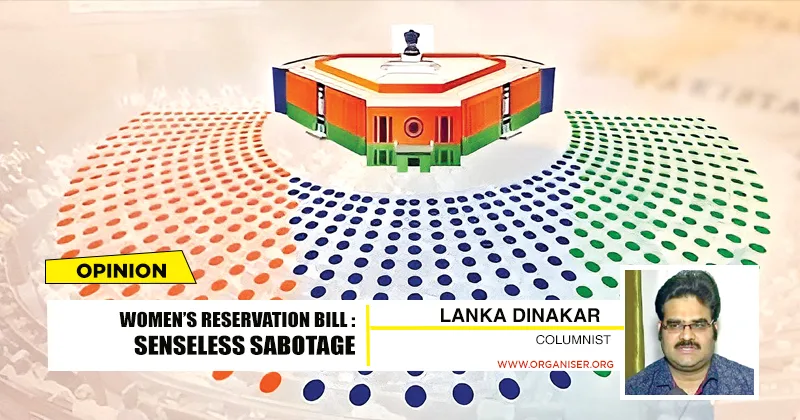
The new Parliament building was inaugurated before the 2024 elections, with seating for 888 members and capacity for 1272 during joint sessions. This reflects long-term planning by the Modi Government, not short-term political motives.
Fifty years ago, 543 seats were decided for a population of 57 crore. Today, with a population of 140 crore, the same number continues. BJP has already won three times, and will win again. However, increasing representation is necessary for better governance.
There are 127 constituencies with over 20 lakh voters, and one with over 48 lakh voters. Malkajgiri in Telangana has 38 lakh voters. In such situations, MPs find it difficult to be accessible to people. Delimitation and seat increase will improve accessibility.