





Origins of the question of women’s reservation in India can be traced back all the way to the Constituent Assembly debates in India. Even amongst the women members of the Assembly, there was resistance to the idea of reservation of seats for women. Therefore, this question is not a new one, and neither is it purely legislative. Leaders such as Hansa Mehta asserted that political participation should be anchored in formal equality rather than reserved quotas. Her beliefs rested on Constitutional beliefs that universal adult franchise would, over time, correct historical imbalances.
That belief of hers has, in fact, only been partially realised. Over the last three decades, successive Governments across the political spectrum have expressed their support and endorsed women’s reservation in principle. Yet, legislative attempts to translate that support into law have repeatedly stalled at the point of implementation. The events of 2026 are not exceptional or an anomaly for the Parliament. These events are a reflection of an enduring pattern where there is agreement at the level of principle but disintegration when the question turns to execution and a shift in political power.
Thirty Year Legislative Journey
The legislative evolution of women’s reservation in India begins with the attempt made through the Constitution (Eighty-first Amendment) Bill in the year 1996 which sought to insert Articles 330A and 332A into the Constitution. It would mandate not less than one-third reservation for women in the Lok Sabha and State Legislative Assemblies. Unfortunately, the Bill never saw the light of day and lapsed with the dissolution of the Lok Sabha. Subsequent efforts to revive the legislation in 1998, 1999 and the early 2000s met a similar fate and were unsuccessful due to procedural disruptions and a lack of political consensus. The most significant legislative progress came in the year 2010, where the bill for reservation for women secured the mandated two-thirds majority in the Rajya Sabha with 186 votes in favour. However, this bill also eventually lapsed in 2014 as it was never taken up in the Lok Sabha. This proposal eventually took constitutional shape when the Constitution (106th Amendment) Act, 2023, was enacted, which provided for one-third reservation for women in State Legislative Assemblies and the Lok Sabha. The implementation of the Act, however, was made contingent on the completion of the subsequent consensus and delimitation exercise, which linked the reservation exercise with the reorganisation of constituencies.
Structural Faultlines
The continued challenges surrounding the implementation of women’s reservation are not rooted in a single point of disagreement but a set of structural factors that have invariably impacted legislative outcomes. The central complexity has been the demand for sub-categorisation within the broader reservation framework, particularly for OBC and minority women. This has complicated all efforts to finalise a common framework. Simultaneously, the proposed mechanism of rotating reserved constituencies has raised concerns regarding the continuity of reservation and the ability of elected members to meaningfully engage with their constituencies.
Another layer of complexity is introduced by the linking of reservation with the delimitation. This exercise aims to update constituency boundaries so that they reflect the changing demographics of India and ensure balanced representation of citizens across the country. The integration of reservation with this process reflects an attempt to integrate it within a broader restructuring of electoral structures. At a fundamental level, this proposal intersects with the redistribution of political opportunity, which creates resistance amongst those already in power. This redistribution would alter the existing electoral dynamics and reshape competition, which further complicates agreement at the time of execution.
The 2026 Amendment Attempt
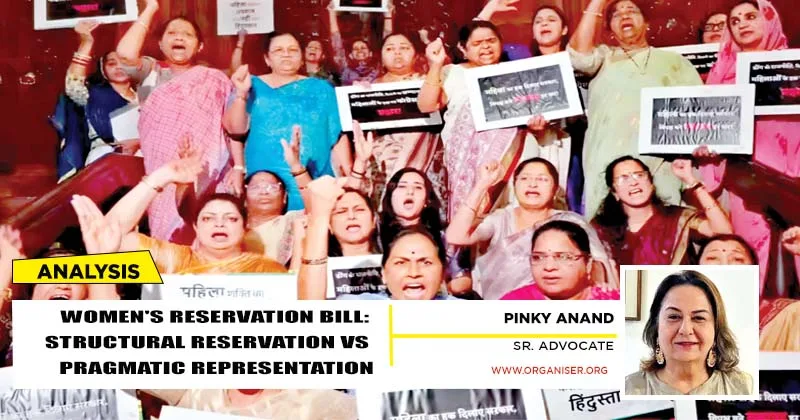
The developments of April 2026 constitute a significant phase in the legislative process of the operationalisation of women’s reservation. The Constitutional (131st Amendment) Bill, 2026, introduced to implement the framework established under the Constitutional (131st Amendment) Act, 2023. However, it failed to meet the requirements under Article 368 of the Constitution, which mandates a two-thirds majority vote of all members present and voting to pass any bill. Out of 528 members who participated, only 298 members supported the bill, while 230 members opposed it, and therefore, the bill fell short of the required 352 votes. The amendment proposal attempted to expedite implementation timelines by initiating delimitation using the data from the 2011 Census. This allowed for the 33 per cent reservation for women to be introduced in the 2029 General Elections. It further included provisions to expand the capacity of the Lok Sabha from 543 seats to 850 seats, which would allow 283 seats to be reserved for women without displacing any sitting members.
Following the failure of this amendment, the operationalisation of reservation for women reverts to the existing statutory framework. This essentially means that the implementation remains contingent on the completion of a fresh census and then a subsequent delimitation exercise. Consequently, the implementation of reservation for women stands deferred till the 2034 General Elections. The absence of effective implementation of women’s reservation has tangible democratic consequences and continues to be reflected in the composition of India’s legislatures. Women currently account for approximately 14 per cent of the Lok Sabha and roughly 17 per cent of the Rajya Sabha, while representation in State Assemblies is as low as 10 per cent. At a global level, India is well below the average of 25 per cent for women’s representation and ranks 148 out of 193 countries.
This underrepresentation stands in drastic contrast to the changed landscape of local Government. At the grassroots level, Panchayats have up to 50 per cent reservation for women in several States and empirical studies into the same show a more efficient and responsive public service delivery system. A measurable impact has especially been seen in sectors such as public infrastructure, sanitation and local development, proving that women have an important role to play.
The Women’s Reservation Act 2023 needed to be implemented for the forthcoming elections to take forward the narrative of gender led development in India. The opposition to the Bill has yet again stalled the process and shattered the dreams and vision of half of India’s population.









