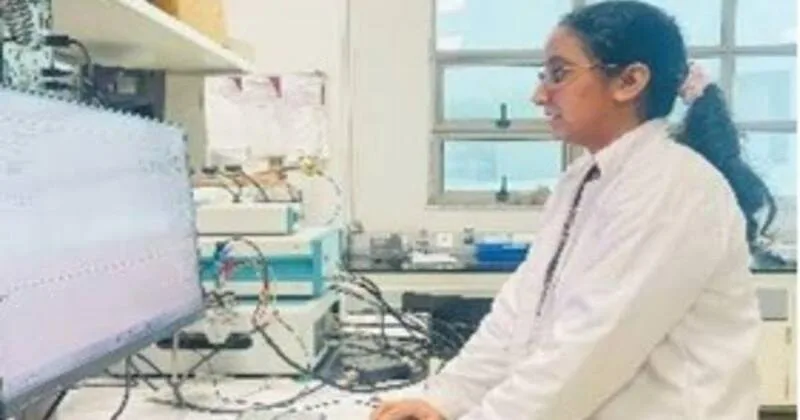
Representative Image From the corridors of Institute of Nano Science and Technology, scientists have developed a breakthrough that could change how nicotine exposure is detected at faster pace, simpler and more accessible. At a time when smoking and second-hand exposure continue to pose serious public health challenges, this innovation arrives with both scientific and real-world relevance.
A new lens on nicotine detection
Nicotine the primary addictive component in tobacco, leaves behind a biochemical trail in the human body. One of its most reliable markers is cotinine, a stable metabolite that is present in blood, saliva and urine long after nicotine itself fades. Detecting both compounds accurately is essential not just for clinical diagnostics, but also for monitoring exposure, understanding addiction pathways and guiding public health interventions.
This detection has relied on sophisticated laboratory techniques such as gas chromatography mass spectrometry and high-performance liquid chromatography. While precise, these methods are expensive, time-consuming and require skilled technicians. For large-scale screening or rapid diagnostics, especially in resource-limited settings, they are far from ideal. This is where the new fluorescent turn-on sensor comes into play a technology that transforms detection into a visual and almost immediate process.
The science behind the glow
The key component that makes this discovery possible is a special type of nanomaterial known as iron-based metal-organic nanospheres or Fe-III-MOFs. They are minuscule sponge-like particles which is made up of iron ions and organic ligands, providing a highly porous structure.
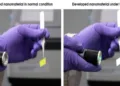
The technology behind this breakthrough is that nanoparticles are filled with small holes able to capture the targeted molecules, such as nicotine and cotinine. As soon as these molecules occupy the pore space, the nanoparticles start emitting higher levels of light, switching to blue light. This reaction serves as a direct indicator of nicotine or cotinine presence.
Researchers believe that the increased fluorescence effect occurs due to the unique host-guest interaction and electron transfer in the nanoparticle. The reaction of the nanoparticle with the captured molecule causes a change in the electronic state, resulting in enhanced fluorescence. It belongs to the larger sphere of Fluorescence spectroscopy, but the application of the phenomenon is specifically designed for biological sensors.
Designed for real-world use
The sensor is capable of functioning effectively in an aqueous environment, which makes it possible to operate in biological liquids with no elaborate preparatory processes required. It paves the way for conducting non-invasive tests and continuous monitoring.
These nanospheres are fabricated through a solvothermal process, which ensures standardization and mass production. Besides increased sensitivity it also provides an opportunity to re-use the material thus making it recyclable.
Safety is another critical aspect of this research. As mentioned above, iron compounds are abundant and safe for biological applications. Cytotoxicity test results show low cytotoxicity levels, which means there will be no harm to living cells. This quality makes it ideal for intracellular monitoring.
Through the application of confocal microscopy techniques, scientists were able to study the behavior of these nanospheres within cellular structures. With an increase in the fluorescence generated from the uptake of nicotine or cotinine, one is able to visualize the molecular interaction.
This study has been published in the journal Nanoscale, which has established itself as a credible publication forum for nanoscience research. The study has been funded by the Department of Science and Technology, India.
Why this matters for public health
Implications for this development go well beyond lab testing purposes. Smoking tobacco is one of the major reasons behind preventable diseases across the world, such as heart diseases, breathing issues and cancer. Being able to test people for nicotine exposure and nonsmokers exposed to second-hand smoke, would have a positive impact on public health.
This device paves the way to quick and inexpensive testing. Consider a compact testing kit capable of detecting nicotine exposure fast, with no need for expensive equipment. The kit could find application in schools, companies, clinics and even health fairs organized in the local community. From a scientific point of view, it will allow investigating nicotine interactions with the body on a molecular level.
Bridging science and society
This innovation stands out due to its association with the larger trend in scientific research of changing directions from complexity to practicality. Through making the process simpler while still maintaining accuracy, it creates a connection between sophisticated science and practical application.
Secondly the innovation ties into the trend of creating materials in nanotechnology that react to changes in the surrounding environment. The nanospheres act almost like sentinels by quietly observing their surroundings and fluorescing once they recognize a particular signal.
Fluorescence in response to the presence of a particular compound does not apply exclusively to detecting nicotine, other biomarkers can theoretically be used as well which will opens the door to developing novel fluorescent biosensors.
Future possibilities and step towards preventive healthcare
While nicotine and cotinine are currently being considered, the underlying approach promises further use in more diagnostics. Upon development it can be used to detect various markers of disease, toxic environmental chemicals or even pathogens.
The ability to produce such biosensors on an industrial scale can potentially lead to commercialization. Cheap biosensor-based health testing kits can prove to be quite helpful in developing countries, where advanced medical facilities are not available. Before being implemented further tests need to be conducted in order to ensure consistency of results.
Such innovations represent an example of the transition to the prevention of illnesses through timely detection of risks, continuous observation of exposure levels and timely implementation of preventive actions. By facilitating faster nicotine testing and making the process affordable, such technologies become very efficient tools for individual as well as systemic use.
For a nation that deals with significant tobacco use and its negative implications on public health issues, such innovations become especially important as they may contribute to the efforts aimed at reducing the burden of diseases associated with tobacco use.
The creation of fluorescent turn-on sensors is able to detect nicotine and cotinine in biological samples becomes not just a scientific innovation, but a milestone towards advance diagnostics. The combination of various technologies and scientific insights, such a diagnostic tool has been developed and will likely prove to be very efficient in practice.