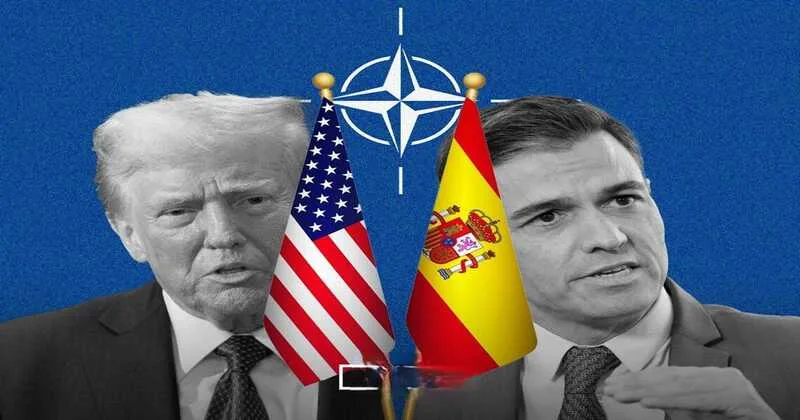
Brussels: A reported move by the United States Department of Defense to consider suspending Spain over its refusal to support military action against Iran has triggered strong backlash within NATO. The alliance clarified that its founding treaty contains no provision to expel or suspend a member state. The controversy stems from a media reports citing a leaked internal email from the Pentagon, which suggested that countries unwilling to back Washington’s military actions should face punitive measures.
The tensions escalated after the United States and Israel carried out joint strikes on Iran’s nuclear facilities on February 28. Spain declined to grant access to its air bases for the operation, a decision that angered Washington. In addition to the possibility of targeting Spain within NATO, reports indicate that the US is also reviewing its diplomatic position on the Falkland Islands, a move that has unsettled key allies.
Growing divisions within NATO
Spanish Prime Minister Pedro Sanchez responded by stating that Spain does not base its decisions on leaked communications and reaffirmed that cooperation with allies would remain within the framework of international law. Meanwhile, US Defense Secretary Pete Hegseth criticised countries that benefit from American security guarantees but fail to provide reciprocal support. He stressed that Europe’s dependence on the Strait of Hormuz necessitates preparedness for conflict.
Last month, US President Donald Trump criticised NATO, describing it as disproportionately benefiting from American protection without adequate contribution from other members.
Despite these tensions, several European nations have expressed solidarity with Spain. Both Italy and Germany backed Madrid, with a German spokesperson asserting that Spain’s membership in NATO should not be questioned. British Prime Minister Keir Starmer has also resisted US pressure. The United Kingdom’s official stance maintains that any blockade of Iranian ports would not align with its national interests. At the same time, the UK and France have indicated readiness to deploy troops after a ceasefire to ensure the safe passage of oil shipments through the Strait of Hormuz.
Italian Prime Minister Giorgia Meloni urged allies to maintain unity during the crisis, while also calling for stronger European defence capabilities. Despite the intensifying dispute, there has been no formal proposal from Washington to withdraw from NATO or shut down its bases, offering some reassurance even as divisions within the alliance deepen.