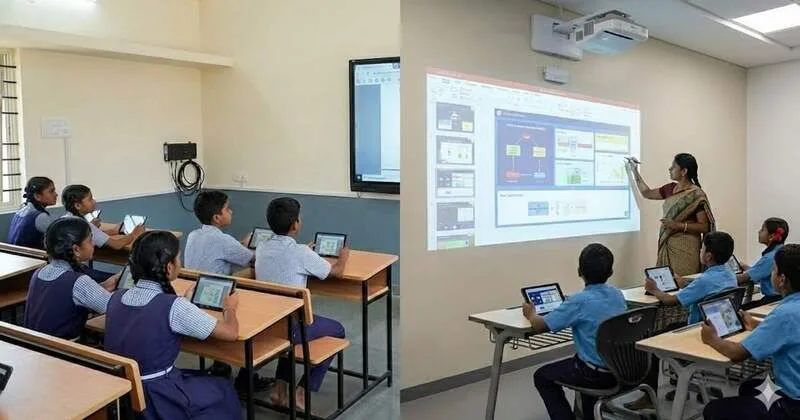
To strengthen digital education, the national capital is set to upgrade and expand its technology infrastructure in government schools. The move comes after the Project Approval Board (PAB) for 2025-26 under the Ministry of Education approved a comprehensive plan to modernize Information and Communication Technology (ICT) facilities across Delhi’s school system.
According to an official circular, the Delhi government will upgrade 376 existing ICT labs in secondary and senior secondary schools. In addition, 31 new digital labs will be established during the academic year 2025-26. These include 24 new ICT labs and seven schools that will receive advanced digital hardware and software (Type-I) facilities. The initiative is being implemented under the Samagra Shiksha programme, which focuses on improving the quality of school education through integrated and technology-driven interventions.
This large-scale upgrade is part of the ICT and digital initiatives sub-component under the broader category of quality interventions. The aim is not just to enhance infrastructure, but also to transform the classroom learning by integrating technology into everyday teaching practices.
The circular says that the supplementary PAB, under the Annual Work Plan and Budget (AWPB) 2025-26, has specifically approved the establishment of 24 new ICT labs in schools where student enrolment exceeds 700. This rule will ensure that the schools with more students get priority, since they need digital resources the most.
In addition to these ICT labs, seven schools have been selected for more advanced digital interventions. These schools will be equipped with modern digital hardware and software systems, taking the total number of new digital initiatives to 31 schools. This dual approach i.e., upgrading existing labs while also introducing new, high-tech facilities show a balanced strategy of both expansion and modernization.
The importance of ICT labs in today’s education system cannot be overstated. These labs play a crucial role in improving digital literacy among students, which is now considered a fundamental skill alongside reading and writing. Access to computers, the internet, and interactive learning tools will enable the students to explore subjects in a more engaging and practical manner.
Moreover, ICT labs help in subject-wise learning by providing simulations, visual content, and real-time information that enhance understanding. Students can access global educational resources, participate in virtual learning environments, and stay updated with the latest knowledge trends. This exposure is particularly valuable in preparing them for higher education and future careers in an increasingly digital world.
Another key benefit of these labs is the development of critical thinking and problem-solving skills. Technology-based learning encourages students to analyze information, work on projects, and collaborate with peers. These skills are essential not only for academic success but also for professional growth in the 21st century.
The initiative is also expected to improve teacher efficiency. With better digital tools, teachers can adopt innovative teaching methods such as multimedia presentations, online assessments, and interactive sessions. This not only makes teaching more effective but also helps in addressing diverse learning needs within the classroom. Inclusion is another important aspect of this digital push. By providing equal access to technological resources, the government is trying to bridge the digital gap between students from different socio-economic backgrounds. Government school students, who may not have access to such facilities at home, will particularly benefit from this initiative.
The district-wise allocation of the new ICT labs shows a targeted approach. The North East II district has been allotted the highest number of new labs, with seven schools selected for the upgrade.
In a parallel development, the Delhi government has also made provisions in its 2025-26 Budget to further strengthen digital infrastructure. An allocation of Rs 50 crore has been announced for setting up 175 new computer labs in government schools, in accordance with the norms of the Central Board of Secondary Education. This shows a combined effort where the central government gives approval and the state government provides funding to speed up digital education.