
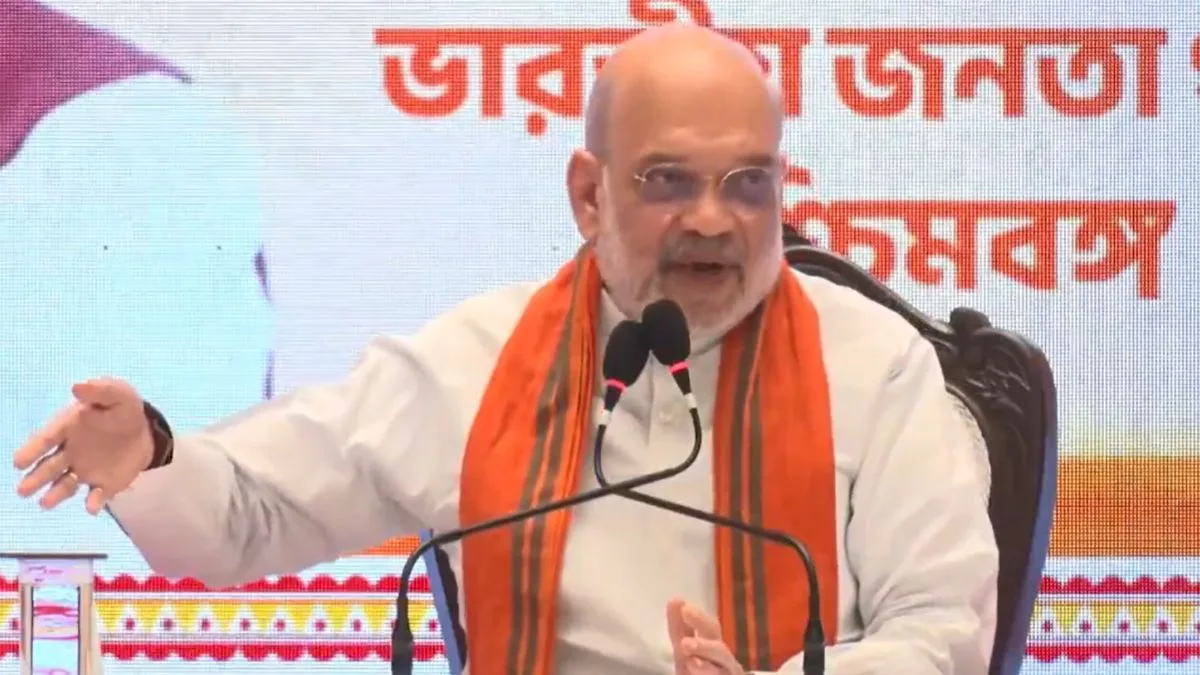
Following the historic voter turnout in the first phase of the West Bengal Assembly elections, Union Home Minister Amit Shah declared that the massive participation signals a clear victory for the BJP. Addressing the media, the senior leader expressed confidence that the party is on track to win 110 out of the 152 seats that have already gone to the polls.
Shah further emphasized that if the BJP comes to power, the Chief Minister would “definitely” be a local figure—someone born in Bengal and educated in a Bengali-medium school. Highlighting the party’s vision for a “double-engine government,” he asserted that the current momentum indicates the saffron party is set to form the next government in the state.
Union Home Minister Amit Shah stated on Friday that the BJP has nominated individuals personally impacted by West Bengal’s incidents of violence as candidates. He asserted that their presence in the Assembly would ensure stricter governance and a tougher stance against criminals.
Shah specifically referenced the RG Kar and Sandeshkhali cases, noting that those who faced “atrocities” have now been given political representation. He claimed these candidates would provide a much-needed voice in the law-making process.
Predicting a “big change” in the state’s political landscape, Shah described the momentum as a “tsunami” of support for the BJP. “I feel that we will win seats with a huge margin,” he said, citing the massive turnout he witnessed during his visit to Madhyamgram.
Bengal Assembly Elections 2026
The West Bengal Assembly elections have transformed into one of India’s most intense political battles, as the BJP seeks to end the Trinamool Congress’s 15-year reign.
West Bengal saw historic first phase of polling on Thursday, which saw unprecedented citizen participation. Despite a recent purge of the electoral rolls that removed lakhs of names, the turnout reached record-breaking levels.
Chief Election Commissioner Gyanesh Kumar confirmed that the voter percentages in both West Bengal and Tamil Nadu were the highest recorded since Independence. Specifically, in West Bengal, the 152 constituencies that voted in this phase reached a massive 92.35% turnout by late evening—the highest engagement seen in these regions since at least 2011.
Assembly Polls: What the Poll Statistics Say
District-level statistics showcased an extraordinary level of voter engagement. In West Bengal, Dakshin Dinajpur topped the list with 94.85%, while Cooch Behar, Birbhum, Jalpaiguri, and Murshidabad all surged past the 90% mark. Similarly, Tamil Nadu witnessed massive turnouts, particularly in Karur, Salem, Dharmapuri, Erode, and Namakkal.
These record numbers have sparked conflicting narratives from the major political players. In Tamil Nadu, the AIADMK interpreted the surge as a massive anti-incumbency wave against the DMK, viewing it as a clear sign of public frustration and a desire for a change in power. They also commended the Election Commission for maintaining a peaceful environment throughout the day.
Meanwhile, in West Bengal, the BJP leadership expressed total confidence, claiming the high participation reflects a public mandate for change and predicting substantial electoral victories. With the first phase concluded, the political spotlight now shifts to the upcoming rounds of voting and the final counting on May 4. This high-stakes environment has only sharpened the rhetoric, as every party attempts to spin the turnout data in their favor while intensifying ground-level mobilization for the remaining battlegrounds of the 2026 elections.