In American politics, Donald Trump’s name has long been associated with sharp rhetoric, controversial policies and shifting stances. His recent remark, labeling India and China as “hellholes” or “gates of hell” serves as yet another illustration of this recurring pattern. Such statements undoubtedly reflect a broader political strategy, a specific mindset, and a power-centric worldview.
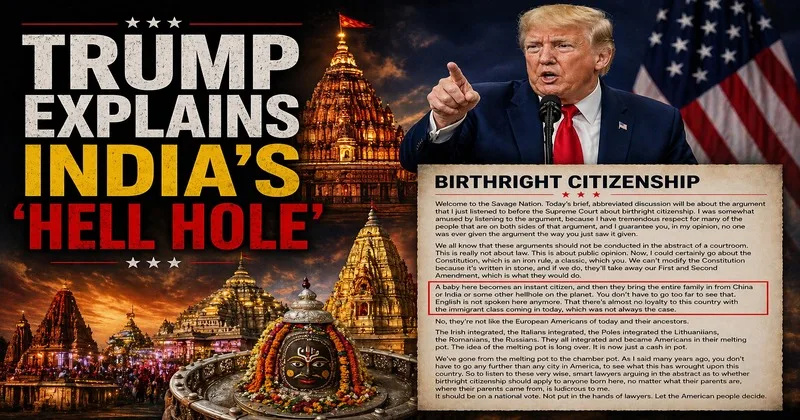
First, let us examine Trump’s recent comments. In a letter posted on social media, he criticised “birthright citizenship”- the practice of granting citizenship based on the place of birth. He alleges that Indian and Chinese immigrants acquire U.S. citizenship by giving birth to children within the country, subsequently bringing their entire families over. This claim is, in essence, partially predicated on the legal framework known as “birthright citizenship,” which is enshrined in the Fourteenth Amendment to the U.S. Constitution.
From a historical perspective, the primary objective of this amendment, ratified in 1868 was to grant citizenship to Black individuals who had endured slavery in the United States. However, over time, its interpretation broadened; consequently, every child born on American soil is now deemed a citizen, regardless of their parents’ immigration status. In recent times, Trump has been actively seeking to alter this very system. Following his inauguration on January 20, 2025, he even attempted to curtail this right by signing an executive order, a move that was subsequently challenged in the courts.
The second facet of Trump’s statement pertains to California’s technology sector. He asserted that Indian and Chinese professionals hold a “dominance” in the region, thereby diminishing opportunities for local residents, whereas the reality behind this claim tells a very different story. The complex reality behind this claim is that the large presence of professionals of Indian and Chinese origin in Silicon Valley and other tech hubs stems from the fact that they have reached these sectors through higher education, technical expertise and global competitiveness. Numerous reports and studies today demonstrate that people of Indian origin constitute one of the most highly educated and high-income immigrant groups in the United States.
Trump’s argument that the hiring process is “unfair” appears to be more of a political statement than a factual conclusion, given that major US technology companies recruit based on merit, experience and innovation. If a particular community is disproportionately represented, the reason often lies in their educational and professional achievements, certainly not in any conspiracy or bias. Furthermore, in his letter, Trump also attacked the American Civil Liberties Union (ACLU), characterizing it as an organization that supports undocumented immigrants. He went so far as to suggest that the organization should face legal action under strict laws. Viewed directly, this statement runs counter to a fundamental principle of American democracy: the right of civil liberties organisations to operate independently.
The question now arises, why does Trump repeatedly make such statements? The answer lies embedded in his political strategy. Trump’s politics are predicated on the principle of “Us versus Them.” He frequently portrays immigrants, foreign nations, or minority groups as a “threat” in order to galvanize his base of supporters. This strategy is not new; during his 2016 election campaign, he employed similar rhetoric regarding Mexico and Muslim-majority nations.
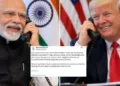
Trump’s stance toward India is particularly intriguing because, on one hand, he characterizes India as a strategic partner, yet on the other, he issues statements that cast India in a negative light. For instance, during his first term, he strengthened defense and trade ties with India yet simultaneously criticized the country by labeling it the “Tariff King.” This double standard signals that, for Trump, foreign policy is not a matter of enduring principles but rather a “deal,” wherein every nation is evaluated based on the extent to which it serves America’s immediate interests. If India stands with the U.S. on a particular issue, it is deemed a “friend”; if not, that very same nation becomes a “problem.”
Here, Trump’s distrust of courts and legal institutions also reflects his mindset. In his statement, he asserted that this issue should not be decided by courts or lawyers, but rather through a nationwide vote. This constitutes a dangerous signal for the democratic framework, given that in a country like the United States, the Constitution and the judiciary are held to be supreme. Furthermore, Trump has accused immigrants of abusing the welfare system, even though numerous studies demonstrate that immigrants make significant contributions to the American economy. They pay taxes, launch new businesses, and create jobs. The Indian-American community, in particular, is renowned in this context for its presence as doctors, engineers and entrepreneurs.
Indeed, in the wake of Trump’s recent characterisation of India as a “gateway to hell,” the collective reaction of every Indian is that this is not merely an isolated derogatory remark; rather, it is symptomatic of a broader mindset in which he views nations of the Global South as sources of problems. This perspective is not only factually incorrect but also detrimental to the diplomatic relations between India and the United States. Ultimately, the realisation dawns that this “eccentric and hateful mindset” of Trump is, more than just a personal conviction, a political tool. He understands that such statements generate media headlines, galvanize his supporters and force the opposition onto the defensive.
In this context, it becomes imperative for a nation like India to recognize that statements made by leaders like Trump do not constitute the permanent policy of the United States; therefore, it would be inappropriate to define the bilateral relationship based on any single remark. India-US relations are grounded in a comprehensive and long-term strategic partnership- one that runs far deeper than the personal views of any single leader. Nevertheless, it must also be asserted that this perspective of Trump warrants a firm and fitting rebuttal from India and its people, as his statement runs counter to the very spirit of global cooperation and mutual respect, including in the context of India-China relations.