
Demonetisation was the first major blow to the black money operators in India, as well as to those perpetrating religious conversion and jihad across the country. It brought a sudden halt to a large part of the anti-Hindu and anti-national activities in India. Reports indicate that for almost two years, the propaganda machinery of terrorists and jihadis was forced to slow down or even stop completely due to the unavailability of funds to sustain their operations.
However, demonetisation failed to purge the venomous, anti-national mindset of these elements — both inside India and abroad. Far from reforming, they immediately started hunting for fresh routes to sustain their agenda of religious conversion and jihad. Until the COVID-19 pandemic hit, these traitors were frantically searching for new pipelines to pump in foreign funds and reignite their jihadi operations across the country.
Since 2021, a disturbing phenomenon has been unfolding in the outskirts of Kerala, particularly in the Malabar region where one particular community forms the majority. Arabic-style restaurants have been mushrooming at an alarming rate across cities and villages of Kerala. There are a number of Arabian restaurants that function without registration in Kerala.
Arabic Restaurants in Kerala Linked to PFI Funding?
The surge in these Arabic restaurants after demonetisation is not normal — it is highly suspicious. Beyond any legitimate business profits, massive unexplained investments appear to be pouring in. NIA must urgently investigate whether foreign funds and other dubious alternative channels are being diverted into these outlets on a large scale.
Even more alarming, there are serious allegations that banned extremist organisations like the Popular Front of India (PFI) and the SDPI are directly or indirectly linked to many of these establishments. What looks like a sudden food trend may actually be a well-funded network serving a deeper, more dangerous agenda.
PFI, banned in 2022 for terror financing, radicalisation, targeted killings, and links to ISIS and other Islamist groups, has a long history of receiving funds from abroad — particularly from Gulf countries via hawala and front organisations. Its stronghold has always been Kerala, where it built a powerful cadre base. Even after the ban, intelligence agencies suspect its activities continue underground through proxies.
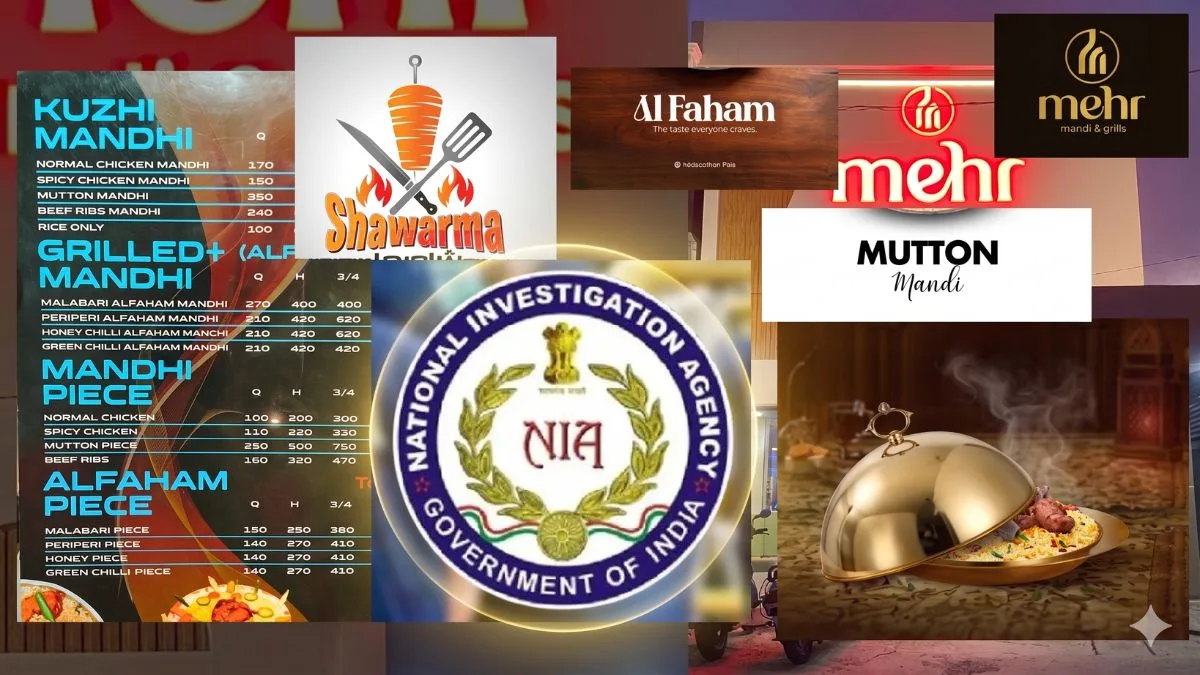
Praseeth Das, convener of the BJP’s Thrissur intellectual wing, has filed a complaint with the National Investigation Agency (NIA), seeking an inquiry into the financial sources of Arabic restaurants that have emerged across Kerala following demonetisation.
Vishu Ad Row: Abuse of Hindutva and Bhagawan Sri Krishna – Portrayed little Krishna eating Arabic non-vegetarian food(Kuzhymandi)
What looks like a harmless “food trend” may actually be a well-funded strategy: cultural infiltration, economic dominance in local markets, and possible continuation of radical activities under the guise of legitimate business. The recent Vishu advertisement controversies — where certain mandi restaurants used images of Lord Krishna promoting non-veg dishes — have only intensified suspicions of deliberate provocation alongside the funding trail. This is not about cuisine. It is about national security. Unexplained foreign money flowing into a specific category of restaurants in a sensitive border state like Kerala, especially with alleged PFI footprints, cannot be ignored.
Surge of Arabic Themed Restaurants in Kerala
In 2021, while around 9,500 restaurants shut down statewide due to COVID-19, approximately 24,000–25,000 new Shawarma, Al Faham, and Mandi (Kuzhimanthi) outlets opened, according to Food Safety Department registration data.
- This boom was especially visible in the Malabar region and outskirts where one community is dominant.
- The surge happened precisely when the overall restaurant sector was collapsing due to lockdowns and economic distress.
- The majority of the shuttered businesses were mid-to-high-tier restaurants located in rented spaces. Notably, vegetarian establishments accounted for nearly 60 percent of these closures. This decline was primarily driven by the dual pressure of dwindling revenue and escalating operational costs
- Many of Arabic food new outlets focused on quick, affordable Arabic/Middle Eastern cuisine that rapidly gained popularity but later triggered repeated food safety crises, leading to multiple statewide “Operation Shawarma” raids, mass closures (e.g., 148 in 2023, 52 in 2024, 45 in 2025), and even fatalities linked to contaminated mayonnaise, stale meat, and unhygienic practices.
- Kerala’s self-sufficiency in poultry farming has significantly expanded the reach of Arabian restaurants across the state.
- Furthermore, the affordability of Arabian cuisine has helped broaden its customer base. A majority of these recent ventures are managed by non-residents who are of particular community who relocated back to Kerala during the lockdown.
The contrast is stark: While thousands of traditional Kerala eateries were forced to shut down and die a slow death during the pandemic, a particular category of Arabic cuisine outlets — shawarma, Al Faham, Mandi and Kuzhimanthi joints — exploded in number, with nearly 25,000 new registrations in 2021 alone.
The real question is: Why this sudden, suspicious surge in one specific cuisine while everything else collapsed? Who is pumping money into this rapidly spreading Arabian food culture, especially in the Malabar region and outskirts of Kerala? And what is the real agenda behind turning Kerala’s streets and villages into a jungle of shawarma and mandi outlets?
Arabic Restaurants – Who are the targets?
Many owners trace roots to Malappuram or have Gulf work experience. Remittances from the Gulf have long fueled Kerala’s economy, and Arabic food has become a mainstream (not just “niche”) option, especially among youth. Chains like Al Reem Mandi started as early as 2010 and expanded. Every nook and corner has an Arabic restaurant.
The state has witnessed multiple statewide “Operation Shawarma” crackdowns by the Food Safety Department. In November 2023, 148 eateries were barred from selling shawarma for flouting mandatory hygiene guidelines. In May 2024, another 52 outlets were shut down after raids on 502 establishments. As recently as August 2025, authorities inspected 1,557 shawarma outlets in just two days and ordered 45 to shut immediately, while issuing rectification notices to hundreds more.
Raids have repeatedly uncovered stale meat, improperly prepared or stored mayonnaise, unhygienic kitchens, and meat cooked without following scientific safety protocols. Worse still, these violations have claimed lives. Several people have died from food poisoning after consuming these items, including:
- A 24-year-old man in Kochi, Rahul D Nair who died after eating shawarma, with contaminated mayonnaise identified as the culprit.
- In May 2022, 16-year-old Devananda from Karivellur (near Kasaragod) died after consuming rotten chicken shawarma from ‘Idea Food Point’ at Cheruvathur. Around 50–58 others fell seriously ill, with lab tests confirming pathogenic Salmonella and Shigella in the shawarma samples.
- Reshmi / Reshmi Raj (33-year-old nurse) from Kottayam, who died in January 2023 after consuming Kuzhimanthi and Al Faham from a local eatery. More than 20 others fell ill in the same incident.
- Anjushree Parvathy was a 19-year-old student from Kasaragod, Kerala, whose death in January 2023 was suspected to be caused by food poisoning from Kuzhimanthi, but was later police said that it was suicide.
- A woman in Thrissur who died after eating Kuzhimanthi, again linked to spoiled mayonnaise.
- Multiple other cases involving families and students hospitalised after consuming Al Faham, Kuzhimanthi or shawarma, with symptoms traced to stale meat, bacterial contamination (including Salmonella), and improperly stored egg-based mayonnaise.
- Despite repeated warnings, special guidelines issued by the Food Safety Department, and even interventions by the Kerala High Court, the same dangerous practices.
Top three states with the most Middle Eastern restaurants – Kerala No.1
Various reports have stated that Kerala leads India with 243 Middle Eastern restaurants (as per one business database report from 2025–2026), accounting for about 20.91% of the national total. Telangana follows with 228. Many are concentrated in districts with high Muslim populations and Gulf migration links, such as Malappuram, Kozhikode (Calicut), Ernakulam (Kochi), and Thrissur.
- Malappuram district: Hundreds listed on directories like Justdial (one page alone shows 194 Arabic restaurants). Popular spots include Airlines Celestial, Malabar Mint, and various Kuzhimandi outlets.
- Kochi (Cochin): Strong presence with chains and independent outlets. Tripadvisor and Swiggy list dozens focused on mandi, shawarma, and alfaham.
- Smaller towns like Tirur (Malappuram area) show high density relative to population (e.g., multiple outlets in areas with ~55K residents)
What looks like a harmless “food trend” may actually be a well-funded strategy
Cultural infiltration, economic dominance in local markets, and possible continuation of radical activities under the guise of legitimate business. The recent Vishu advertisement controversies — where certain mandi restaurants used images of Lord Krishna promoting non-veg dishes — have only intensified suspicions of deliberate provocation alongside the funding trail.This is not about cuisine. It is about national security. Unexplained foreign money flowing into a specific category of restaurants in a sensitive border state like Kerala, especially with alleged PFI footprints, cannot be ignored.
Clicks, Influencer Collabs, and Commerce: The Social Media Playbook of Arabic Restaurants
Middle Eastern (Arabic) restaurants in Kerala have aggressively established a strong digital presence across all major platforms, turning what was once a physical street-level boom into a deeply penetrating online invasion. These outlets dominate food delivery apps like Swiggy and Zomato, with dedicated sections and collections for “Shawarma,” “Arabian,” and “Mandi” cuisine flooding the platforms in every major city and small town — from Thiruvananthapuram and Kochi to Kozhikode (Malabar), Thrissur, and even remote areas.
On Instagram and YouTube, countless reels and videos showcase glowing reviews of shawarma, Al Faham, Mandi (Kuzhimanthi), and Arabian platters. Influencers film “food tours,” “taste tests,” and “best shawarma in town” content, often highlighting the “juicy meat,” “smoky flavours,” and “authentic Arabian experience.” Many such collaborations feature paid promotions, free meals, or sponsored posts that flood feeds with mouth-watering visuals, making these outlets appear trendy and irresistible.
This influencer-driven strategy has proven highly effective in penetrating deep into Hindu households and student communities, where one-tap delivery via Swiggy and Zomato brings the food straight to the doorstep. What was once limited to certain localities has now gone viral digitally, accelerating consumption even in areas far from the Malabar region.
Names like Shawarma Daddy, Sheikh Shawarma, Sultanate of Shawarma, Shawarma Company, and countless “Al Faham” or “Kuzhimanthi” joints appear prominently with flashy offers, quick delivery promises, and heavy promotions. On social media — especially Instagram and Facebook — they run slick reels showcasing “juicy shawarma,” Arabic fests, mouth-watering mandi platters, and targeted advertising aimed heavily at Kerala’s youth. Many outlets maintain active pages with daily posts, stories, and influencer tie-ups to normalise and popularise this cuisine among Hindu and other non-Muslim communities.
Broader debates link these outlets to “halal jihad” narratives, love jihad concerns, or use of restaurants as fronts for radicalization/money laundering. Some reports connect Salafi groups in Kerala (with Gulf funding history) to extremism, though direct restaurant ties remain allegations under investigation or political debate rather than proven convictions in public records.
Salafi groups in Kerala
Another major red flag is the massive financial support flowing into Salafi organisations in Kerala. Over the years, Kerala has emerged as a dangerous hub of radicalisation and a prime recruitment ground for several transnational terrorist groups, including ISIS.
Salafi outfits (Mujahid movement) in Kerala have repeatedly been accused of promoting violent extremism. Many ISIS recruits from the state were radicalised through these networks. Banned terror groups such as the Students Islamic Movement of India (SIMI) and now-banned Popular Front of India is accused of using a strict, conservative interpretation of Islam—often described as Salafi ideology—to influence and indoctrinate young Muslims, with the aim of recruiting or pushing some of them toward extremist activities.
What should alarm every Indian is that the surge in these foreign-funded transactions perfectly coincides with the sharp rise in radicalisation and extremist incidents in Kerala. The timeline matches too closely to be dismissed as coincidence.