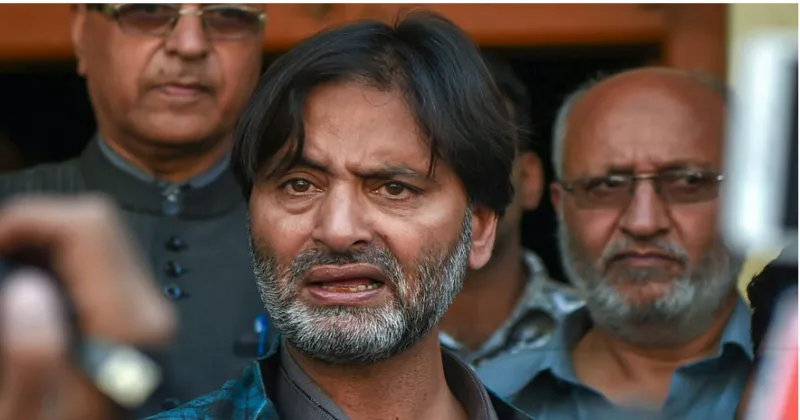
In the ongoing legal proceedings against Kashmiri separatist leader Yasin Malik, the National Investigation Agency (NIA) has informed the Delhi High Court that Malik maintained direct links with Pakistan’s highest political leadership and used these connections to propagate secessionist narratives in Jammu and Kashmir.
The submission, made through a detailed affidavit, comes as part of the agency’s plea seeking enhancement of Malik’s sentence to the death penalty in a terror funding case. Malik is currently serving a life sentence awarded by a trial court.
In its affidavit, the NIA has stated that Malik was in contact with senior figures in Pakistan, including the Prime Minister, President, senators, and chief ministers of various provinces. According to the agency, these links were not incidental but were actively used to advance an anti-India narrative and promote the idea of Kashmir’s separation.
The affidavit shows that these interactions formed part of a broader strategy to internationalise the Kashmir issue and legitimise separatist demands on foreign platforms.
“It is manifest that the accused was in contact with the top leadership of Pakistan… and was using such contacts to propagate narratives against India and further the secessionist agenda,” the agency submitted before the court.
Responding to Malik’s defence, where he claimed to have been engaged by multiple Indian governments, from that of V. P. Singh to Manmohan Singh, the NIA firmly rejected the argument as legally irrelevant.
Malik had argued that successive governments had interacted with him as part of efforts to resolve the Kashmir issue, implying a degree of legitimacy to his role. However, the agency countered that such claims do not dilute the seriousness of the charges against him.
According to the NIA, references to meetings with political leaders, bureaucrats, and foreign delegates are being used selectively to create a narrative that could influence public perception rather than contribute to the legal merits of the case.
The agency has gone a step further, characterising Malik’s assertions about his proximity to influential figures as a deliberate attempt to gain sympathy and public attention.
“It is only with a view of gaining popularity and drawing sympathy from the public,” the affidavit states, adding that such claims have no bearing on the charges for which Malik has been convicted.
The NIA emphasised that personal interactions or alleged access to high-level officials cannot override documented evidence related to terror funding and separatist activities.
Crucially, the NIA reiterated Malik’s alleged associations with known terrorist figures, including Hafiz Saeed and Syed Salahuddin.
The agency argued that such links form a critical part of the case and cannot be negated by citing meetings with political or administrative figures. It further pointed out that Malik himself has acknowledged being the Commander-in-Chief of the Jammu Kashmir Liberation Front (JKLF), reinforcing the seriousness of the allegations.
In his earlier submissions, Malik had claimed that his interactions extended beyond politicians to include senior intelligence officials. He alleged that he met Hafiz Saeed in 2006 at the request of an Intelligence Bureau official and also referred to interactions with former Prime Minister Atal Bihari Vajpayee’s government.
He further claimed that Ajit Doval, during his tenure in intelligence services, had visited him in jail and informed him about his release.
However, the NIA has dismissed these claims as unverifiable and irrelevant to the legal questions at hand. The agency maintained that such assertions fall within Malik’s personal knowledge and appear to be strategically introduced to influence public opinion.
The matter came up for hearing before a bench comprising Justices Navin Chawla and Ravinder Dudeja.
During the proceedings, Malik, who is representing himself, informed the court that he had not received a copy of the NIA’s rejoinder affidavit. Taking note of this, the bench adjourned the matter to July, when it will hear arguments on the NIA’s plea for enhancement of sentence.
The NIA was represented by Special Public Prosecutor Akshai Malik, along with advocate Khawar Saleem.
Malik was convicted in a terror funding case linked to separatist activities in Jammu and Kashmir and sentenced to life imprisonment by a trial court. The NIA has since moved the High Court seeking capital punishment, arguing that the gravity of the offences warrants the maximum penalty under law.
The current proceedings are part of that appeal process, with both sides presenting detailed arguments on the nature of Malik’s actions and their implications.
At the heart of the case lies a critical question, whether political engagement or dialogue with state actors can be used as a defence in serious criminal proceedings involving national security.
The NIA’s position is unequivocal: such interactions, even if proven, do not absolve an individual of responsibility for unlawful activities, particularly those involving terror funding and separatist agendas.
By framing Malik’s claims as a “sympathy-building exercise,” the agency has sought to draw a clear line between political narratives and legal accountability.
With the next hearing scheduled for July, the case continues to remain a crucial test of how courts evaluate claims of political legitimacy against the backdrop of serious criminal charges.