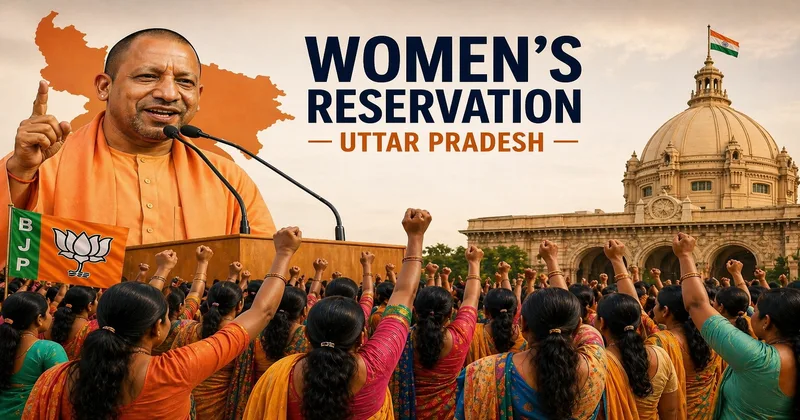
The political temperature in Uttar Pradesh has risen sharply after the Constitution Amendment Bill linked to the Women’s Reservation proposal failed to secure passage in the Lok Sabha. The Bharatiya Janata Party (BJP), which has been actively supporting greater participation of women in governance, is set to convene a special session of the Uttar Pradesh Legislative Assembly on April 30. The proposal shows that the government wants to take this issue beyond Parliament and bring it directly to the public. The special session is likely to see strong debates, with the BJP focusing on women’s representation and targeting the opposition’s stand.
The Women’s Reservation Bill, which aims to provide 33 per cent reservation for women in Parliament and state assemblies, has long been a subject of national debate. Its recent failure to pass in the Lok Sabha has led to sharp reactions, particularly from the BJP, which has accused opposition parties of blocking a historic reform. The BJP has directly targeted the Congress and the Samajwadi Party, saying their opposition stopped the bill from becoming law. BJP leaders also say this shows a lack of commitment to women’s empowerment.
What makes this coming session politically significant is the BJP’s decision to take the issue beyond legislative forums. Instead of limiting the debate to Parliament or the Assembly, the party is preparing for an extensive statewide outreach campaign which aims to directly engage the citizens.
The campaign will focus on spreading awareness about the benefits of women’s reservation and highlighting what the BJP calls the opposition’s “obstructionist politics.” It will also stress that the bill is an important step toward inclusive governance and will give women a stronger voice in decision-making. A structured plan has been drawn up to ensure outreach at every level i.e., from urban centres to rural belts. The campaign will include public meetings, awareness drives, and targeted interactions with key voter groups.
Central Role of BJP Mahila Morcha
A key part of the campaign will be the active role of the BJP’s women’s wing. The Mahila Morcha will lead efforts to connect with women voters. Special programmes will be held in colleges, universities, and coaching centres to reach young women and first-time voters so they can understand the importance of political participation.
At the grassroots level, the campaign will involve door-to-door outreach and local gatherings at the mandal and district levels. Women party workers will play a key role in these efforts, ensuring that the message reaches maximum households directly.
Opposition’s Counter-Argument
While the BJP is presenting the issue as one of women’s rights, opposition parties have a different view. Leaders from the Congress and Samajwadi Party have linked women’s reservation to delimitation, saying more clarity is needed before implementing it. However, the BJP has rejected these arguments and says it’s just an attempt to delay a long-pending reform.
Electoral Implications in Uttar Pradesh
The issue is very important in Uttar Pradesh, which is Bharat’s most populous state and a major political battleground. Women make up a large share of voters. In recent elections, such as the 2022 Assembly polls, women voters were nearly equal to men. Over the past decade, parties including the Bharatiya Janata Party have tried to attract women voters through welfare schemes, safety measures, and targeted policies. The Women’s Reservation issue adds another layer to this by linking political representation with empowerment. If communicated effectively, the BJP’s campaign could strengthen its support among women voters. At the same time, it puts pressure on opposition parties to clearly explain their stand and respond to the narrative.
The special session of the Uttar Pradesh Assembly on April 30, 2026, is expected to play an important role in shaping the political narrative. While it may not directly affect the national law, it will give the BJP a platform to present its stand and challenge the opposition. The coming weeks will be crucial in determining how effectively the campaign resonates with voters. Much will depend on the BJP’s ability to communicate its message clearly and the opposition’s capacity to present a compelling counter-narrative.