How India effectively combatted red terrorism
June 23, 2026
  • Read Ecopy
  • Circulation
  • Advertise
  • Careers
  • About Us
  • Contact Us
Android AppiPhone AppArattai
Organiser
  • ‌
  • Bharat
    • Assam
    • Bihar
    • Chhattisgarh
    • Jharkhand
    • Maharashtra
    • View All States
  • World
    • Asia
    • Europe
    • North America
    • South America
    • Africa
    • Australia
  • Editorial
  • International
  • Opinion
  • RSS @ 100
  • More
    • Op Sindoor
    • Analysis
    • Sports
    • Defence
    • Politics
    • Business
    • Economy
    • Culture
    • Special Report
    • Sci & Tech
    • Entertainment
    • G20
    • Azadi Ka Amrit Mahotsav
    • Vocal4Local
    • Web Stories
    • Education
    • Employment
    • Books
    • Interviews
    • Travel
    • Law
    • Health
    • Obituary
  • Subscribe
    • Subscribe Print Edition
    • Subscribe Ecopy
    • Read Ecopy
  • ‌
  • Bharat
    • Assam
    • Bihar
    • Chhattisgarh
    • Jharkhand
    • Maharashtra
    • View All States
  • World
    • Asia
    • Europe
    • North America
    • South America
    • Africa
    • Australia
  • Editorial
  • International
  • Opinion
  • RSS @ 100
  • More
    • Op Sindoor
    • Analysis
    • Sports
    • Defence
    • Politics
    • Business
    • Economy
    • Culture
    • Special Report
    • Sci & Tech
    • Entertainment
    • G20
    • Azadi Ka Amrit Mahotsav
    • Vocal4Local
    • Web Stories
    • Education
    • Employment
    • Books
    • Interviews
    • Travel
    • Law
    • Health
    • Obituary
  • Subscribe
    • Subscribe Print Edition
    • Subscribe Ecopy
    • Read Ecopy
Organiser
  • Home
  • Bharat
  • World
  • Operation Sindoor
  • Editorial
  • Analysis
  • Opinion
  • Culture
  • Defence
  • International Edition
  • RSS @ 100
  • Magazine
  • Read Ecopy
Home Bharat

From Insurgency to Elimination: India’s strategy against Maoist violence

By 2026, red terrorism, which was once a widespread and deeply entrenched movement has been reduced to near insignificance, marking a major milestone in India’s internal security landscape

Abhay Pratap SinghAbhay Pratap Singh
Apr 22, 2026, 07:30 am IST
in Bharat, Opinion
Follow on Google News
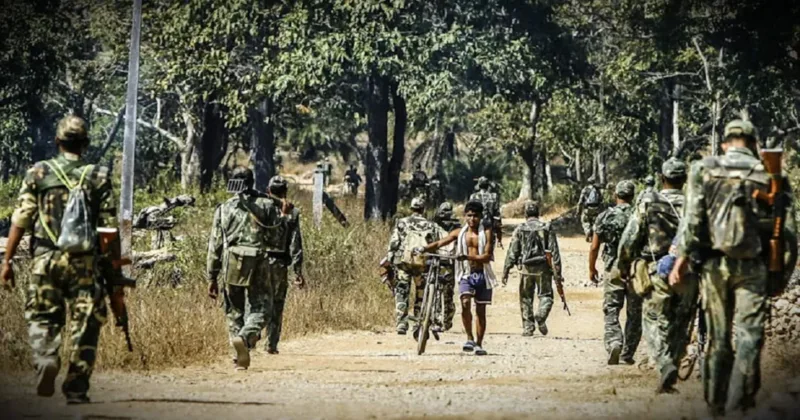
Representative Image

Representative Image

FacebookTwitterWhatsAppTelegramEmail

For decades, Maoism popularly known as Naxalism stood as India’s most enduring internal security challenge. At its peak in the late 2000s, the so-called ‘Red Corridor’ stretched across nearly 180 districts across India, posing a serious threat to governance, development, Security of Citizens and State Authority.When Maoist leaders gave slogans of From Tirupathi to Pashupati (Nepal) indicating the extension of insurgent areas.

The phase saw Killing thousands of innocent civilians and security personnel, making Communist Party of India (Maoist) as one of the World’s deadliest terrorist organisations. But by today, in 2026, that landscape has dramatically changed. What was once a widespread insurgency has been totally eradicated from head to toe.

This transformation did not happen overnight. But by sheer Political Will, commitment to nation and efforts of Security forces.

India’s success against Naxalism lies in a carefully calibrated strategy, one that combined security operations with development, rehabilitation and political coordination. In short, it was not just a war fought with guns, but one fought through governance.

The early phase of the response was security-heavy. Operations included the deployment of specialized forces like CoBRA, Greyhounds and District Reserve Guards pushed Maoist cadres out of their strongholds. Over time, however, the strategy evolved.

Intelligence-based operations replaced broad offensives. Top Maoist Leadership was systematically targeted, breaking the insurgency’s command structure and morale.

Read More: Pahalgam terror attack anniversary: India fortifies national security grid against cross-border terrorism of Pakistan

A central pillar of the Narendra Modi Government’s counter insurgency strategy has been the calibrated application of leadership decapitation, defined as the systematic targeting of an insurgent organization’s top and mid level leadership through intelligence led operations, arrests and incentivized surrenders. Over time, this approach evolved into a precision centric doctrine, wherein security agencies prioritized high value individuals who constituted the ideological, strategic and operational core of the Communist Party of India (Maoist), rather than relying on broad based force deployment alone.

But what truly changed the trajectory was what followed force.
Thousands of cadres began surrendering not just out of fear, but because the Government offered them a viable alternative. Reiterating Prime Minister’s commitment of maximum Governance.

Rehabilitation policies, particularly in states like Chhattisgarh and Maharashtra provided financial support, livelihood opportunities and social reintegration of the surrendered cadres majority of whom were tribals.

Programmes such as Puna Margem in Chhatisgarh showed that the state was not only willing to punish but also to reintegrate the ones who were ready to abandon violence and accept constitution.

Simultaneously, development reached areas that had long been neglected. Roads, mobile towers, schools and healthcare facilities began appearing in remote tribal regions. Welfare schemes from housing to healthcare started reaching the last mile. Initiatives like the Bastar Olympics even redefined engagement, bringing youth into mainstream social participation and breaking cycles of alienation.
At the heart of this transformation was cooperative federalism. While law and order is a state subject, the central government led by Prime Minister Narendra Modi provided strategy, Leadership, funding and forces. While states implemented operations and built local trust. This coordination ensured that security gains were not temporary but consolidated through governance.

The final phase what officials have called Operation Kagar targeted the last remaining strongholds, particularly in Abujhmad. By combining sustained security pressure with administrative outreach, the state effectively dismantled the insurgency’s remaining backbone by neutralising senior cadres.
The results are telling. Violence has declined by nearly 95 per cent since its peak in 2010. The number of affected districts has shrunk drastically. By 31st March 2026, the government set a milestone: the effective end of Naxalism as a major internal security threat.

Of course, challenges remain both on ground and ideologically but Maoist Insurgency may no longer dominate headlines in India.

Yet, the broader lesson is clear.

A comparative perspective across Asia further highlights the distinctiveness of India’s approach. In countries such as the Philippines, where the state has long confronted the New People’s Army (NPA) and in parts of Southeast Asia where insurgencies persist in protracted cycles, counter insurgency strategies have often remained heavily security-centric, with limited integration of governance and rehabilitation frameworks. Similarly, Nepal’s Maoist insurgency was resolved primarily through a political settlement rather than a sustained hybrid model combining force and development. In contrast, India’s experience demonstrates a more calibrated and layered approach, where coercive operations were systematically complemented by welfare delivery, institutional expansion and reintegration policies within a federal framework. This combination not only weakened the operational capacity of insurgent groups but also eroded their social base, offering a model that moves beyond conventional binaries of military suppression versus political accommodation.

India’s experience shows that insurgencies are not defeated by force alone. They are resolved when the state combines strength with legitimacy, enforcement with inclusion and strategy with sensitivity.
As countries around the world grapple with internal conflicts, India’s approach offers a valuable model and a Case Study: not just how to fight insurgency but how to end it.


 

Topics: CobraOperation KagarMaoistsRed Terrorism
Abhay Pratap Singh
Abhay Pratap Singh
PhD Research Scholar, Department of Political Science Banaras Hindu University, Varanasi, India [Read more]
ShareTweetSendShareSend
✮ Subscribe Organiser YouTube Channel. ✮
✮ Join Organiser's WhatsApp channel for Nationalist views beyond the news. ✮
Previous News

Pahalgam Terror Attack Anniversary: From tragedy to tough action

Next News

Ramanujacharya Jayanti: Apostle of equality who challenged the caste barriers

Related News

(Left) Maoist Arms seized (Right) Security personnel with the seized arms of Maoists

Odisha: Major Maoist arms cache recovered in Koraput, sixth such seizure within two weeks

Shri J. Shri Nandakumar,
Dr Rahul Shastri, Shri SM Rama Mohan (Left to Right)

Cultural Marxism, Maoist networks, narco menace pose emerging threats: Speakers at Samvit Kendra seminar in Hyderabad

Security forces undertake anti-Maoist campaign in Odisha in Kandhamal and Malkangiri and seize huge cache of arms

Odisha: Security forces recover caches of weapons of Maoists in Kandhamal and Malkangiri in last three days

Maoist looted weapons under scanner as Odisha Police launch crackdown

Odisha Police launch nationwide hunt to recover Maoist-looted weapons amassed over last three decades

Representative Image

FCRA: Why foreign funding is a catalyst for Maoism and religious conversion!

Armed Soldiers in the jungle during ant-Maoist operation

Jharkhand: 4 Maoists including Sahdeo Mahto carrying bounty of Rs 15 lakh killed by security forces in Singhbhum

Load More

Latest News

Female recruitment in Jihadist networks emerges as major security concern

Khadija Terror Case: Female recruitment, online radicalisation in Jihadi networks poses major security concern

Outcry grows after Dalits in Theeyathur village carry deceased woman across paddy fields due to lack of burial access

Tamil Nadu: Dalits forced to carry deceased woman through paddy fields as Pudukkottai village lacks road access

ASI transfers Rakhigarhi skeletal remains to Anthropological Survey of India for detailed examination

Rakhigarhi’s ancient secrets to be unveiled as human skeletal remains reach AnSI for advanced scientific analysis

Dr Syama Prasad Mookerjee: A Life That Still Guides Bharat’s National Resolve

(Left) Maoist Arms seized (Right) Security personnel with the seized arms of Maoists

Odisha: Major Maoist arms cache recovered in Koraput, sixth such seizure within two weeks

Delhi Chief Minister Rekha Gupta paid tribute to Bharatiya Jana Sangh founder Syama Prasad Mookerjee on his death anniversary

Article 370 abrogation was the greatest tribute to Syama Prasad Mookerjee: Delhi CM Rekha Gupta

Prime Minister Narendra Modi

Viksit Bharat: PM Modi slams Congress — ‘Blocks development, claims credit’

(Left) Petrol bomb hurled at BJP leader’s clinic opposite newly inaugurated RSS office in Bhatinda (Right) BJP leader Dr Tarsem Garg

Punjab: Petrol bomb hurled at BJP leader’s clinic opposite newly inaugurated RSS office in Bhatinda

Functionaries of Akhil Bharatiya Rashtriya Seva Bharati on the stage release Rashtriya Seva Sadhana–2026

Tamil Nadu: Seva Bharati reviews service initiatives, charts roadmap for future expansion

PM Modi Pays Homage to Jan Sangh Founder Syama Prasad Mookerjee

Balidan Diwas: PM Modi pays tribute to Jan Sangh founder Syama Prasad Mookerjee, hails his nationalist legacy

Load More
  • Privacy
  • Terms
  • Cookie Policy
  • Refund and Cancellation
  • Delivery and Shipping

© Bharat Prakashan (Delhi) Limited.
Tech-enabled by Ananthapuri Technologies

  • Home
  • Search Organiser
  • Bharat
    • Assam
    • Bihar
    • Chhattisgarh
    • Jharkhand
    • Maharashtra
    • View All States
  • World
    • Asia
    • Africa
    • North America
    • South America
    • Europe
    • Australia
  • Editorial
  • Operation Sindoor
  • Opinion
  • Analysis
  • Defence
  • Culture
  • Sports
  • Business
  • RSS @ 100
  • Entertainment
  • More ..
    • Sci & Tech
    • Vocal4Local
    • Special Report
    • Education
    • Employment
    • Books
    • Interviews
    • Travel
    • Health
    • Politics
    • Law
    • Economy
    • Obituary
  • Subscribe Magazine
  • Read Ecopy
  • Advertise
  • Circulation
  • Careers
  • About Us
  • Contact Us
  • Policies & Terms
    • Privacy Policy
    • Cookie Policy
    • Refund and Cancellation
    • Terms of Use

© Bharat Prakashan (Delhi) Limited.
Tech-enabled by Ananthapuri Technologies