It is wrong for any religion to claim that it is the only true religion: Decoding Allahabad HC Ruling
July 21, 2026
  • Read Ecopy
  • Circulation
  • Advertise
  • Careers
  • About Us
  • Contact Us
Android AppiPhone AppArattai
Organiser
  • ‌
  • Bharat
    • Assam
    • Bihar
    • Chhattisgarh
    • Jharkhand
    • Maharashtra
    • View All States
  • World
    • Asia
    • Europe
    • North America
    • South America
    • Africa
    • Australia
  • Editorial
  • International
  • Opinion
  • RSS @ 100
  • More
    • Op Sindoor
    • Analysis
    • Sports
    • Defence
    • Politics
    • Business
    • Economy
    • Culture
    • Special Report
    • Sci & Tech
    • Entertainment
    • G20
    • Azadi Ka Amrit Mahotsav
    • Vocal4Local
    • Web Stories
    • Education
    • Employment
    • Books
    • Interviews
    • Travel
    • Law
    • Health
    • Obituary
  • Subscribe
    • Subscribe Print Edition
    • Subscribe Ecopy
    • Read Ecopy
  • ‌
  • Bharat
    • Assam
    • Bihar
    • Chhattisgarh
    • Jharkhand
    • Maharashtra
    • View All States
  • World
    • Asia
    • Europe
    • North America
    • South America
    • Africa
    • Australia
  • Editorial
  • International
  • Opinion
  • RSS @ 100
  • More
    • Op Sindoor
    • Analysis
    • Sports
    • Defence
    • Politics
    • Business
    • Economy
    • Culture
    • Special Report
    • Sci & Tech
    • Entertainment
    • G20
    • Azadi Ka Amrit Mahotsav
    • Vocal4Local
    • Web Stories
    • Education
    • Employment
    • Books
    • Interviews
    • Travel
    • Law
    • Health
    • Obituary
  • Subscribe
    • Subscribe Print Edition
    • Subscribe Ecopy
    • Read Ecopy
Organiser
  • Home
  • Bharat
  • World
  • Operation Sindoor
  • Editorial
  • Analysis
  • Opinion
  • Culture
  • Defence
  • International Edition
  • RSS @ 100
  • Magazine
  • Read Ecopy
Home Bharat

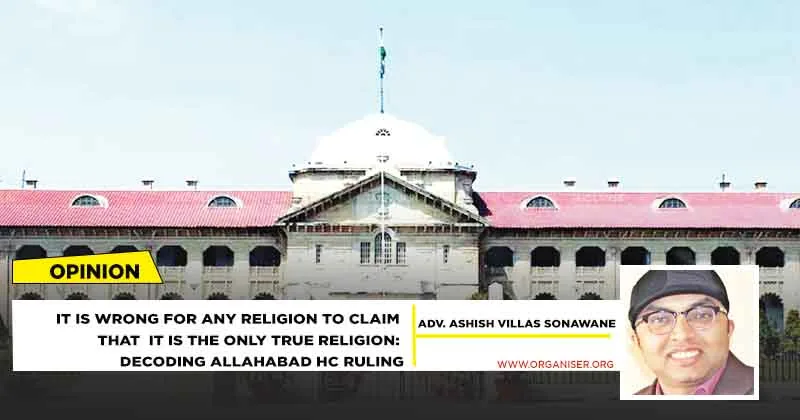
It is wrong for any religion to claim that it is the only true religion: Decoding Allahabad HC Ruling

Religion supremacist approach in the name of propagation & preaching is anti-Constitution. Allahabad High Court setting the record straight will ensure that promoting one's own faith does not mean denigration of other faiths

Adv Ashish Villas SonawaneAdv Ashish Villas Sonawane
Apr 21, 2026, 08:30 pm IST
in Bharat, Opinion
Follow on Google News
Allahabad High Court set the record straight in its March 18 order

Allahabad High Court set the record straight in its March 18 order

FacebookTwitterWhatsAppTelegramEmail

The recent order of the Allahabad High Court regarding a quashing petition brings into focus an issue that resides much deeper than the mechanics of Criminal Law, FIR, or the prima facie threshold. The immediate legal catalyst was the Court’s observation that when an individual publicly asserts that their religion alone represents the absolute truth, such a statement may carry an inherent, implied disparagement of other faiths. At least at the threshold stage, the Court found that Section 295-A could not be dismissed as wholly inapplicable, and it was therefore unwilling to terminate proceedings simply by accepting the defence’s version of events.

This reasoning is rooted in a pragmatic understanding of religious discourse within a pluralistic society. If one faith is publicly proclaimed as the sole path to truth, the assertion does not remain a private conviction; it communicates, by necessary implication, that all other faiths are inherently false. It is at this precise juncture that theology enters the realm of public consequence.

Such an observation warrants scrutiny not merely for its legal ramifications, but because it exposes a fundamental friction within the ideal of secular coexistence.

A person may hold, with complete sincerity, the inward belief that their faith is the solitary truth. Many religious traditions are not built upon a foundation of loose cultural preference; they are constructed upon absolute claims of revelation, salvation, and divine duty. In these traditions, proclamation is not incidental to the faith—it is a core requirement. Consequently, belief and proselytisation become organically linked, where that which is held to be true must also be shared, defended, and disseminated.

Under these conditions, the challenge for a secular society extends beyond policing harsh language or careless phrasing; it lies in the structural tension between an exclusivist theology and a pluralistic public order.

For this reason, the friction cannot be mitigated by simply advocating for more polite speech. While civility is a functional necessity, as public order cannot survive if every community characterises the “other” in terms of spiritual worthlessness, mere politeness does not resolve the underlying contradiction. If one believes that their path is the only truth and others are fundamentally in error, outward restraint might prevent immediate friction, but it does not cultivate a lasting peace. It achieves management rather than harmony, resulting in a state of suspended conflict rather than genuine social integration.

The dilemma sharpens when one questions the authenticity of this outward restraint. If a person truly believes in the exclusivity of their faith but publicly declares all religions to be equally valid merely to avoid legal or social censure, the result is an artificial performance. This is not coexistence born of conviction, but a coexistence performed for safety. Such a compromise may be socially convenient, but it fails to produce durable trust because it is not anchored in actual belief. A peace that rests solely on verbal diplomacy remains inherently fragile, surviving only as long as the incentive for restraint outweighs the impulse for proclamation.

Simultaneously, the opposite extreme remains incomplete. Fidelity to one’s faith does not necessitate the denigration of another’s. There is a vital distinction between confessing one’s own belief and condemning the convictions of others. One may honestly testify to their own faith and live by its tenets without converting that belief into a public assertion that other paths are false in a manner intended to wound or diminish the equal dignity of fellow citizens. The stability of a plural republic depends upon the preservation of this distinction, and while the law can enforce such discipline by restraining the outward form of speech, it cannot, of its own accord, bridge the deeper chasm where theology remains structurally exclusivist and the social order expects genuine reciprocity.

The High Court’s order serves as a critical point of reflection. While the legal issue was narrow—focused on whether allegations, taken at face value, could *prima facie* attract Section 295-A—the reasoning invites a broader civilisational inquiry: can secularism ever rest securely on restraint alone if the inward structure of religious belief continues to deny the validity of the “other”?

A sustainable resolution may lie in acknowledging that constitutional secularism and deep social peace are distinct achievements. The former can regulate conduct, protect freedom of conscience, and penalise speech that crosses into deliberate provocation. However, the latter requires more than legal discipline; it demands a genuine internal accommodation of plurality. Unless there is an honest acceptance that the human search for ultimate truth may manifest through diverse paths, secular coexistence will remain defensive—reliant on institutions and caution rather than a settled culture of mutual recognition. In this sense, the contradiction cannot be indefinitely concealed.

Where theology demands exclusivity and treats proclamation as a religious mandate, secularism remains vulnerable to recurring friction unless there is a corresponding moral commitment to view other paths with more than just tactical tolerance. A society may remain orderly and lawful under such conditions, but it will struggle to become inwardly peaceful. Civility will continue to feel like an external imposition rather than an internal virtue. The fundamental challenge is not whether a single sermon attracts a penal provision, but whether a plural society can be sustained by careful speech while inward belief remains locked in the permanent negation of the other. For coexistence to become secure, it must evolve beyond the tactical necessity of speaking carefully and become a matter of believing, in a profound sense, that the existence of other paths does not threaten one’s own truth. Until that deeper reconciliation is sought, secularism will continue to be defended as a legal arrangement rather than lived as a shared ethic.


Topics: Allahabad High CourtSection 295-Areligious traditionsfundamental challengeprima facieReligions to be equallyAllahabad HC Ruling
ShareTweetSendShareSend
✮ Subscribe Organiser YouTube Channel. ✮
✮ Join Organiser's WhatsApp channel for Nationalist views beyond the news. ✮
Previous News

What is a Sainik School, role of defence Ministry and why does Adani army narrative does not hold any water

Next News

Pahalgam terror attack anniversary: India fortifies national security grid against cross-border terrorism of Pakistan

Related News

A representative image

Allahabad High Court refuses to quash FIR in ‘Nikah Halala’ gangrape case, says personal law cannot shield crime

Senior Advocate Harishankar Jain claims he has documentary evidence that the Taj Mahal was originally the Hindu Mandir "Tejo Mahalaya"

Taj Mahal Was Originally ‘Tejo Mahalaya’: Adv Harishankar Jain says he has documentary evidence to back his claim

Allahabad High Court opens the door to the Tejo Mahalaya inquiry; First step in reclaiming civilisational glory

Allahabad HC seeks response from centre, ASI over plea claiming Mandir presence inside Taj Mahal

ATS investigation into foreign funding of 4,000 Uttar Pradesh madrasas set to accelerate after HC order

Allahabad High Court clears way for ATS probe into foreign funding of 4,000 Uttar Pradesh madrasas

No bail for Taukeer Raja in the Bareilly violence case, said Allahabad High Court (Photo: Hindu Post)

“Sar Tan Se Juda slogans challenge India’s sovereignty”: Allahabad HC denies bail to Bareilly riot accused Tauqeer Raja

Load More

Latest News

Punjab Pharma Officer Exam Cheating Racket Exposed: 35 detained, candidates allegedly paid up to Rs 13 lakh

(Left) Congress leader Mohammed Nalapad (Right) Karnataka Minister Priyank Kharge

RSS Defamation Case in Karnataka: Court orders personal appearance Of Priyank Kharge, Mohammed Nalapad

BMS hosts 15th BRICS Trade Union Forum (TUF) Summit 2026 in Hyderabad; Calls for worker-centric global order

BRICS TUF Summit 2026: Shifting the labour discourse

Courtesy: T.C. Rajesh’s FB post

Keralam: CPM’s Deshabhimani daily drops ‘Vijayan, the thief’ article from Sunday supplement; text Surfaces on FB

Self-immolation by Lobsang Palden in front of UN Headquarters in New York, (inset) the activist shortly before immolating himself

China and Tibet: Immolation of ‘Imposed Unity’

Authorities attacked during anti-encroachment drive in Shivajinagar

Anti-Encrochment Drive in Karnataka: Officials attacked in Shivajinagar; BJP slams govt’s appeasement politics

The Shadow of politics & radical ideologies behind NEET protests

AgriBio 2.0 aims to build a self-reliant, climate-resilient agricultural future through biotechnology

NITI Aayog’s AgriBio 2.0: How biotechnology and climate-resilient crops will transform Indian agriculture

(L) Jalaudheen Ustad with Dr. Arif Hussein Theruvath (R)

Keralam: Islamic scholar inaugurates Ex-Muslim event anonymously over security fears

Delhi's CJP protest allegedly shifted from student issues to political confrontation, overshadowing educational concerns

Delhi’s CJP Protest: How opposition collectives hijacked the movement and compromised students’ interests

Load More
  • Privacy
  • Terms
  • Cookie Policy
  • Refund and Cancellation
  • Delivery and Shipping

© Bharat Prakashan (Delhi) Limited.
Tech-enabled by Ananthapuri Technologies

  • Home
  • Search Organiser
  • Bharat
    • Assam
    • Bihar
    • Chhattisgarh
    • Jharkhand
    • Maharashtra
    • View All States
  • World
    • Asia
    • Africa
    • North America
    • South America
    • Europe
    • Australia
  • Editorial
  • Operation Sindoor
  • Opinion
  • Analysis
  • Defence
  • Culture
  • Sports
  • Business
  • RSS @ 100
  • Entertainment
  • More ..
    • Sci & Tech
    • Vocal4Local
    • Special Report
    • Education
    • Employment
    • Books
    • Interviews
    • Travel
    • Health
    • Politics
    • Law
    • Economy
    • Obituary
  • Subscribe Magazine
  • Read Ecopy
  • Advertise
  • Circulation
  • Careers
  • About Us
  • Contact Us
  • Policies & Terms
    • Privacy Policy
    • Cookie Policy
    • Refund and Cancellation
    • Terms of Use

© Bharat Prakashan (Delhi) Limited.
Tech-enabled by Ananthapuri Technologies