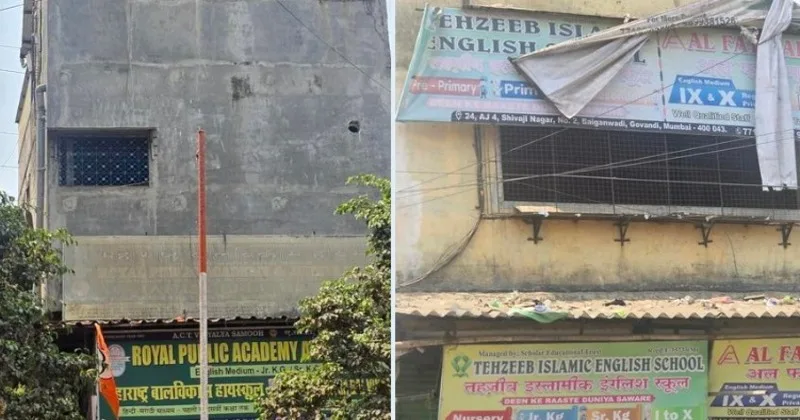
The controversy surrounding the alleged ‘School Jihad’ in Mumbai has added a new dimension to the ongoing political and social discourse. Citing a list compiled by the Brihanmumbai Municipal Corporation (BMC), Bharatiya Janata Party (BJP) leader Kirit Somaiya has claimed that 164 illegal schools are currently operating within the city. Of these, approximately 150 schools are allegedly being run by a Muslim ‘land mafia.’ These schools are operating without official recognition or permits; furthermore, the motive behind them is alleged to be a dual agenda involving both land encroachment and the propagation of a specific ideology.
Somaiya presented these figures to the media, noting that while Mumbai has previously witnessed discussions surrounding issues such as ‘Land Jihad,’ ‘Corporate Jihad,’ ‘Love Jihad,’ and ‘Coaching Jihad,’ a new issue dubbed ‘School Jihad’ has now come to the fore. Evidence gathered in this regard suggests that these activities have been ongoing for the past 15 to 20 years, involving numerous schools located in areas such as Govandi, Malad, and Kurla. The modus operandi typically involves first encroaching upon a plot of land, and subsequently cementing that illegal occupation by constructing a school or other structures on the site.
आता मुंबईत स्कूल जिहाद
मुंबई महानगरपालिकेने (BMC) १६४ अनधिकृत शाळांची यादी प्रसिद्ध केली आहे, यापैकी १५२ शाळा गोवंडी, मालवणी, कुर्ला यांसारख्या मुस्लिम/बांग्लादेशी भागांतील आहेत…. या शाळा भूमाफियांच्या नियंत्रणाखाली आहेत. सरकारी जमिनीवर अवैध बांधकाम आहे pic.twitter.com/DYcdrx0ly5
— Kirit Somaiya (@KiritSomaiya) April 19, 2026
The Alleged Strategy of Land Encroachment
Kirit Somaiya views this entire process as part of a meticulously planned strategy. He alleges that the land mafia first illegally encroaches upon a plot of land and then gradually initiates construction work under the guise of establishing educational institutions. This tactic serves a dual purpose: on one hand, it lends an appearance of legitimacy to the illegal occupation, and on the other, it renders administrative enforcement and action significantly more difficult. He further alleged that, in several instances, mosques have been constructed either within the premises of these schools or in their immediate vicinity.
In the context of this entire affair, Somaiya also raised serious questions regarding the functioning and efficacy of the Municipal Corporation. According to him, the proliferation of such illicit activities over the past two decades is a direct consequence of corruption and negligence within the municipal administration. He argued that had timely action been taken, such a large number of illegal schools would never have been allowed to come into existence. However, he also noted that, following his complaints, the concerned departments have now taken cognizance of the matter, and action is expected to commence shortly.
The Issue Linked to Illegal Migration
Somaiya also linked this entire episode to the issue of illegal migration. He alleges that these schools are being utilized to settle illegal Bangladeshi nationals within Mumbai. He stated that, in this regard, he has held several meetings with officials from the State Home Department and the Municipal Corporation. According to him, he has received assurances that strict action will be taken against these illegal institutions, and the process is expected to begin soon.
The Core Concept of the Term ‘Jihad’
Amidst this controversy, discussions regarding the interpretation of the term ‘Jihad’ have also intensified. According to Islamic scholars, the term ‘Jihad’ fundamentally signifies struggle or exertion an internal process linked to self-improvement and the battle against one’s own vices. It is broadly categorized into ‘Jihad-al-Akbar’ (the Greater Jihad, representing the internal struggle) and ‘Jihad-al-Asghar’ (the Lesser Jihad, representing the external struggle). Most scholars regard the internal struggle as the more significant aspect and dismiss any association of the term with violence as a misinterpretation. Conversely, some authors and researchers have presented a different interpretation of Jihad based on historical contexts.
This Interpretation of Jihad Also Appears in Numerous Texts
According to these authors, throughout history, the concept of Jihad has been invoked not merely in a spiritual context, but also as a means of political and military expansion. They argue that, within Islam, Jihad serves as a mechanism for the faith’s expansion prescribing various methods, including violence, to ensure the establishment of Islamic authority by any means necessary. Consequently, they contend, Jihadists across the globe are perpetrating acts of violence against non-Muslims. Andrew G. Bostom writes in his book, ‘The Legacy of Jihad: Islamic Holy War and the Fate of Non-Muslims’ (Prometheus Books, 2005, pp. 23–25): “The history of jihad has not been limited merely to spiritual struggle; rather, it has also been an integral part of an organized process of political and military expansion, wherein taxes and social pressures were imposed upon non-Muslim communities.”
Robert Spencer states in his book, ‘The Politically Incorrect Guide to Islam (and the Crusades)’ (Regnery Publishing, 2005, pp. 47–50): “The early expansion of Islam was achieved largely through military campaigns, and jihad served as an ideological instrument of that expansion, through which control over new territories was established.” M. A. Khan shares this view, writing in his book, ‘Islamic Jihad: A Legacy of Forced Conversion, Imperialism, and Slavery’ (iUniverse, 2009, pp. 102–110): “At various stages throughout history, jihad has been employed to secure political dominance and social control; a process in which, following military conflicts, captives were taken and subjected to pressure to convert to the faith.”
Bat Ye’or, in her book ‘The Dhimmi: Jews and Christians Under Islam’ (Fairleigh Dickinson University Press, 1985, pp. 56–60), writes regarding Jihad as follows: “Under the Dhimmi system, non-Muslim communities were treated as second-class citizens; consequently, due to social and economic pressures, many individuals embraced Islam.”
Analysis in the Indian Context
In the Indian context as well, reference is made to certain historical studies. Sita Ram Goel’s book, ‘Hindu Temples: What Happened to Them’ (Voice of India, 1990, pp. 12–18), asserts that temple destruction in medieval India was not merely a political act; rather, it was also driven by religious (specifically, intensely religious) objectives. K.S. Lal elaborates on this point in his book, ‘The Muslim Slave System in Medieval India’ (Aditya Prakashan, pp. 78–85), stating: “During the wars of medieval India, vast numbers of people were taken captive; subsequently enslaved, they were either induced or coerced into converting to Islam.”
Michael Bonner, in his book ‘Jihad in Islamic History: Doctrines and Practice’ (Princeton University Press, 2006, pp. 34–40), writes: “In the early Islamic period, Jihad was perceived not merely as a religious duty, but as an organized social and political process.” A similar observation appears in Majid Khadduri’s book, ‘War and Peace in the Law of Islam’ (Johns Hopkins University Press, 1955, pp. 60–65): “In Islamic law, Jihad was defined as a legitimate instrument through which the expansion of the Islamic state was deemed possible.”
References in Historical Texts
References to this subject are also found within historical texts. ‘Futuh al-Buldan’ (by Ahmad ibn Yahya al-Baladhuri) chronicles the early Islamic conquests, whereas Ziauddin Barani’s ‘Tarikh-i-Firoz Shahi’ provides details regarding the rule and policies of the Delhi Sultanate. Indeed, amidst these historical, ideological, and political contexts, the allegations of a ‘School Jihad’ that have surfaced in Mumbai have sparked a new debate. A new crisis now confronts everyone. These schools are allegedly being utilized to settle illegal Bangladeshi immigrants in Mumbai. The wait is now for concrete action to be taken in this regard.