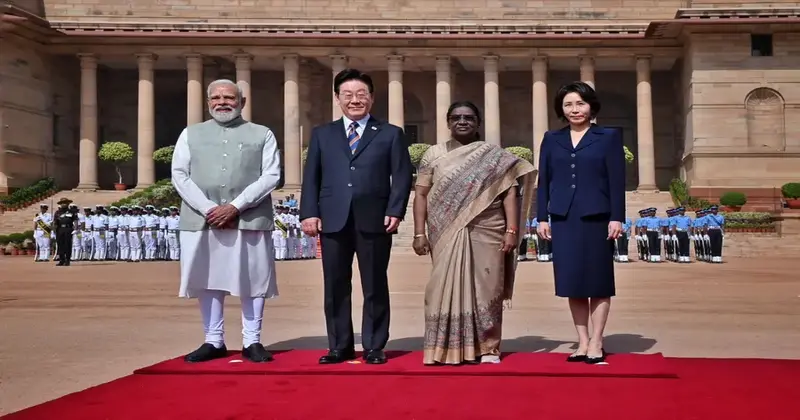
In a pivotal step to strengthen the comprehensive strategic partnership between New Delhi and Seoul, the President of South Korea Lee Jae-myung makes a historic visit to India. The strategic importance of the diplomatic visit is multi-faceted in the backdrop of spiking faultlines and unpredictable trajectory of the geopolitical latitude. The two strong and emerging Asian economies thus intend to strengthen partnership to consolidate the collective security architecture across the Indo-Pacific which is increasingly evolving as a contentious maritime zone to escalate hegemonic footprints.
The visit also aims to bolster the partnership in the critical and emerging technology domain and propel momentum for the trade ties to de-risk supply chains which is hitherto entangled amidst a risky and unpredictable geopolitical landscape and geo-economic conundrums. The key strategic message underlying the visit of the South Korean President to India entails that the solid and emerging economies of Asia and the Global South act as resilient partners amidst the fractured strategic mosaic of the globe, where nations are stuck in great power competition, triggering global ramifications.
Also, a President of South Korea is visiting India after a span of 8 years. This illustrates the emerging strategic propositions in the Indo-Pacific region and the weightage rendered to the ties with New Delhi amidst all the geopolitical upheavals. The three-day visit of the South Korean President to India aims to script massive gains in the diplomatic playbook of Seoul and New Delhi in terms of trade, technology, defence relations and larger security credentials worth billions of dollars. Thus, the visit is not just analysed as a routine diplomatic visit, but a high-octane revamp in the India-South Korea relations to strengthen the speed and scope of the bilateral benefit and enhance the depth of regional stability, security and prosperity.
Redefining strategic priorities amidst geopolitical despair
For almost 8 years the strategic partnership between New Delhi and Seoul was at a stalemate. It doesn’t mean both countries had a diplomatic blockade or other bilateral animosity. The relations were just overshadowed by other priorities pertaining to domestic and geopolitical reasons. The Special Strategic Relations sealed between both the countries largely remained as a theoretical concept for a decade and didn’t get any pivotal attention. Trade continuously flowed between countries and diplomatic ties were consistent and stable, with no serious fissures.
However, there was no high-profile political momentum to redefine and propel the relations to greater heights. India-South Korea relations were overshadowed by other immediate strategic compulsions. For example, Seoul was largely pre-occupied with the North Korea factor. It was also extremely aligned with the United States and the strategic terms of Seoul was dictated by Washington DC. South Korea was also continuously occupied in dealing with the assertive nature of China in the Indo-Pacific.
Internally, Seoul was witnessing political disintegration, change of leadership etc. thus diplomatic continuity with India was challenging. India as well was stuck in similar geopolitical risks. It was dealing with China in the Himalayan frontier and cross-border terrorism emanated from Pakistan is a persistent threat. New Delhi was also entangled in other recent bottlenecks such as the tariff tussle unleashed by the Trump administration, prioritising the needs of Global South etc. New Delhi and Seoul always respected the importance asserted to the bilateral relations and insisted on escalating the ties, however, it was not an urgent strategic priority.
However, the geopolitical realities of the current era, resurfaced the strategic importance of New Delhi and Seoul to the forefront. Both India and South Korea quest for a trustworthy, credible and resilient Asian partner to navigate the geopolitical challenges. Amidst, the transactional and unpredictable policies of the Trump administration, West Asia crisis coupled with supply chain risks, spiking contentions in the Indo-Pacific as a spill-over effect of the West Asia conflict and shifting geopolitical alliances, New Delhi and Seoul deem each other as solid partners. India-South Korea can articulate responsible statecraft to accelerate economic leverage, national priorities and larger regional stability and collective security.
South Korea also considers India as an epicentre to fulfill its latest foreign policy priorities. The stable government in New Delhi, strong leadership, vast market opportunities, emerging industries and indigenous production capabilities, huge skilled man power, rapid digitisation in India and the consistent importance asserted by India to the priorities of Global South, makes it an attractive destination for South Korea. It helps Seoul to have a stable alternate partner and reduce over dependence on the United States. It also helps to catalyse a shield against China in terms of seeking economic self-reliance and espousing security networks. Thus, the visit of President Lee is not just symbolic, but deeply strategic.
High-profile business delegation lands in New Delhi
The President of South Korea Lee Jae-myung is accompanied by a high-profile and larger business delegation. Nearly 200 executives from the world’s top companies have landed in Delhi to boost business partnership. This includes the heads of Samsung, Hyundai, LG, SK Group etc. By strengthening business-to-business relations, New Delhi and Seoul aims to accelerate investment, co-production, employment opportunities and larger economic security, thus de-risk the emerging economies from the unprecedented geopolitical volatilities.
USD 50 billion bilateral trade target by 2030
India and South Korea have an ambitious agenda to achieve bilateral trade worth USD 50 billion by 2030. To fulfill this goal, the Comprehensive Economic Partnership Agreement(CEPA) signed in 2010 has to be upgraded as it seems to be outdated and hit a roadblock that doesn’t suit the priorities of the current decade. India also has frequently raised concerns regarding the spiking trade deficit with South Korea. This gap has to be bridged. The latest visit by the South Korea President aspires to give this necessary push to consolidate balanced trade flow alnog with pushing for supply chain resilience.
Fostering stronger technology partnership
India-South Korea technology partnership is said to be one of the prospective areas for bilateral cooperation. Deeper ties in the realm of electronics, EV ecosystem, semiconductors auto components, defence manufacturing and other high-end industrial machinery is anticipated during the current visit. India offers large skilled manpower, consumer base and policy incentives. If this is coupled with the cutting-edge technology from South Korea and world-class industrial base, the global supply chain reaches new heights.
Similarly, during the bilateral meeting major investment is anticipated from the South Korean tech giants, in the semiconductor ecosystem of India. South Korea and India can form a solid partnership in the semiconductor supply chain encompassing packaging, testing, assembly, fabrication and design collaboration. The strong R&D ecosystem prevailing in South Korea can render greater leverage to the emerging semiconductor aspiration of India.
Capitalising stronger security and defence partnership
In fostering stronger defence and security partnership, India and South Korea are deemed as sustainable partners to consolidate balance of power in the Indo-Pacific. In the Indian Ocean Region(IOR), New Delhi acts as a first-responder and net security provider. This will indeed boost its credentials to partner with South Korea in the Indo-Pacific to ensure collective security. New Delhi also always votes for free, open, inclusive and rule-based Indo-Pacific. It champions freedom of navigation. Seoul, on the other hand, encounters increasing security risks in the South China Sea.
Thus, common threats encountered by India and South Korea act as catalysts for defence partnership. In terms of defence manufacturing and co-production as well, both countries have a lot of potential. Cutting-edge Korean technology and India’s rapid defence indigenisation potential will act as a boon. Thus, agreements related to defence cooperation are also anticipated during the bilateral meeting. India considers South Korea as a key stakeholder in its defence partnership diversification strategy.
The New Delhi-Seoul partnership is thus anticipated to articulate a greater mileage across sectors including trade, technology, defence, security, co-production, critical minerals partnership etc. The visit by the South Korean President indeed marks a new era in the India-South Korea relations amidst a distorted geopolitical landscape where sustainable diplomatic relations remain in a state of flux with spiking basket of risks and frictions embedded with hyper transactionalism and assertive endeavours.