
“Rotherham Metropolitan Borough Council is not fit for purpose. It is failing in its legal obligation to secure continuous improvement in the way in which it exercises its functions. In particular, it is failing in its duties to protect vulnerable children and young people from harm. This inspection revealed past and present failures to accept, understand and combat the issue of Child Sexual Exploitation (CSE), resulting in a lack of support for victims and insufficient action against known perpetrators. The Council’s culture is unhealthy: bullying, sexism, suppression and misplaced ‘political correctness’ have cemented its failures. The Council is currently incapable of tackling its weaknesses, without a sustained intervention” –Report of Inspection of Rotherham Metropolitan Borough Council Author: Louise Casey CB, (Report Presented to the House of Commons, United Kingdom on Rotherham Child Sexual Exploitation Scandal between 1997- 2013) February 2015
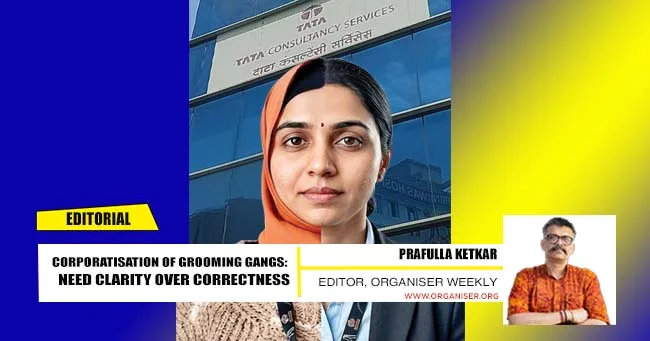
The sexual abuse case at the Nashik BPO centre of Tata Consultancy Services was in complete contrast with the national excitement over the Nari Shakti Vandan Adhiniyam (Women’s Reservation Bill). While the entire country was enthusiastically welcoming the women’s roles in legislative decision-making, a group of women exposed the unsafe environment within a corporate office, highlighting sexual abuse with communal overtones and systematically neglected grievances by the HR department. This incident naturally triggered critical questions: Is this an isolated incident or part of a systemic pattern? How did such a serious issue persist for four years? Who is accountable for the rise of grooming gangs in corporate settings? The main concern is whether high-level policy advances are truly translating into real reverence, dignity and participation for women at all levels of society.
The direct perpetrators, who used their position and power to coerce and sexually abuse young girls and convert them to Islam, are the most real culprits. Nine FIRs document the harrowing experiences suffered by these well-educated professional Hindu women, who endured months of trauma. The systemic neglect by authorities and the alleged complicity of absconding HR personnel, Nida Khan, reportedly orchestrated by the main accused, Tausif Attar, fit patterns that corporations often fail to acknowledge. This sequence of actions demonstrates how abuse can become institutionalised and overlooked.
A pattern emerges in the way habitual secularist voices, including politicians and media members, respond: they quickly label such incidents as routine crimes and distract with unrelated comparisons, such as a sexual exploitation case involving a fake baba in the same region. In the TCS case, the Islamists argue that it is not a communal matter, despite clear evidence to the contrary. Elsewhere, such as in Kerala, documented cases of Christian and Hindu girls being lured into Islam, sometimes trafficked abroad, are dismissed as propaganda by the same secular voices, even after being termed ‘Love Jihad’ by official bodies. Similar incidents of Hindu women being targeted under false identities surface often but are minimised as ‘interfaith marriage.’ Yet, when Muslim women are involved in interfaith unions, partners of other faiths face violence, met with silence by these secularists. This persistent denial obscures the real issue: certain radical groups justify spreading their views through various forms of Dawah as a religious duty. To respond effectively, society needs clarity and sensitivity about the dangers of such radicalisation.
The corporates seem to be the new frontier for promoting ‘radical elements’, after education, healthcare, entertainment and advertisement industries. Here, the real culprits are the Communists and the wokes. Globally, they are spreading the same menace. In the name of diversity, equity, and inclusion, they normalise many absurd practices and norms, as was apparent in the Rotherham Child Abuse Scandal in the United Kingdom. The alleged Lenskart Academy guide, which accepts Hijab but not bindi by female staff in their stores, follows the same norms originated in some American universities to avert the political narrative of ‘Islamophobia’. In turn, they promote radicalism and Kafirophobia. They forget the fact that tolerating intolerance beyond a point is promoting intolerance. The ‘Khawateen’ gang of the Islamic State or Dukhtaran-e-Millat, led by Asiya Andrabi, supported by the Pakistani terror group are using Muslim women as the tools of radicalism. This trend has immediate implications for social harmony and national security. No corporate house has the right to play with these vital concerns in the name of blindly following global governance standards.
Hindu civilisation accepts and respects all ways to be true, and celebrates diversity. It is our common strength. That does not mean anybody would use, abuse and misuse this trait to manipulate this culture of acceptance to subjugate the national ethos. Curbing radicalism through all means and sensitising all sections of society about the ills of ‘political correctness’ is the need of the hour. Religious freedom and a dignified life are Fundamental Rights of every human being. Anyone using a religious supremacist approach to impose one’s religion on others is a constitutional and civilisational crime, and it should be clear to every individual in the society without the fear of being judged on the flawed conception of ‘political correctness’. True equality and inclusion promote fraternity, not enmity.