NEW DELHI: In a historic and highly contentious session of the Lok Sabha on April 17, 2026, the 131st Constitution Amendment Bill, designed to expand Parliament and finally operationalize 33 per cent reservation for women, was defeated. While the government secured a simple majority with 298 votes in favor, the bill collapsed after falling short of the required two-thirds majority because 230 members, primarily from the Congress-led opposition, voted against it. This failure marks a somber moment in Indian legislative history; it was not merely a defeat for the BJP, but a tragic day for the millions of Indian women who saw their dreams of political representation crushed by partisan maneuvers. By choosing to block a bill that would have guaranteed seats for the nation’s daughters, the opposition has effectively prioritized political strategy over the empowerment of the “Nari Shakti” (women power) that forms the backbone of the country.
A betrayal of India’s daughters
The defeat of the bill has been widely characterized as a betrayal of the Indian woman. While the Prime Minister and Home Minister Amit Shah appealed to the House to pass the amendments to ensure the 2029 elections would see 33 per cent women lawmakers, the opposition, including the Congress, TMC, DMK, and Samajwadi Party, stood united to block the measure. They argued against the linkage of women’s quotas with the delimitation process and the 2011 Census, yet in doing so, they prevented the very mechanism that would have made reservation a reality. Critics argue that by voting “No,” these parties have not just opposed a government policy but have actively “defeated the women of society,” stalling a progressive movement that has been decades in the making. Home Minister Amit Shah noted that while the opposition pays lip service to gender equality, their actions in the Lok Sabha proved they were willing to sacrifice women’s representation to protect their own electoral maps.
Global media and the tarnished image of India
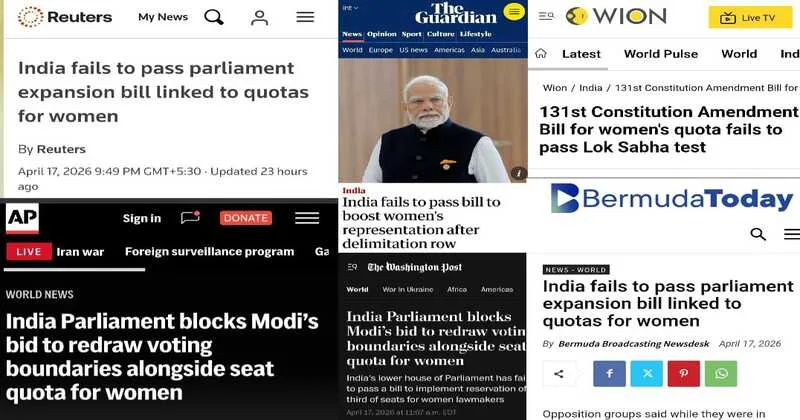
The international reaction was swift and damaging, casting a shadow over India’s reputation as a rising, modern superpower. Global media houses portrayed the event not as a complex constitutional debate, but as a fundamental “failure” of the Indian state to modernize its political structure. Headlines from major outlets were blunt: Reuters: “India fails to pass parliament expansion bill linked to quotas for women.” The Washington Post: “India Parliament blocks Modi’s bid to redraw voting boundaries alongside seat quota for women.” The Guardian: “India fails to pass bill to boost women’s representation after delimitation row.” WION: “131st Constitution Amendment Bill for women’s quota fails to pass Lok Sabha test.”
By providing the world with this narrative of failure, the opposition has inadvertently tarnished the global image India has worked tirelessly to build. Instead of showcasing a nation united in empowering its women, the headlines painted a picture of a fractured democracy unable to grant basic representation to half its population.
With the Congress-led opposition blocking the measure, a long-awaited reform for women’s representation has been delayed, allowing global narratives to cast India as faltering on gender inclusion. This “failure” in the eyes of the world is a direct result of the opposition’s refusal to support the 131st Amendment, leaving India’s daughters to wait even longer for their rightful place in the halls of power.