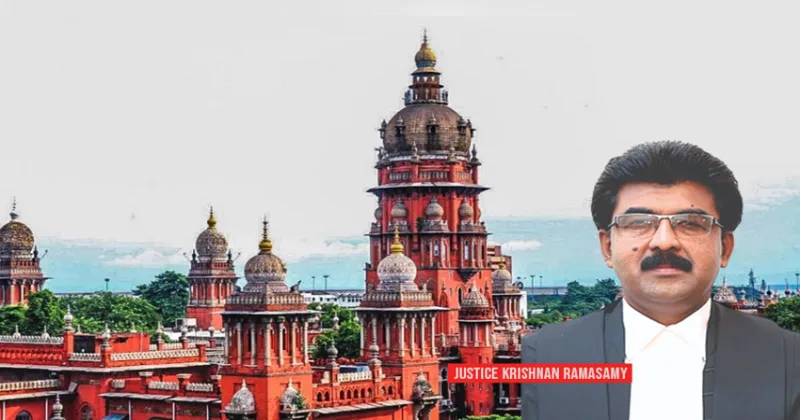
Chennai: The bench of Justice Krishnan Ramasamy dismissed a petition seeking the removal of alleged encroachments, including a temple, from land earmarked as a public park in Thiruvallur district. The plea had also requested directions to local authorities to restore the land strictly for recreational use and uproot the temple from the area. However, the court found no merit in the argument of the petitioner that the temple constituted an illegal occupation. It observed that the structure had been in existence for nearly 50 years and had become a part of the social and cultural fabric of the locality.
Petition challenged temple’s presence
The case arose from a petition filed by Jesudass Cornelius, who contended that a parcel of land in Thiruvallur district—approved as a park and playground layout in 1960—had not been maintained as intended. He argued that a temple situated within the designated area was not part of the original plan and should be removed as it is an encroachment. The petitioner sought directions to local authorities, including the district administration and municipal body, to restore the land strictly for public recreational use.
Court recognises long-standing existence
Dismissing the plea, Justice Krishnan Ramasamy noted that the temple had existed on the site for nearly 50 years. The court held that such prolonged, uninterrupted existence weighed heavily against the claim of encroachment. It further observed that any objection to the structure should have been raised much earlier. Bringing such allegations after decades, the court said, weakened the petitioner’s case and credibility.
Long delay weakens petitioner’s case
The petitioner, Jesudass Cornelius, had argued that the land layout approved in 1960 designated the area strictly for park and playground use and that the temple was not part of the original plan. He alleged that authorities had failed to maintain the land properly and sought removal of the structure.
The court, however, questioned the timing of the petition. It pointed out that if the temple had indeed been an encroachment, objections should have been raised much earlier. Raising the issue after several decades reduces the authenticity of the petition.
Authorities defend status quo
Government authorities informed the court that the temple occupied only a small portion—approximately 2,260 to 3,000 square feet—of the total 9,000 square feet area. They argued that the remaining land could still function effectively as a park and playground. The court accepted this reasoning, noting that the temple’s presence did not obstruct public movement or significantly impact the usability of the park.
Temple viewed as part of public well-being
In a key observation, the court expanded the understanding of public spaces beyond physical recreation. While parks are meant for leisure and relaxation, it said, places of worship can serve a similar purpose by promoting mental peace and emotional well-being. The bench noted that for many people, spiritual practices offer relief from stress and contribute to overall quality of life. On this basis, the temple was treated as an integral part of the park rather than an obstruction to it.
Court flags malafide intent
In a strong observation, the court stated that the petition appeared to have been filed with a malafide intention, potentially to create communal disharmony. It emphasized that long-standing religious practices and public faith should not be disrupted based on unsubstantiated allegations.
As a result, the plea was dismissed with costs. The petitioner was directed to pay ₹1 lakh to the Tamil Nadu Legal Services Authority within four weeks as a penalty. By recognising the temple as part of the park ecosystem, the court affirmed that public spaces can accommodate cultural practices, faith & belief system of the community along with their well-being—physical, social and spiritual—without necessarily being in conflict.