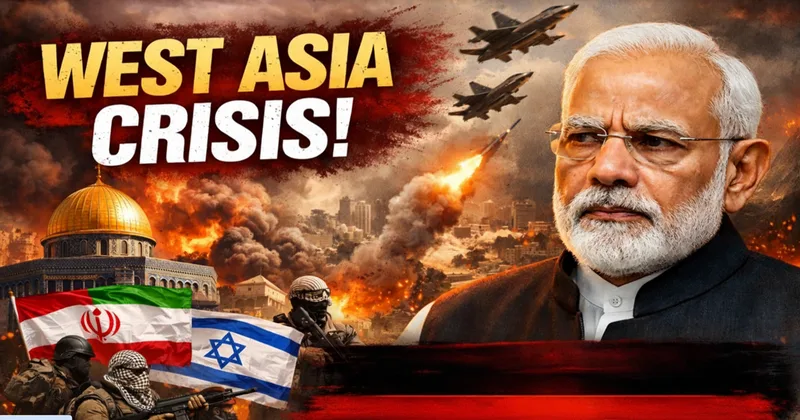
As the Iran war escalates, the Indian economy faces a pivotal moment. This conflict, pitting Iran against a coalition led by Israel and backed by Western powers, disrupts global energy markets and trade routes critical to India’s growth story. With India as the world’s third-largest oil importer, consuming over 5 million barrels per day, with West Asia being the major supplier with nearly 75-80 per cent of the crude coming from the Strait of Hormuz. Hence, the stakes for India are immense.
This article is trifurcated in three sections. The first section highlights the problems arising for India due to this war. The second one discusses the opportunities arising for India due to the same. The third and the last part explores cautions for India to weather through this storm with minimal damage and initiatives India must benefit from the crisis.
Mounting Problems for Bharat’s Economy
The Iran war has unleashed a cascade of economic headwinds for India, primarily through energy shocks, supply chain disruptions, and inflationary pressures. Oil prices, already volatile, have surged past $100 per barrel since hostilities intensified in late 2025, according to Brent crude benchmarks. India imports more than 90 per cent of its crude oil. Iran supplies nearly 10 per cent of that import requirement. More critically, the Strait of Hormuz—through which nearly 20 per cent of global oil flows—remains a chokepoint under threat from Iranian missile strikes and naval skirmishes. Partial blockades have forced rerouting via the Cape of Good Hope, adding 10-15 days to shipping times and inflating freight costs by 30-50 per cent, according to Drewry Shipping Consultants.
This energy crunch directly erodes India’s current account balance. The oil import bill, which stood at $132 billion in FY24, could balloon by $40-50 billion annually at sustained $110/barrel prices, widening the trade deficit from 2.5 per cent to over 4 per cent of GDP, IMF estimates suggest. Rupee depreciation—already at Rs 94/USD and sliding toward Rs 100—amplifies this problem. A weaker currency hikes import costs. Inflation, hovering at 5.5 per cent in early 2026, risks double-digit spikes in fuel and petrochemicals, squeezing household budgets and corporate margins. Food inflation compounds the pain: fertilizer imports from Iran and Russia – that constitutes nearly 40-45 per cent of the total imports – face delays, potentially cutting kharif crop yields by 5-10 per cent, as per the ICAR projections.
Trade disruptions extend beyond energy. India’s US$3 billion annual exports to Iran—textiles, pharmaceuticals, and rice—have plummeted 70 per cent due to sanctions and port closures at Bandar Abbas. Remittances from 2.5 million Indian workers in the Gulf, worth $50 billion yearly, are at risk as regional instability prompts evacuations; Saudi Arabia and the UAE inflows alone could dip to 15 per cent. Supply chains for gems, jewellery (Iran supplies rough stones), and auto parts falter, hitting SMEs in Mumbai and Surat hardest.
Macro stability is fraying. Foreign portfolio inflows, vital for funding India’s $2.5 trillion stock market, have reversed by $10 billion since January, per RBI data, as FPIs flee to safer U.S. Treasuries amid risk-off sentiment. Fiscal pressures mount too: subsidies on LPG and diesel, already Rs 1 lakh crore, may double, pushing the deficit beyond 5.5 per cent of GDP and crowding out capex. Geopolitical spillovers loom—Pakistan’s covert support for Iran could inflame the Line of Control, diverting defense spending (now 2.5 per cent of GDP) from growth imperatives.
In sum, these shocks threaten India’s 7 per cent GDP growth target for FY26, potentially shaving it to 5-5.5 per cent, as per a Goldman Sachs downgrade. Vulnerable sections—rural poor reliant on cheap fuel and urban consumers facing EMIs on depreciating assets—bear the brunt, risking social unrest if unmitigated.
Opportunities Emerging from the Crisis
Paradoxically, the Iran war opens doors for India to accelerate economic diversification and global positioning. First, energy security beckons. With Iranian supplies offline, India has pivoted to discounted Russian crude (now 40 per cent of imports, up from 20 per cent), saving $5-7 billion in forex annually despite Western sanctions, per Petroleum Ministry figures.
Long-term, this crisis fast-tracks domestic production. ONGC and Reliance’s investments in the Krishna-Godavari basin could boost output by 200,000 barrels/day by 2027, reducing import dependence to 70 per cent. Green energy gets a tailwind too—solar and wind auctions have accelerated, with 50 GW capacity additions targeted by 2030, positioning India as a hydrogen exporter amid global decarbonisation.
Trade realignments favour India’s manufacturing push. As Iranian oil floods gray markets elsewhere, India captures premium markets in Europe and Japan, with refined product exports (diesel, jet fuel) from Jamnagar refinery up 25 per cent YoY. The “China+1” strategy gains urgency: Apple’s iPhone production in Tamil Nadu has scaled 50 per cent, and Foxconn expansions draw $10 billion FDI. War-induced U.S.-China tensions amplify this—India’s electronics exports hit $30 billion in FY26, per NASSCOM.
Geoeconomic shifts elevate India’s diplomacy. Neutrality pays dividends: as a Quad member balancing BRICS ties, India secures oil from Saudi Arabia (up 15 per cent) and UAE at stable prices via rupee-denominated deals. This bolsters the INSTC (International North-South Transport Corridor), slashing China-Pakistan Economic Corridor reliance; pilot shipments from Chabahar (India’s Iran port stake) to Russia cut transit times by 40 per cent. Defense opportunities arise—HAL and L&T export BrahMos missiles to Gulf allies wary of Iran, targeting $5 billion in orders.
Financial markets offer arbitrage. Rupee volatility attracts carry traders, while domestic equity indices like Nifty have rebounded 8 per cent on bargain hunting in infra stocks (Larsen & Toubro up 15 per cent). Tourism rebounds as MICE events shift from Dubai to Goa. Agriculture benefits from higher global rice prices (India’s basmati exports up 20 per cent), and pharma giants like Sun Pharma fill Iran’s medicine gap via third countries.
Critically, the war catalyses reforms. Atmanirbhar Bharat 2.0 gains traction—PLI schemes for semiconductors and EVs draw Micron and Tesla investments worth $15 billion. IMF projects this could lift potential GDP growth to 8 per cent by decade-end. For startups, drone tech for border surveillance booms, with ideaForge securing Rs 2,000 crore contracts. Thus, adversity forges resilience, potentially adding 1-1.5 per cent to GDP via export diversification and capex multipliers.
Cautious Approach
India must tread cautiously while acting decisively to shield its economy and capitalise on the war. Key risks include escalation: a full closure of Strait of Hormuz could spike oil to $150/barrel, triggering stagflation (RBI’s nightmare scenario). Over-reliance on Russian oil invites secondary sanctions, eroding forex reserves ($650 billion but vulnerable). Inflation pass-through to wages could spark strikes, while black swan events—like cyber attacks on refineries—demand cyber resilience.
Proactive initiatives are imperative
Increase strategic reserves to 120 days’ imports, which currently stands at 65 days. Fast-tracking nuclear deals with France for 10 GW capacity is a must. Diplomatic outreach to OPEC+ for quota hikes from Iraq and Nigeria is crucial—target 1 million barrels/day incremental supply is equally essential.
RBI should front-load rate cuts to 5.5 per cent if growth dips below 6 per cent, paired with targeted bond buys for rupee stability. Fiscal prudence via DBT expansions—universalise PM-KUSUM for solar pumps—curbs subsidy leakages. A “War Economy Fund” of Rs 2 lakh crore, funded by windfall oil taxes, to prioritise infra like the Rs 1 lakh crore National Highway upgrades must be deliberated upon.
Bharat Must Invokes WTO Safeguards
India must invoke WTO safeguards against dumped Iranian goods rerouted via Turkey.
India must explore ways and means to expand FTAs with Oman and Israel for secure corridors; operationalise IMEC (India-Middle East-Europe Corridor) pilots by Q4 2026. PLI 3.0 must emphasise critical minerals—secure lithium from Argentina to power EVs.
Monitoring via a high-level War Impact Task Force (PMO-led, with RBI, NITI Aayog) may ensure agility in the economy. Scenario planning—base, adverse, extreme—guides policy. By blending caution with opportunism, India can emerge stronger, targeting 8 per cent growth post-crisis. In this crucible, India’s choices will define its global economic stature.