
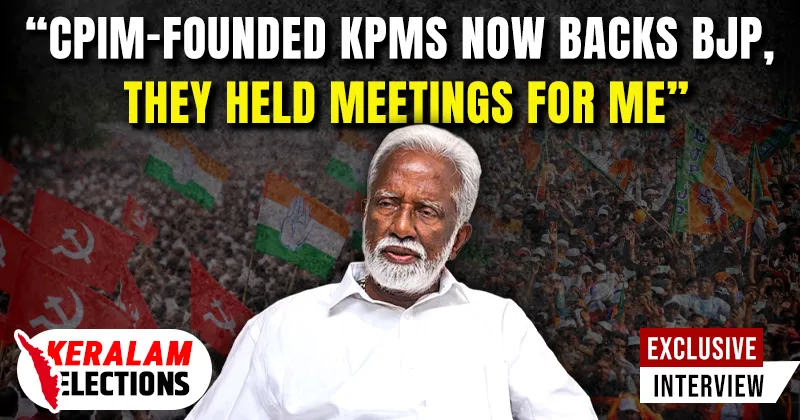
Kerala has recorded a landmark 78.27% voter turnout in the 2026 Assembly Polls, the highest since 1987. With women leading the charge at a staggering 80.86%, the surge signals a major shift toward a genuine triangular contest. In an exclusive interview with Organiser, former Mizoram Governor and BJP candidate for Aranmula, Kummanam Rajasekharan, breaks down the party’s historic growth. He discusses how the BJP successfully breached traditional LDF and UDF strongholds to consolidate minority and backward community votes, forever changing the state’s political arithmetic.
The ‘Sanitization’ of Electoral Rolls – SIR
Kummanam Rajashekaran said that the most vital factors behind this turnout was the “sanitization” of the electoral rolls. “For too long, our lists were cluttered with lakhs of ineligible and bogus entries—names that should never have been there. The service rendered in cleaning these rolls was truly remarkable and result oriented. By removing these “lags” and ensuring a clean list, we finally gave legitimate, eligible voters the confidence that their vote would actually count,” said the veteran leader.
BJP leader continued – “It is important to note that from the very beginning, the CPIM and Congress criticized this cleanup. They were so threatened by a transparent list that they issued an open call to boycott the process. However, the record participation proves that the people are for a clean system, not for the manipulative tactics of the LDF and UDF. On this issue, both the Congress and the CPM have been completely cornered by the will of the people.”
Kummanam Rajashekaran said that the record turnout isn’t just about a “triangular fight”; it is about the people of Kerala declaring their unconditional support for a democratic process that is free from fraudulent entries.
You have navigated a phase where the BJP was often unfairly characterized as a political outsider in Kerala. Looking back at the trajectory over the last five years, how would you assess the party’s transition from the periphery to becoming the decisive third pillar of the state’s political landscape?
“This is my fifth time contesting an Assembly election in Kerala, having represented various constituencies across the Thiruvananthapuram district in the past. Over these years, I have witnessed a decisive shift in the psyche of the Kerala electorate. The public is no longer satisfied with the status quo; there is a profound desire to transform the state’s political landscape. For decades, voters were trapped between only two options: the LDF or the UDF. Today, a genuine third alternative has emerged. A natural political vacuum was created by the failures of the two fronts, and the BJP has stepped in to fill that space, rallying those who believe that Kerala deserves a fresh, viable alternative.”
We are seeing a significant shift in traditional voting patterns. In your view, has the NDA successfully moved past the ‘outsider’ tag to become a genuine third pillar that the people of Kerala now trust to break the LDF-UDF cycle?
“Yes, absolutely. The time is now ripe for a political transformation. We can say with confidence that the NDA has secured significant ground and widespread mass support across Kerala. We have evolved into a formidable third alternative—a force capable of mounting a serious challenge to both the UDF and the LDF.”
Prime Minister Modi’s presence in Kerala this season was palpable. How central was the ‘Modi Factor’ in galvanizing the NDA’s ground game?
“The Prime Minister’s visits have been transformative. We saw massive participation across all social strata. His message focused on inclusive development—Sabka Saath, Sabka Vikas—which not only energized our cadre but also dismantled long-standing misinformation campaigns. It has replaced skepticism with a profound sense of public confidence in the NDA’s vision.”
Rajashekaran ji, you have spoken about a deep sense of betrayal among the OBC, SC, and ST communities regarding the ‘lapsing’ of Central welfare funds by the state government. Beyond this financial neglect, why do you believe that the historically LDF and UDF-aligned groups now view the BJP as a more sincere advocate for their welfare?
“I can confidently testify that various sections of the Hindu society are now distancing themselves from both the LDF and the UDF. This shift is driven by a deep sense of betrayal; these communities—particularly the downtrodden, the backward classes, and the OBC, SC, and ST groups—feel that both fronts have cheated them for decades.
They have presented clear evidence of a total lack of genuine welfare measures under successive LDF and UDF regimes. Specifically, leaders from the OBC and SC communities are highlighting a major grievance: substantial welfare funds sanctioned by the Central Government are being left unutilized by the State Government, eventually being allowed to lapse.
This issue has become a central point of contention within these communities. We are seeing a significant transformation in community organizations; for example, groups like the Scheduled Caste Kshema Samithi, which were previously non-functional and unable to even hold meetings, are finding a new voice.
Furthermore, traditional organizations such as the KPMS and the Siddharth Service Society—which were once under the strict control of the Communist Party—are breaking away. It is noteworthy that despite KPMS being founded by the communist leader Chathan Master, its current leadership is now openly supporting our propaganda and campaign activities.
In my own constituency of Aranmula, I have seen these leaders organize public meetings in favor of the BJP, marking a clear departure from their historical political allegiances.”
Critics argue the BJP lacks consistent, stable leadership at the constituency level compared to the established fronts. How do you respond?
Building deep-rooted, decades-long consistency takes time, and we are in that growth phase. Our candidate selection now balances representation with merit. While some constituencies are still evolving, our organizational strength is now formidable enough to shape a genuine three-way contest across the state.
There is a historical trend where Kerala voters prioritize national issues in Lok Sabha polls but revert to local dynamics in Assembly elections. Is the BJP finally bridging that gap?
It is true that in Parliamentary elections, the voter thinks from a national perspective. Traditionally, Congress exploited the perception that they were the only alternative to the LDF at the state level. However, that duopoly is crumbling. Our vote share is no longer just a “nationalist protest”; it is now a mandate for local governance.
The prevailing narrative often paints the BJP as having limited reach among Kerala’s minorities. However, you’ve claimed a significant breakthrough in this election. Beyond the rhetoric, what is the ground reality of your engagement with these communities?
We have engaged deeply with minority groups, particularly the Christian community, to clarify facts and counter fearmongering. Despite organized misinformation campaigns aimed at creating a “fear psychosis,” many community leaders are now openly aligning with the BJP. They see the reality of the Center’s welfare schemes, which do not discriminate based on religion.
For decades, the OBC and SC communities were considered the bedrock of the LDF and UDF. However, there is a growing sentiment that these groups now feel politically marginalized by the traditional fronts. Is the BJP their new home?
Precisely. For decades, the LDF and UDF used these communities as vote banks while effectively neglecting their welfare. Funds allocated for their upliftment have been consistently underutilized or diverted. We have spent months addressing these specific concerns, and that dissatisfaction has translated into a favorable environment for the BJP.
Sabarimala remains a deeply emotive issue. Has the BJP managed to convert that cultural sentiment into sustained political capital?
“We brought this critical issue directly to the public to mobilize people against the systemic corruption in the state. The BJP is the only party that has consistently kept this issue alive in the public consciousness through sustained action. We organized numerous demonstrations and agitations, including massive rallies at the Secretariat and three separate protests at the Cliff House.
In contrast, the Congress party has remained largely passive, failing to effectively oppose or resist the LDF’s involvement in the gold smuggling scandal. We purposefully made this a cornerstone of our campaign to ensure voters were fully aware of the facts, and that awareness has clearly resonated across the electorate.”
Beyond our focus on development, the Sabarimala issue remains a prominent pillar of our movement. The LDF and Congress are currently on the defensive because they lacked the sincerity to stand with the devotees. For them, it was merely a matter of political publicity.
The BJP’s commitment, however, has been both honest and steadfast. Our leaders and supporters didn’t just speak; they acted. Thousands of our workers were jailed, and leaders like K. Surendran and Shoba Surendran continue to face numerous legal cases for their participation in these agitations. Meanwhile, Congress leaders like Ramesh Chennithala or V.D. Satheesan haven’t faced a single legal consequence because they never truly involved themselves in the struggle. The people of Kerala see this contrast clearly—they know who was sincerely fighting for their traditions and who was merely posturing.”
There was once a “social boycott” or a sense of exclusion toward the BJP in Kerala’s elite circles. Has that social barrier finally fallen?
“Thousands of people from various sections of society—irrespective of caste, creed, religion, or political affiliation—have come forward to join the BJP. This is a first in the history of the BJP in Kerala. No other party has been able to attract such a diverse range of leaders to its fold.
In the BJP today, we see retired judges, lawyers, and former IAS officers from elite circles. Furthermore, top-tier leaders from the CPI, CPIM, and Congress have also joined our ranks. This has provided a significant moral boost to our dedicated grassroots workers.
In three specific constituencies, former MLAs are contesting as our candidates, creating a highly favorable environment for us in the current political scenario. This has generated immense goodwill for the BJP during this election cycle.
The doors are now open. Those who prioritize national development and transparent political activity recognize that the BJP is the only party where they can work effectively toward these goals. We have opened the doors to a new era of positive political activity in Kerala.”