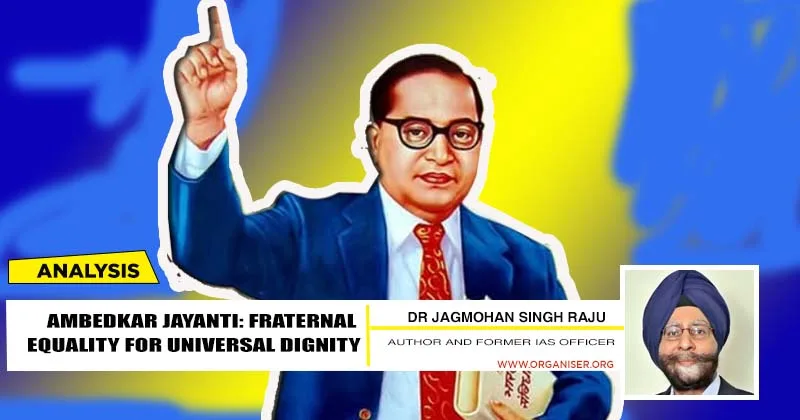
Each year on April 14, Bharat pauses to remember Babasaheb Dr Bhimrao Ambedkar, not just as the principal architect of its Constitution, but as one of the most profound moral thinkers of modern democracy. His life was more than a political journey; it was an unrelenting social quest to secure dignity for those whom society had pushed to its very margins to the extent of exclusion. His struggle for the excluded was not only for rights, but for recognition, for a place within the moral community of the nation.
Ambedkar’s thought cannot be confined to constitutionalism. It arose from a direct engagement with the lived realities of exclusion, particularly the condition of those rendered “untouchable,” excluded not only from resources, but from the very idea of social belonging. For him, social justice was not an abstract principle but a transformative project: to dismantle structures of graded inequality and enable the most oppressed to live with dignity as equals in public life.
Delineating Democracy
At the heart of his vision was a radical understanding of democracy. Democracy, he insisted, is not merely a form of Government; it is a mode of associated living grounded in mutual respect. Political democracy cannot endure without social democracy. Liberty, equality, and fraternity are not isolated ideals but interdependent principles. Among them, fraternity (bandhutva) is the most foundational. Without it, equality remains formal and justice struggles to take root in everyday life. Fraternity alone can convert rights into relationships and coexistence into community.
It is in this context that Ambedkar’s call for the annihilation of caste must be understood — not merely as a critique of social hierarchy, but as an attempt to restore harmony of society. A social order based on graded inequality and exclusion cannot sustain a shared sense of belonging. Without dignity for the most marginalised, democracy becomes procedural rather than substantive. In this sense, fraternity is not a moral virtue; it is a condition for the survival of democracy itself.
Shared Vision of Ambedkar and Upadhyaya
A different yet resonant articulation of this moral concern appears in the thought of Pandit Deendayal Upadhyaya, who advanced the principle of Antyodaya — the idea that the last person must be placed first in the priorities of national life. Antyodaya is not merely a policy framework or economic goal; it reflects a deeper ethical orientation. It insists that the measure of progress lies not in aggregate growth, but in the condition of the individual standing at the very end of the social spectrum. The antim vyakti (last person) in Antyodaya is not a passive recipient of welfare, but the moral centre against which the legitimacy of development must be judged.
At first glance, Ambedkar and Upadhyaya seem to emerge from different intellectual traditions. Ambedkar’s social project is marked by a rigorous critique of inherited social structures, particularly caste, and a commitment to structural transformation through law and institutional reform. Upadhyaya, by contrast, draws upon civilisational continuity and emphasises harmony, integration, and a compassionate social order. Their points of departure differ — one begins with the urgency of justice, the other with the ethos of cultural cohesion.
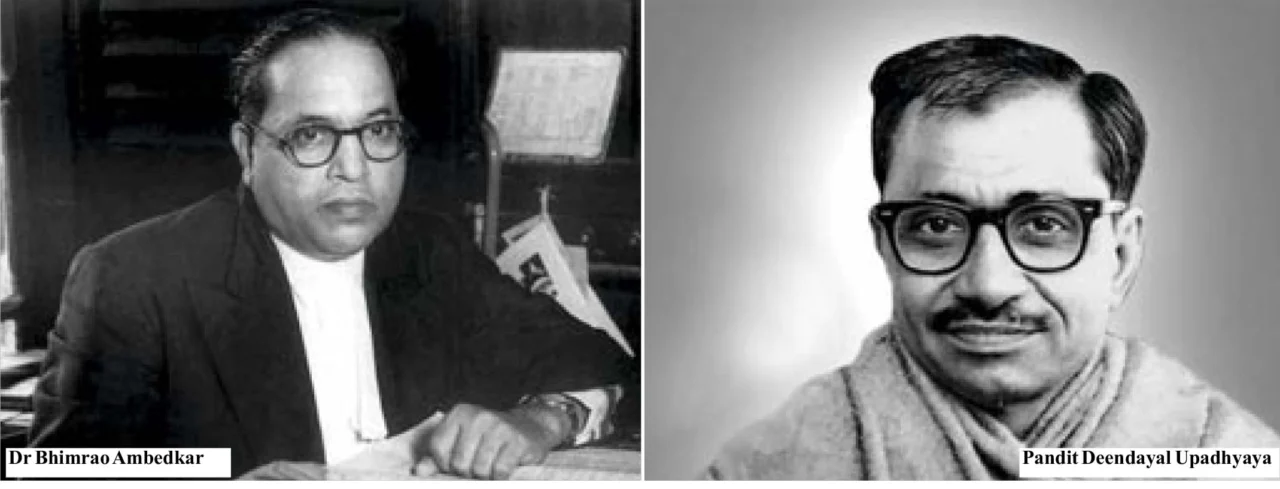
Yet, their convergence lies not in identical premises, but in a shared moral destination. Both centre their vision on the individual at the margins. The “oppressed” in Ambedkar’s framework and the “last person” in Antyodaya represent the same ethical concern: that no society can claim moral legitimacy if it leaves sections of its people behind. Both reject any model of progress that is indifferent to human suffering at the bottom.
Their difference, in fact, enriches this convergence. Ambedkar foregrounds ‘nyaya’ — the imperative of justice, the necessity of dismantling entrenched hierarchies, and the centrality of dignity secured through rights. Upadhyaya introduces ‘samvedana’ — a deeply felt sensitivity that ensures the last person is not merely protected by institutions, but embraced within the social fold. Justice without sensitivity risks becoming impersonal; sensitivity without justice risks remaining superficial. Together, they offer a framework that is both corrective and compassionate.
In contemporary Bharat, this synthesis acquires renewed significance. The challenge before the nation is not only of achieving growth, but of ensuring that development is inclusive, humane, and rooted in ethical purpose. The question is not simply whether rights are guaranteed, but whether dignity is realised in the everyday lives of those historically excluded. To place the last person first is not a slogan — it is a test of whether democracy is substantive or merely procedural.
It is here that the idea of fraternity assumes its central role once again. For Ambedkar, fraternity was the force that could bind individuals into a shared national community, transcending divisions of caste, class, and status. It transforms coexistence into belonging. Seen in this light, Antyodaya can be understood as the practical expression of fraternity. To prioritise the last person is to affirm that no one lies outside the circle of national concern. It is to translate moral sentiment into social action.
The shared vision of Ambedkar and Deendayal Upadhyaya thus culminates in a deeper philosophical unity. Social justice restores dignity; Antyodaya ensures that dignity reaches the last person; fraternity sustains that dignity within the fabric of society. Together, they point towards a vision of civilisation that is not only just and prosperous, but also cohesive and humane.
On Ambedkar Jayanti, this reflection acquires particular urgency. Babasaheb’s legacy is not merely a constitutional inheritance; it is a continuing moral challenge. It asks whether we can build a society where equality is real, justice is lived, and fraternity binds diverse individuals into a shared community. The last person, then, is not simply a measure of our progress. He is the test of whether our democracy is real.