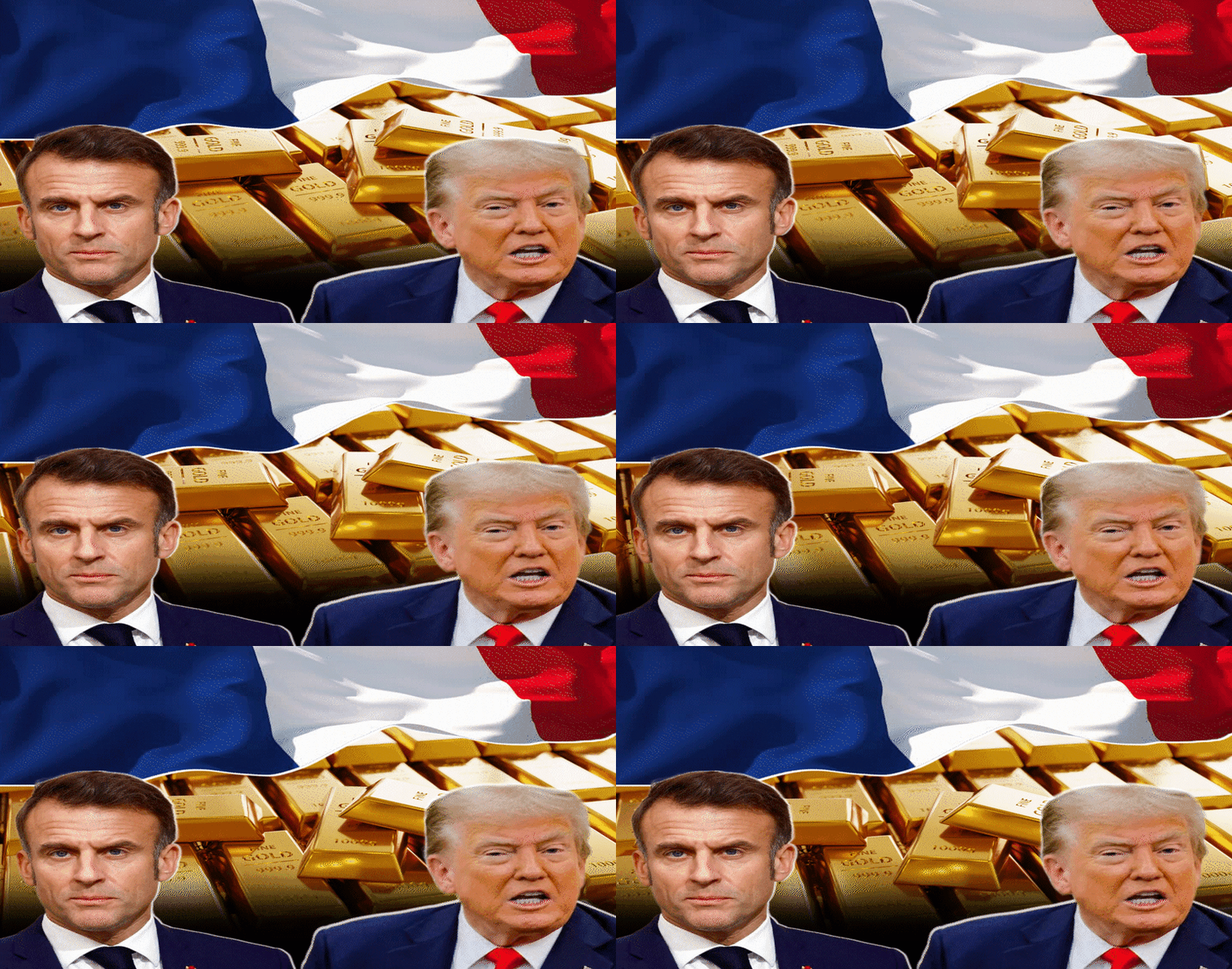
Gold is the ultimate and sovereign saviour for any state during an economic crisis. It aids a country as a shield to protect against financial bankruptcy, forex rupture, acts as cushion against inflation or geopolitical instability, thus consolidating national interests during economic collapse. When gold forms such a vital pillar of a nation’s economic landscape, it is critical to hold sovereign control over the strategic asset and fortify it against external gridlocks. In this direction, France accelerated a major realignment in its macroeconomic fundamentals and has made a monumental shift in its grand gold strategy, thereby has etched its protective layer against the ambiguous dollar-centric ecosystem of the United States, under the Trump administration.
Banque de France, the Central Bank of the country has successfully concluded its long-running effort to bring the USD 15 billion worth gold reserves back home that were parked in the United States. With this Paris has sealed a major strategic victory against Washington DC. The more interesting fact is that the unique strategy articulated by Paris to bring back the gold reserves to the country. Instead of physically transporting the gold from the United States to France, Banque de France sold the gold chunks in New York and swiftly transferred the money to the country, thus fetching record profits beyond mere gold bars.
The grand gold strategy by Banque de France that yielded record profits
As mentioned, between July 2025 and January 2026, 129 tonnes of old and non-standard gold bars were stored in New York. Taking advantage of the record-high gold prices, France sold old gold bullions(bars) at current prices, thus gaining huge profits. Another striking factor is that France completed this process of selling old gold in New York, within a span of one year. It has repatriated all the proceeds to Paris and has newly purchased high-standard bullion from the European market.
Thus, the entire sovereign gold reserves of Paris that sums upto approximately 2,437 tonnes are stored in Paris itself. With this, France has consolidated its strategic autonomy and complete sovereignty over its financial and economic credentials. By this, Paris has established a clear protective layer over its economic decisions away from external geopolitical and geo-economic oscillations. The operation of selling old bars in New York at record gold prices, converting it into significant capital gains and proceeding to re-investing it in the European market by purchasing equivalent high quality gold, has indeed surged the profits of the Central Bank of France, as it generated USD 15 billion.
As per the reports, the Central Bank of France in the financial year 2025 has marked a drastic rise in its net profits culminating to 8.1 billion Euros, which is also a sharp reversal from the losses recorded in the previous year that had summed upto 7.7 billion Euros. This strategy also avoided the complexity and risk of transporting physical gold across continents. Simultaneously, outdated bullions were modified into gold bars that meet modern day international monetary parameters. This is indeed an economic masterstroke by Paris. Thus, the total gold reserves currently held by Paris accounts for 5 per cent of the country’s total financial holdings.
A challenge to the dollar-centric hegemony of the US
The Governor of France explained that the decision is not political but purely economical. The process was accelerated to source a new set of gold bullions that would have a compliance with present international gold standards. To fulfill this goal, it was an easier task to purchase new gold in Europe rather than upgrading outdated gold bars that too when it is present abroad. However, geopolitical experts and economic analysts assert a different reason behind the decision of France.
Memories from 1960s; When France challenged dollar dominance
During the 1960s, global economic transactions were defined by the Bretton Woods system. Accordingly, the US dollar was directly convertible into gold for foreign central banks. Thus, the US dollar was the de facto parameter and was the prime underpinning to determine all international transactions. However, under President Charles de Gaulle, Paris was sceptical of the US dollar. It was afraid that by using the dollar as an instrument, the US could expand its hegemony across continents. Also, France thought that Washington DC was spending unmindfully and that might derail the stability of the dollar eventually.
Thus, from 1963 to 1966, under the title of Operation vide Gousset, Paris secretly shifted 3,000 tonnes of its gold in the US back to home via ships and aircrafts. Such scepticism about the dollar-pegged economy, shattered the Bretton Woods establishment. As an impact, in 1971, Bretton woods collapsed and the US de-linked gold and US dollar with no opportunity for direct convertibility. This move indeed marked a new era in the global financial system and transactions, to some extent destabilising dollar hegemony of the US.
The latest move of France is also read with similar scepticism that poses a significant challenge to dollar dominance under the Trump administration. The rift between NATO countries, Europe and particularly France and the United States is spiking under the Trump doctrine. President Donald Trump has threatened to pull out of NATO & annex Greenland, targeted European leaders and has repeatedly mocked the President of France Emmanuel Macron. On the other hand, Europe too has a steep trust deficit on the policies of Trump, which is earmarked with unpredictability, high scale transactionalism and unilateralism. Europe has also not unequivocally supported Trump’s latest war in West Asia targeting Iran.
Thus, it is said that by pulling out the gold reserves from the USA, France is aiming to protect its economy against the volatile policies of Trump and also assert a diplomatic and economic challenge to the dollar hegemony indirectly. By relocating its gold reserves France is aiming to gain political and strategic leverage against the US hegemony. France is insulating itself from the inherent vulnerabilities of the Trump policies and the dollar-pegged US economic system which is lately witnessed with inflation, fiscal cliff, soaring debt burden etc. much in line with countries of Global South.
However, a European country which is a historical ally of the US, marking such a sharp counter to the latter indeed illustrates a fundamental switch in the world economic and geopolitical order, that is drifting the strategic landscape away from the US hegemony. Europe is consistently aiming to reduce dependency on the US and gain strategic autonomy. As France pulled out its gold reserves from the US, there are also apprehensions that Germany, which has significant gold reserves stored in the US might embark on a similar mission. There are compulsions on the German government to bring back the gold from the US.
Meanwhile, India is also repatriating its gold reserves from the US back to the domestic purse. Since March 2023, RBI has brought back 274 tonnes of gold from the US. In the financial year 2026 alone, RBI has repatriated 64 tonnes of gold. New Delhi has espoused this decision to consolidate the domestic economy away from the geopolitical risks. The stumbling of the dollar-centric US hegemony thus is not a sudden rupture. But, a structural transformation of the world economic and geopolitical order. It is a gradual undercurrent in the contemporary great power competition, which is firm and solid. It is catalysed not just from the Global South, but even from Europe & Western economies and that is a geopolitical reality.