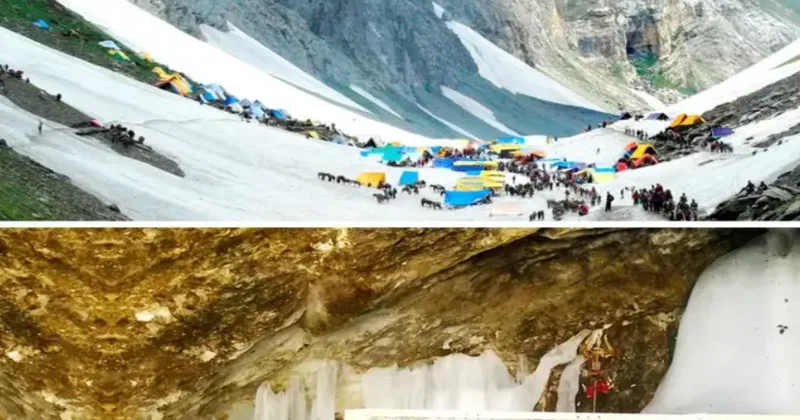
Lieutenant Governor Manoj Sinha has announced that Shri Amarnath Ji Yatra will commence this year on 3 and conclude on Raksha Bandhan, August 28, spanning a total of 57 days. He said the Pratham Puja, to invoke the blessings of Lord Shiva, will be held on Jyeshtha Purnima, June 29. This is in keeping with established traditions handed down from generation to generation.
Incidentally, LG Sinha is the ex officio chairman of the Shri Amarnath Shrine Board (SASB), which looks after all arrangements pertaining to this pilgrimage. Before the establishment of the SASB, the involvement of the government started only after terrorism engulfed the Kashmir valley in 1989-90. At one time, it was entirely in private hands with some involvement of the Anantnag district administration.
The pilgrimage to Shri Amarnath cave was allowed only from the Anantnag side via Pahalgam, Chandwari, Pissu Top, Mahaganus, Sheshnag, Panjtarni and onwards to the cave. The entire route from this eastern side is around 42 km and the pilgrims had to stop at camps for overnight halts at designated spots.
Almost three decades ago, an alternative route, via Baltal (Ganderbal district) was started. It was usually frequented more by security forces and hardy locals who traversed the entire 16 km stretch from Baltal to the cave and back within a single day. Over time, younger pilgrims began using the Baltal route. The locals of Ganderbal saw an opportunity in the opening of the Baltal route, as it led to more footfall on this side, giving a boost to the local economy.
In 2008, the allocation of a patch of land in Baltal to improve pilgrim facilities led to the fall of the Congress government led by Ghulam Nabi Azad. This happened as the People’s Democratic Party (PDP) walked out of the coalition, and the breaking point was the land allotment for Shri Amarnath pilgrims.
Addressing a press conference on April 12 in Lok Bhavan, Jammu, Sinha said advance registration for the Yatra will begin on April 15 (Wednesday) via both offline and online modes. The registration will also be available for both the traditional Pahalgam and Baltal routes.
“The registration facility will be available at 554 branches of J&K Bank, Punjab National Bank, State Bank of India, and Yes Bank across the country,” he said.
Sinha said the Radio Frequency Identification Device (RFID) will be issued to every registered pilgrim and service provider. Registered pilgrims will receive group accident insurance with the sum assured enhanced to Rs 10 lakh per person. Coverage for both accidental and natural deaths of ponies-Rs. 50,000 per animal will be provided through the National Livestock Mission.
“Grid power supply will be available along the Baltal Axis up to the Holy Cave and from the Holy Cave to Panjtarni. Yatra tracks will be adequately illuminated. Various e-services and a pre-paid system for hiring ponies, pithoos, palkis etc will be available to pilgrims for ease of Yatra. Yatri Niwas facilities will be available at Baltal, Pantha Chowk (Srinagar), Nunwan, and Chanderkote,” Mr Sinha added.
At one time, diesel and small portable generation sets carried to camp sites by individuals provided lighting. However, the connection to grid power has transformed the scenario at various camps altogether nowadays