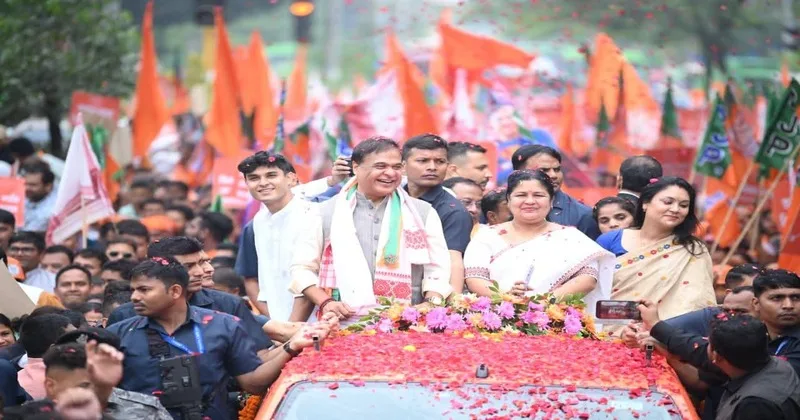
With the countdown to the Assam Assembly elections underway, a latest opinion poll has offered a crucial snapshot of the political mood in the state. The survey conducted by C-Voter suggests that the BJP-led National Democratic Alliance (NDA) is poised to secure a third consecutive term, reinforcing its dominance in the northeastern state.
According to the findings, the NDA is projected to win between 96 and 98 seats in the 126-member Assam Assembly, indicating a comfortable majority. This projection, if realised, would mark a significant political milestone for the alliance, which has steadily expanded its footprint in the state over the past decade.
The opposition, led by the Congress, is expected to trail behind, with estimates suggesting it may secure around 26 to 30 seats. Despite the gap in projected seats, the contest is still being described as competitive, with several constituencies likely to witness close fights.
Vote share and electoral trends
The survey indicates that the NDA enjoys a clear lead in terms of vote share as well. Around 48 percent of respondents expressed support for the alliance, while the Congress-led opposition is estimated to secure approximately 35 percent.
A separate breakdown of vote share places the NDA at 42.7 percent, compared to 36.1 percent for the opposition bloc. While the numbers vary slightly across datasets, the trend remains consistent: the ruling alliance holds a decisive edge.
What stands out is the widespread nature of this support. Region-wise estimates suggest that the NDA is leading across Upper Assam, Lower Assam, and the North Bank. This indicates not just localised dominance but a broad-based acceptance across diverse geographical and demographic segments.
One of the most significant takeaways from the survey is the strong leadership advantage enjoyed by Chief Minister Himanta Biswa Sarma. Nearly 48 percent of respondents named him as their preferred choice for the top post.
In comparison, Congress leader Gaurav Gogoi garnered around 37.7 percent support. The gap underscores Sarma’s continued popularity and his central role in shaping the NDA’s electoral prospects.
Governance and Public Perception
The survey also sheds light on how voters perceive the performance of the current government. Around 47 percent of respondents expressed satisfaction with the state government’s work, suggesting that anti-incumbency has not significantly dented the NDA’s standing.
On specific issues, such as action against illegal immigration from Bangladesh, public opinion appears largely favourable. Approximately 50.6 percent of respondents rated the government’s efforts as “good” or “very good.”
At the same time, a segment of respondents described the performance as average, while a smaller proportion expressed dissatisfaction. This indicates that while the government enjoys broad approval, there are areas where voter expectations remain high.
Welfare schemes strengthening support base
Welfare initiatives have emerged as a key pillar of the NDA’s electoral strategy in Assam. The survey highlights strong support among various social groups, including Scheduled Castes, Other Backward Classes, and upper-caste communities.
One of the notable schemes influencing voter sentiment is the Rs 9,000 direct benefit transfer initiative aimed at women. Around 42.8 percent of respondents believe that this scheme could further consolidate support for the ruling alliance.
Such targeted welfare measures, combined with broader development initiatives, appear to be reinforcing the NDA’s support base and helping it maintain an electoral advantage.
Beyond vote share and seat projections, the survey also captures voter perception about the likely winner. A significant 51.8 percent of respondents believe that the NDA will form the next government in Assam.
This perception gap is crucial, as it often influences undecided voters and can shape the overall electoral narrative. The belief that a particular party is likely to win can create a bandwagon effect, further strengthening its position.
Opposition challenges
While the Congress-led opposition retains a considerable vote share, it faces multiple challenges in converting support into seats. The gap in leadership preference, combined with the NDA’s organisational strength, appears to be working against it.
Additionally, the opposition’s ability to present a unified and compelling alternative remains under scrutiny. In a state where regional dynamics and community-based voting patterns play a significant role, even small shifts can have a major impact on electoral outcomes.
In some cases, they have accurately captured voter sentiment, while in others, they have failed to account for late swings, alliance changes, or silent voter preferences. Factors such as turnout variations and last-minute campaign developments can significantly alter the final outcome.
As Assam moves closer to polling day, the focus will increasingly shift to campaign strategies, voter mobilisation, and ground-level dynamics. The NDA will aim to maintain its momentum and convert favourable perceptions into votes, while the opposition will look to close the gap and capitalise on any emerging discontent.
For now, the numbers suggest an advantage for the ruling alliance, but as always in Indian politics, the final verdict will rest with the voters.