For over a hundred years, many in India have been made to believe an entirely fabricated story to be their actual past. They were made to believe that their ancestors weren’t who they thought they were, but were instead invaders in their own home. It was called the Aryan Invasion Theory (AIT), and it propounded that around 1500 BCE, a race of light-skinned, horse-riding, warrior nomads from Central Asia invaded the Indian subcontinent and conquered a sophisticated, dark-skinned native civilisation. It was those light-skinned Aryans who created the caste system, subdued the dark-skinned natives of the land, and forced them to migrate to India’s South.
This was not just a theory or a chapter in a history textbook which couldn’t have any influence on the larger Indian society. It became a powerful idea that instilled fault lines in the Bharatiya social fabric. This fabricated narrative divided brethren from their fellow brethren, the North from the South, and castes from one another. The AIT gave birth to politics of anger and separation whose reverberations in the Indian political landscape continue to reflect even till today in the form of hatred, discrimination, divisive politics and exchange of slurs.
Today, a plethora of evidence-based empirical research in the fields of archaeology, genetics, and textual analysis tells us that this theory is, in fact, a myth. This myth, created during the colonial period and kept alive for mala fide political endeavours, has deeply harmed the soul of this great civilizational nation.
The Birth of Aryan Invasion Theory: Colonial Storytelling
The Aryan Invasion Theory was not discovered or created in India. It was initially imagined in European universities and colonial offices in the 1800s. It started with a genuine discovery in linguistics. Scholars such as Sir William Jones found that Sanskrit, Greek, and Latin were sister languages descended from a common ‘mother language’. This was actually a brilliant finding in linguistics and across the research and academic domains. In the 19th century, the climate of an obsession with race and cultural dominance, language was twisted into a story about races, ethnicity and people. The term ‘Aryan’, which in Sanskrit literally means “noble”, was made into a label of a master race, superior to others.
Colonial historians like Vincent A. Smith projected Indian history as a tale of defeats, one foreign conquest after another: Aryan, Persian, Greek, Muslim, and finally British. It was meant to portray British imperialism as just another chapter in the history of India, which was completely normal, thereby trying to justify British rule. The Aryan Invasion Theory was primarily developed and propagated by European scholars and colonial administrators in the 19th and 20th centuries, with motives to create and use the conflict and divide in Indian society and exploit it for their own benefits, for smooth administration, trade/loot, and evangelism.
Max Müller, German philologist, Sanskrit scholar and Oxford professor, in his ‘Lectures on the Science of Language (1861)’ mentioned that, “If we assume that the Veda was composed 1000 B.C., the Aryan conquest of India could not have taken place long before 1500 B.C.” Thus, he established that there was a race in Central Asia termed “Aryans” and an Aryan invasion followed by a conquest happened in the Indian subcontinent. Although he later corrected himself (in Biographies of words, 1888) that the term “Aryan” was purely linguistic, the damage had already been done, and its racial interpretation was rigidly established.
Another orientalist scholar and a missionary, John Wilson, also aggressively racialised the AIT, propagated it and connected it with caste. The motive was to use it for evangelistic purposes. In his book ‘India Three Thousand Years Ago’ (1858), he portrayed the so-called Aryan-Dasyu conflict as a racial war. The Christian missionaries argued that the “Aryan Brahmins” were, in fact, foreign invaders who had imposed the caste system on the true natives of this land. It was a deliberate strategy to create a religious and social rift in India and exploit it for mala fide benefits.
Racialising India: Census, Caste and Colonial Institutionalisation
The colonial administrators strategically deployed the AIT, formalising and institutionalising social division within India. They found this theory useful as a tool for ruling over Indians, following their ‘divide et impera’ strategy. They made this fabricated History their weapon against the brotherhood, social harmony and civilizational values of Bharat. By framing history as a racial conflict between Aryan North and Dravidian South, and between so-called Aryans and Dasyus. Using their European lens, they failed to understand the beauty of cultural diversity and imposed racial hierarchies in Indian society, deepening and institutionalising caste distinctions through state policy.
Herbert H Risley, the Census Commissioner of India, wickedly operationalised the AIT as state policy in 1901 and exemplified how colonial administrators weaponised it. Developing upon Max Müller’s work and then-prevalent doctrines of scientific racism, he equated race and used dubious anthropometric tools such as the nasal index to classify and rank caste groups. These rankings and classifications, based on insubstantial sample sizes and inconsistent data, were incorporated in census operations and governance, rigidly compartmentalising the caste identities that had previously been flexible. In ‘The People of India’ (1908), he directly mapped the so-called Aryan invasion onto the caste hierarchy by asserting, “The caste system is the natural result of the contact of conquering race… the Aryans… with the dark-skinned, flat nosed Dasyus of the aboriginal stock”.
The motives of these European colonial scholars, missionaries, and administrators blended academic hypothesis (based on linguistics), scientific racial theories of the era, evangelical ambitions, and a political need to portray Indian society as perpetually divided and subject to foreign rule, thereby legitimising the British Raj.
Rejection of the Aryan Invasion Myth
Realising that this theory was an attack on their civilizational values and the soul of Bharat, the Indian scholars retaliated against this fabricated, divisive story. Bal Gangadhar Tilak, in his 1903 book, ‘The Arctic Home in Vedas’, used astronomical evidence to argue that the Aryans were actually ancient inhabitants of the Arctic region (rather than Central Asia), who migrated to India (rather than invaded) thousands of years before 1500 BCE. Although having several lacunae in it, Tilak’s goal was to prove that Hindu civilisation was ancient and indigenous and not a recent import. M.S. Golwalkar vehemently rejected the theory, calling it a colonial plot “to divide the nation into two warring camps”.
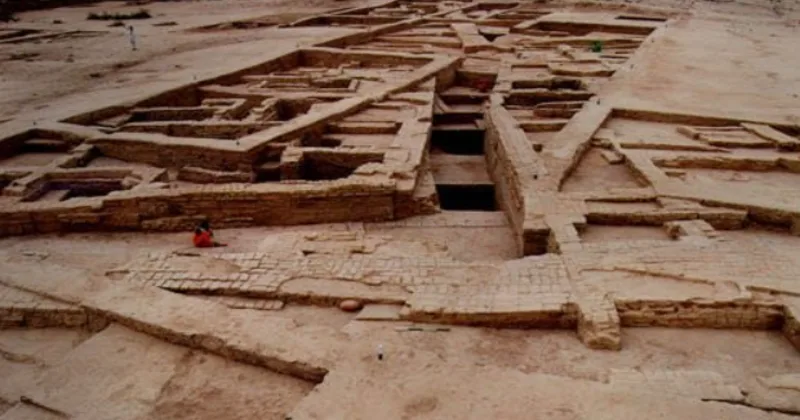
A stronger blow came to the AIT not from political leadership or philosophers, but from the cold, empirical evidence. Decades of Archaeological research and excavation have found no traces (destruction layers, foreign weaponry, new pottery styles, and abrupt cultural breaks) of a great massive invasion that occurred around 1500 BCE according to the AIT. The archaeological record points to a seamless transition, not to any violent replacement in the second millennium BCE. There is no archaeological layer pointing towards a violent break between the Indus Valley Civilisation (IVC) and subsequent cultures. Settlement patterns reflect a gradual eastwards shift linked to internal factors like a shift in the course of the river, deforestation due to the use of iron, and not foreign conquest.
If a massive migration occurred, there must be a trail of foreign material culture, pottery, tools, and burials from Central Asia into the Indian subcontinent around 1500 BCE. No such trail exists. The characteristic artefacts of Central Asian Andronovo culture are not found in the archaeological layers at Indian sites of the relevant period.
Horses, central to the AIT myth, have been identified in pre-Vedic Indian sites like Surkotada, dated to be around 2100 BCE. The chariots discovered at Sinauli date back to 2000 BCE, predating the supposed Aryan invasion. Also, the sophisticated construction of those chariots, with copper-covered wooden frames, intricate geometric decorations, and advanced wheel design, proved that chariot-building technology existed in Indian indigenously well before the imagined invasion of the so-called Aryans in 1500 BCE. Dr Sanjay Kumar Manjul, joint director-general of ASI has said regarding the findings at Sinauli that, “Western scholars proposed that chariots and weapons came to Indian with the Aryan invasion, which changed the society. The Sinauli excavation denies the entire agenda, as we have evidence of burials of warriors, weapons and chariots which is indigenous in nature”.
The summary by archaeologists Shaffer and Lichtentein clearly states that, “The biological and cultural data do not support… any version of the invasion or migration hypothesis. What the data do indicate is that South Asia, from the Neolithic through the Early Historic period, is characterized by a basic biological and cultural continuity.”
The Out of India Theory proposed by the likes of Koenraad Elst, propounds that the Indi-European languages originated in the Indian subcontinent and spread westward through trade and migrations. Koenraad Elst argues that AIT persists due to political misuse by colonialism, Dravidianism, and “breaking India” forces.
Studies in modern genetics by researchers like Davide Reich vouch for a genetic continuity for over ten thousand years in the Indian subcontinent. Although there has been a, indication of a gradual gene flow from the steppe into the Indian subcontinent after 2000 BCE. The scale, and timing of the influx are incompatible with the invasion propounded by the Aryan Invasion Theory. Scholars and Cultural Archaeologists like Prof. Vasant Shinde, dedicate this gradual gene mixing to trade relations with other civilizations abroad.
A Deliberate Attack on the Idea of Akhand Bharat
The Aryan-Dravidian narrative was never merely an academic theory but has been a deliberate ideological assault on the core concept of Akhand Bharat, the idea of an undivided, civilizational nation with cultural continuity spanning thousands of years. The AIT was used to shatter this unity and cultural cohesion of India by imposing a racial conflict and exploiting the beautiful cultural diversity of this nation. Several left-leaning historians, such as Romila Thapar, DN Jha, Irfan Habib and others, have championed this theory. According to these historians’ biased narratives, the ancient Indian society was divided in rigid social compartments called castes that had its origin in the foundational conflict between Aryans and Dravidians.
The mala-fide Dravidian politics based on the racial differences between North Indians (“Aryans”) and South Indians (“Dravidians”), led by people like Annadurai and Periyar, found this fabricated theory a perfect tool to dismantle what they believed to be Brahmanical dominance on Indian society and of northern Aryans on Indian culture. By advocating and endorsing this myth, they contributed in execution of the divide and rule strategy of the British, and kept on dividing the nation and weakening the idea of Akhand Bharat. The hatred for northern Aryans and Brahmins extended to the religious texts of Hinduism also.
Periyar even claimed that the epics like the Ramayana intentionally depicted Dravidians and villains and inferiors. This Dravidian narrative delegitimised the authority of Indic cultural and religious texts and Sanskritic traditions. They labelled Vedas and other cultural and religious texts of Sanatan culture to be Brahmanical and Sanskritic narratives deliberately written to show Dravidians as inferior to the northern Aryans.
Conclusion
For a long time, we Indians have looked at ourselves through foreign lenses. Be it the periodic division of Indian history by James Mill or the Aryan Invasion Theory, we have been told fabricated lies in the garb of telling our history, and a section of historians has been advocating and championing these false narratives for decades. This AIT has impacted the Indian society deeply and has become a dividing line between brothers. It made a Tamilian feel he/she had nothing in common with a Gujarati or a Bihari. It made a “Brahmin” feel like an outsider in his own motherland. It made a person from “lower caste” feel like someone who has been eternally suppressed and exploited on his/her own homeland. It converted our beautiful cultural and regional diversity into a source of hatred and conflict.
The foundation of the Aryan-Dravidian divide was based on an out-and-out lie, fabricated by the British imperialists. It was institutionalised and used for political gains for a long time. We, as a civil society, academicians and policy makers, need to spread awareness towards the real history of our people, re-written by Indic historians and scholars, which would be empirical and evidence-based, instead of imagined narratives like the Aryan Invasion myth.
It is high time to put down the colonial lens and see India as it has always been: “One Nation, One Civilization, One Family!”
“अयं निजः परो वेति गणना लघुचेतसाम्।
उदारचरितानां तु वसुधैव कुटुम्बकम्॥”
“This is mine, that is his, say the small minded,
The wise believe that the entire world is a family”
(Maha Upanishad 6.71–75)