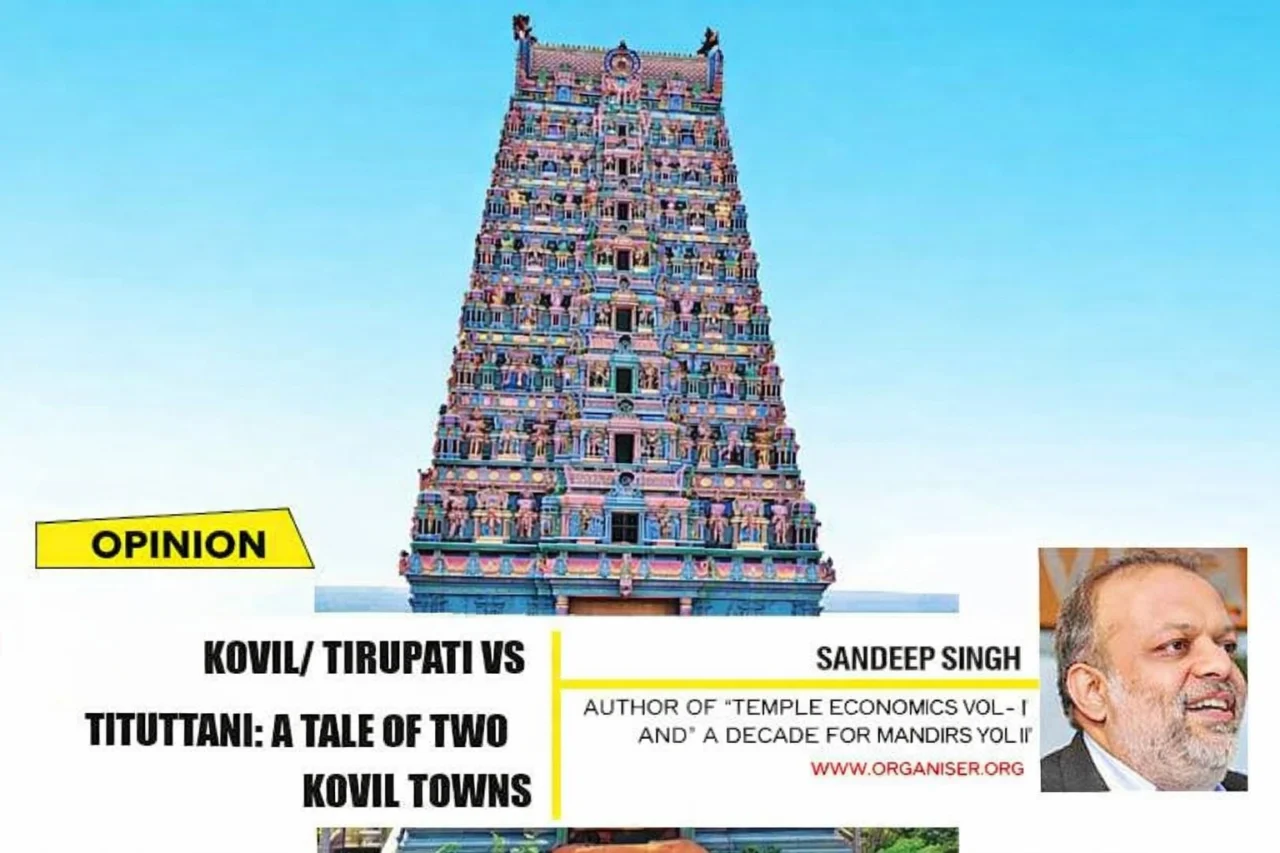
Barely 75 kilometres separate the hill shrines of Tirumala Venkateswara Kovil and Subramaniya Swamy Kovil Tiruttani. (Kovil is the word for Mandir in Tamil). Historically, they belonged to the same sacred landscape – linked by pilgrimage routes, patronised under Vijayanagara rule, and later administered within the Madras Presidency. In that older civilisational framework, Kovils were not bounded by language or State lines, but by kṣetra networks – a shared geography of faith.
Formation of AP
Post-Independence Bharat changed that. The creation of Andhra Pradesh in 1953, following the movement led by Potti Sriramulu, made language the primary basis of State formation. In the process, something deeper was disrupted: sacred geographies were cut to fit political maps.
The dispute over Madras city “Madrasu Manade” (Madras is ours, in Telugu) versus “Madras Namade” (Madras is ours, in Tamil) – is well remembered. Less remembered is the North Border Movement (Vada Ellai Porattam) led by MP Sivagnanam, which sought to retain culturally Tamil regions within Madras State. Among these, Tiruttani held special significance as one of the six abodes of Murugan. After a two-phase settlement – first in 1953 and then through the Pataskar Commission – Tirupati remained with Andhra, while Tiruttani was restored to Tamil Nadu in 1960.
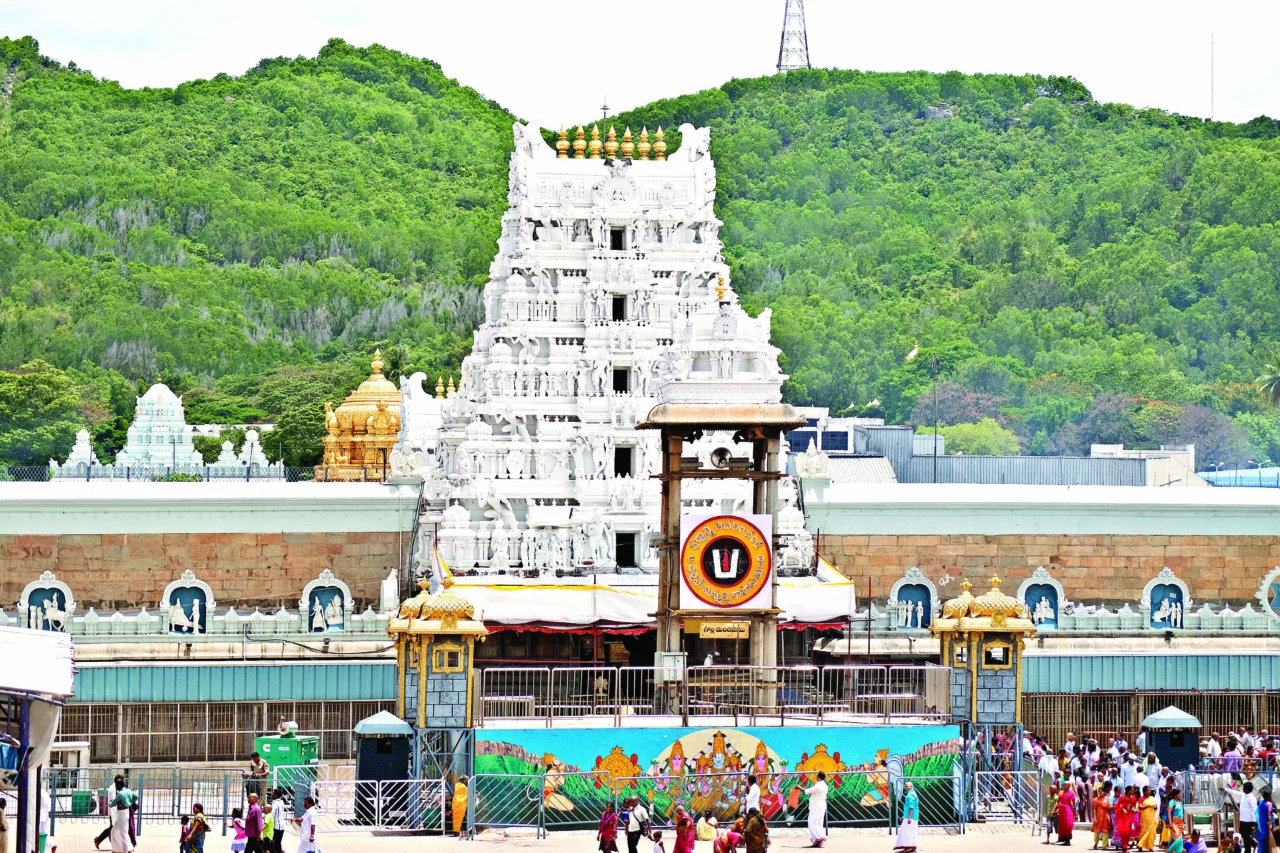
Six decades later, the outcomes could not be more different. Tirupati has become one of the world’s most visited pilgrimage centres, drawing tens of millions annually, supported by world-class infrastructure, a sophisticated administrative system, and a global devotional network.
Tiruttani, despite its deep theological importance, remains modest in scale, largely confined to regional pilgrimage circuits. The divergence is not due to history or theology. It is the result of policy, institutional design, and political ideologies.
In Andhra Pradesh, Kovil is administered by the Tirumala Tirupati Devasthanams (TTD) – a semi-autonomous body that retains and reinvests its revenues. Over decades, the TTD has built an ecosystem: free food schemes, hospitals, educational institutions, transport networks, and digital systems that manage vast pilgrim flows. Tirupati is not just a Kovil town; it is a sacred economy, a byproduct of devotion.
In Tamil Nadu, Tiruttani falls under the Hindu Religious and Charitable Endowments Department Tamil Nadu, a Government department that administers thousands of Kovils. Revenues are misused. The result is slow collapse. Kovil continues to function, but without being able to create a surrounding ecosystem.
This institutional difference reflects a deeper ideological divide.
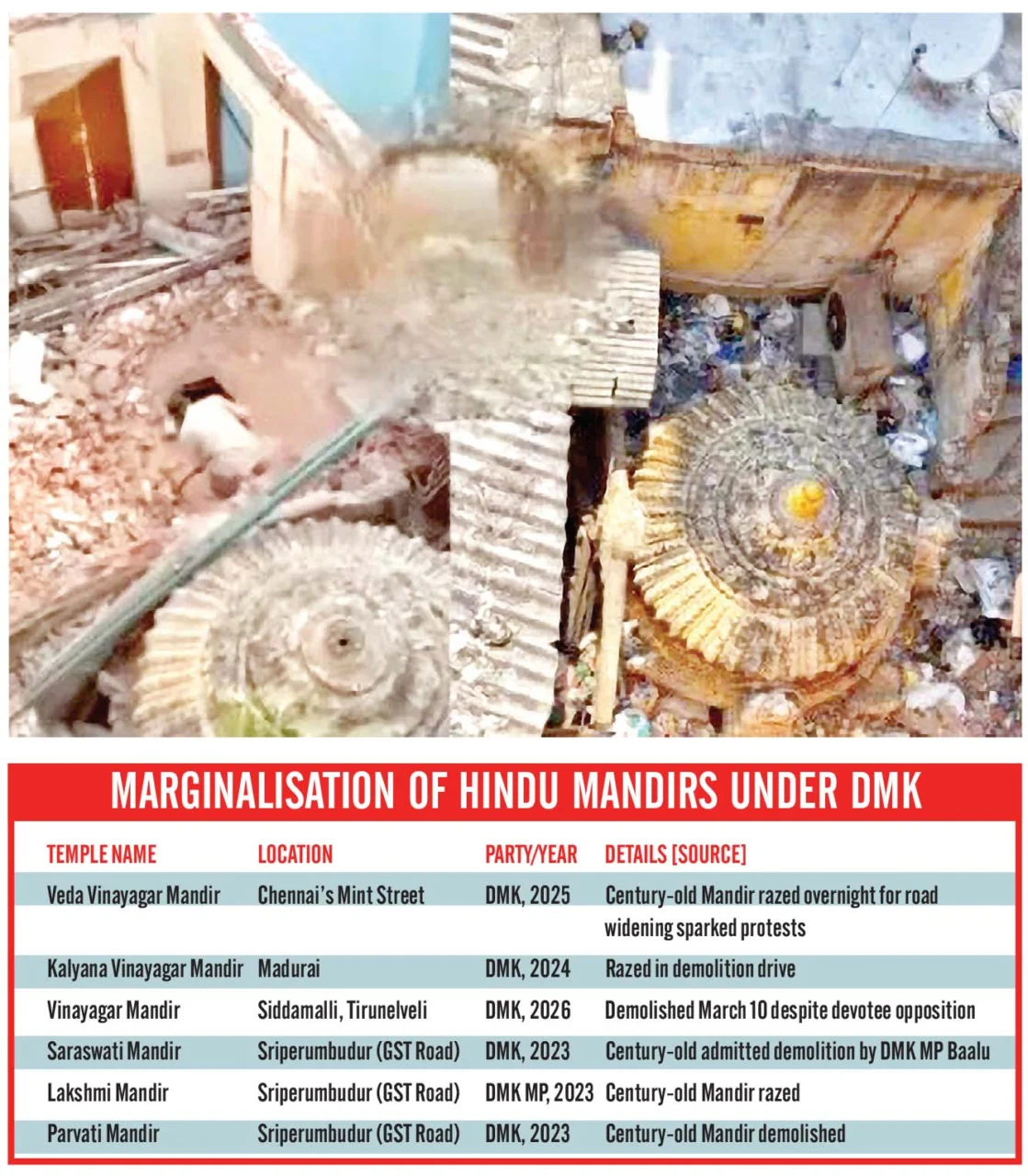
Across decades, sections of Tamil Nadu’s political establishment – shaped by strands of Dravidian thought like “Sanatan is AIDS” (DMK Member of Parliament A. Raja, September 2023) have approached Hindutava and Kovils with hate. The critique began as a social reform impulse, but in practice, it has translated into suppression of Kovils by State curtailing Kovil-centric cultural life.
The contrast with Tirupati is instructive. Andhra Pradesh’s political class – across parties – has treated Tirupati as money making engine arising out of devotion. After losing Madras (Chennai), the state invested in Tirupati’s growth to build identity and revenue. Motive is not devotional as demonstrated by appointment of large no of non-Hindus in TTD or procuring “adulterated Ladoo” to save money; economic incentives have played the most important role. But the outcome is undeniable: continuous reinvestment, expanding infrastructure, and a self-reinforcing growth cycle.
Tiruttani, by contrast, has not been positioned as a driver of regional development. Located in Tiruvallur district, its surrounding economy is shaped more by industrial spillovers from Chennai than by pilgrimage. This creates a different dynamic. Industrial economies can grow rapidly, but they are also cyclical and vulnerable to shifts in technology and capital. Kovil – centred economies, by contrast, have historically demonstrated remarkable longevity – sustaining cities like Varanasi, Madurai, and Ujjain for centuries. (for more refer Temple Economic Vol I)
This is not an argument against industrialisation. It is an argument for recognising that Kovils can be parallel engines of stable, long-term economic and cultural vitality – if allowed to function as such.
What explains Tirupati’s rise and Tiruttani’s relative stagnation?
First, network integration. Tirupati is embedded in national and global pilgrimage circuits, with seamless connectivity including an international airport. Tiruttani remains under-integrated—even within the Murugan circuit.
Second, branding and narrative. Tirupati has been projected as “Balaji,” a pan-Bharatiya deity. Tiruttani, despite its scriptural importance, lacks comparable narrative amplification.
Third, institutional innovation. TTD has embraced technology, professional management, and global outreach. Tiruttani’s governance structure offers limited scope for such innovation.
Fourth, economic vision. Tirupati is treated as a node in a larger sacred economy. Tiruttani is treated as a single Kovil within a large administrative portfolio.
All of this brings us to a difficult but necessary question: can this trajectory be changed?
The answer lies not only with governments, but with society.
If Tiruttani is to regain its stature, the first step is institutional reform – Government moving out of Kovil. Second, Tamil Nadu must consciously build a Murugan pilgrimage circuit, integrating all six abodes into a cohesive spiritual network. DMK has been attempting to position Bhagwan Murugan as the “Thamizh Kadavul” (Tamil God), while people from Tamil Nadu travel all over Bharat for darshan e.g., they visit Maharashtra for Ashtavinayak darshan. Third, civil society participation – through trusts, volunteer groups, and devotee initiatives – must complement state action.
Equally important is narrative reconstruction. Murugan is not merely a regional deity; He represents knowledge, valour, and youth – qualities that resonate with today’s Gen Z across Bharat. Repositioning Tiruttani within a broader national and global framework can expand its reach and relevance.
Finally, there must be an honest conversation about the ideological lens through which Kovils are viewed by politicians in Tamil Nadu. Critique of social inequities is legitimate and necessary. But when that critique evolves into targeting of Kovils and related rituals like The Karthigai Deepam controversy or calling to “eradicate” Sanatan Dharma (Udhayanidhi Stalin, the Minister for Youth Welfare and Sports Development, Tamil Nadu and a leader of the DMK party, September 2023) it weakens assets that have historically sustained communities – spiritually, culturally, and economically.
The story of Tirupati and Tiruttani is not just about two Kovils. It is about two approaches to civilisation.
One sees the Kovil as a living ecosystem – worthy of investment, innovation, and expansion. The other risks reducing it to a neglected administrative unit.
The future of Tiruttani will depend on whether this balance can be reset. Governments respond to incentives, but societies shape those incentives. If the people of Tamil Nadu choose to reassert the centrality of their Kovils – not as relics, but as living institutions – they can alter the trajectory by selecting leaders accordingly.
The lesson from just 75 kilometres away is clear: when Kovils are nurtured as institutions, they do not merely survive – they transform entire regions.