In a major boost to India’s strategic and economic ambitions, the country’s defence exports surged by 62.66 percent to reach a record Rs 38,424 crore, approximately $4.6 billion, in the financial year 2025-26, according to the Ministry of Defence. The sharp rise marks one of the most significant annual growths in recent years and underscores India’s steady emergence as a key player in the global defence manufacturing ecosystem.
The latest figures represent a substantial increase of Rs 14,802 crore compared to Rs 23,622 crore recorded in the previous fiscal year. This sharp jump highlights not only the growing demand for Indian defence products globally but also the success of sustained policy reforms aimed at boosting domestic production and exports.
A key feature of this growth story is the balanced contribution from both Defence Public Sector Undertakings and private companies. DPSUs accounted for 54.84 percent of the total exports, while private sector firms contributed 45.16 percent, reflecting a maturing defence industrial base where both segments are playing complementary roles.
Notably, DPSUs recorded an exceptional surge of 151 percent in exports, rising from Rs 8,389 crore in FY25 to Rs 21,071 crore in FY26. This remarkable growth signals a strong revival and enhanced competitiveness of state-run defence enterprises in the global market.
On the other hand, private sector exports also witnessed steady growth of 14 percent, increasing from Rs 15,233 crore to Rs 17,353 crore. The consistent performance of private firms highlights their growing role in innovation, niche manufacturing, and integration into global supply chains.
The surge in defence exports is closely linked to the government’s focused policy push over the past few years. Initiatives aimed at promoting ‘Atmanirbhar Bharat’ in defence manufacturing have created a conducive environment for both public and private players.
The Ministry of Defence has introduced several reforms to simplify export procedures and improve ease of doing business. These include a revamped online export authorisation portal, simplified standard operating procedures, and faster clearances for export approvals. Such measures have reduced bureaucratic delays and encouraged more companies to enter the export market.
Additionally, the government has actively supported Indian defence manufacturers through diplomatic channels, helping them access new markets and secure international contracts.
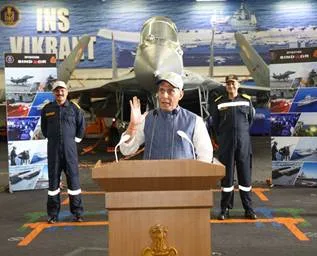
Defence Minister Rajnath Singh lauded the performance of the sector, describing the export growth as a testament to India’s rising capabilities in defence production. He credited the Department of Defence Production, industry stakeholders, and exporters for their coordinated efforts in achieving this milestone.
In his remarks, Singh emphasised that India is steadily progressing towards becoming a global hub for defence manufacturing. He noted that the country is “scripting an impressive defence exports success story” under the leadership of Prime Minister Narendra Modi, highlighting the government’s long-term vision of strengthening national security through self-reliance.
India’s defence exports have not only grown in value but also in geographical reach. During FY26, Indian defence equipment was exported to more than 80 countries, demonstrating increasing global trust in the quality and reliability of Indian products.
The number of registered defence exporters also rose significantly, increasing from 128 in the previous year to 145 in FY26. This expansion reflects a broader industrial participation and the entry of new players into the defence export ecosystem.
The growing international demand is also indicative of India’s ability to meet diverse defence requirements, ranging from small arms and ammunition to advanced systems and components.
The latest export figures mark an almost threefold increase over the past five years, underlining the sustained momentum in the sector. This growth trajectory is the result of consistent policy support, increased investment in research and development, and stronger collaboration between the government and industry.
India’s focus on indigenisation has reduced dependence on imports while simultaneously enhancing export potential. The development of advanced technologies and platforms within the country has enabled Indian firms to compete effectively in international markets.
The rise in defence exports carries significant strategic and economic implications. On the strategic front, it enhances India’s global standing and strengthens defence partnerships with other nations. Exporting defence equipment also contributes to building long-term diplomatic and security ties.
Economically, the growth of defence exports contributes to job creation, boosts manufacturing, and supports ancillary industries. It also helps in generating valuable foreign exchange, thereby contributing to overall economic stability.
The government remains optimistic about sustaining this growth momentum in the coming years. With continued reforms, technological advancements, and increased participation from private players, India is well-positioned to further expand its presence in the global defence market.
The record-breaking performance in FY26 signals that India is not only meeting its domestic defence needs but is also emerging as a trusted supplier of defence equipment worldwide.