On April 1, 1560, a sombre and transformative event unfolded on the streets of Old Goa: the first Auto-da-fé. Translating literally from Portuguese as an “Act of Faith,” this public ritual was not merely a ceremony but the official commencement of a complex and difficult era in colonial history—the Goa Inquisition. For more than two and a half centuries, this institution would exert a significant influence over the social and religious life of the Indian subcontinent, representing a period of intense institutional oversight and the rigorous enforcement of colonial religious policy.
The Inquisition in Goa stands as a profound historical example of how institutional structures during the colonial era sought to enforce conformity. While the period is often viewed through the lens of religious mission, the historical reality reveals a systematic attempt to consolidate power by regulating the innermost beliefs and daily habits of the local population. Understanding this chapter requires looking beyond simple narratives to see the deep tensions between an imported administrative framework and the ancient, pluralistic traditions of the Indian people.
The Administrative Foundations: St. Francis Xavier
To understand the origins of this tribunal, one must look toward its primary administrative advocate, St. Francis Xavier. While popular history frequently focuses on Xavier as a dedicated missionary, the records regarding the establishment of the Inquisition offer a more nuanced administrative perspective. In 1545, it was Xavier who drafted a formal letter to King John III of Portugal, explicitly requesting that the Inquisition be established in the Eastern territories.
Xavier’s primary motivation was a deep-seated concern regarding the “purity” of the faith among the “New Christians”—those who had recently converted from Hinduism, Islam, or Judaism. He harboured significant suspicions that these converts were secretly maintaining their ancestral beliefs and spiritual practices. Although Xavier passed away in 1552, years before the tribunal was officially inaugurated in 1560, his persistent lobbying and detailed correspondence provided the ideological and administrative blueprints for the institutional system that followed. His vision was one of a unified religious front where any lingering influence of local spiritual traditions was viewed not just as a deviation, but as a challenge to the absolute authority of the colonial Church.
The Architecture of Secrecy: The Santa Casa
The physical and administrative heart of this era was the Palace of the Inquisition, more commonly known as the Santa Casa (Holy House). This sprawling architectural complex was designed to be self-contained and impenetrable, housing the judicial tribunal, the private residences of the Inquisitors, and a complex, labyrinthine system of dungeons.
The defining characteristic of the Santa Casa was its absolute secrecy. Once an individual was brought within its gates, they were effectively severed from the outside world, with no communication allowed with family or legal counsel. The Inquisition operated primarily through a system of anonymous denunciations. This meant that an individual could be apprehended based on a whispered rumour or a private grudge, never being informed of the identity of their accuser or the specific nature of the evidence against them. This environment of constant uncertainty and paranoia was systematically designed to alter the social fabric of Goan society, often leading to a breakdown of trust within the community.
The Legalistic Process of Purification
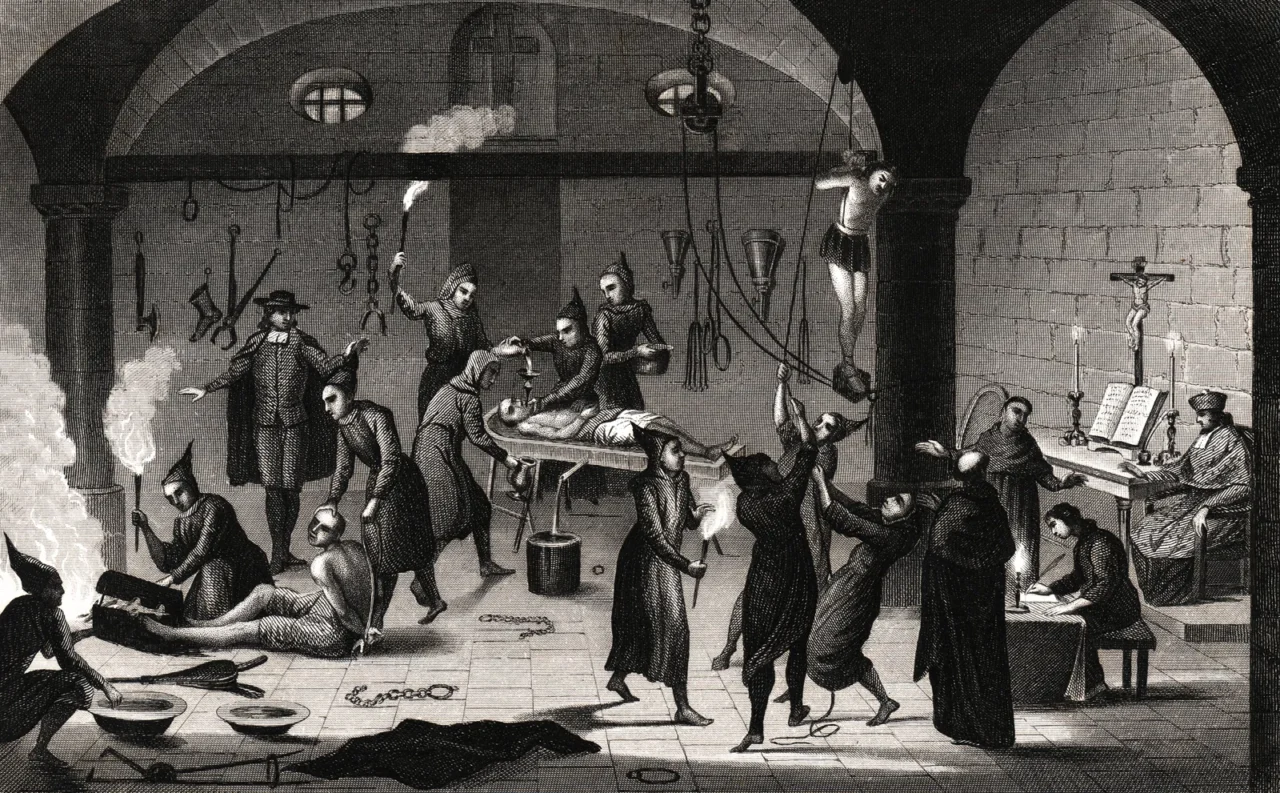
The tribunal’s methods for extracting confessions of “heresy” were codified and supervised by the institutional hierarchy. During this period, the Inquisition’s official manuals authorised the use of physical duress as a legalistic tool to “purify” the soul of the accused. These acts were not the result of unauthorised behaviour but were a formal part of the judicial process.
Among the methods documented were:
● The Strappado (Pulley): A common technique where the individual’s hands were bound behind their back and they were hoisted into the air by a rope. The sudden tension and subsequent drops were intended to cause severe joint strain and physical collapse.
● The Toca (Water Torture): This involved placing a thin cloth over the face and slowly pouring water over it, creating a persistent and terrifying sensation of suffocation and drowning.
● The Rack: A specialised wooden frame used to stretch the human body until ligaments were severely damaged and bones were displaced from their sockets.
● The Brazier: In this method, the feet of the accused were coated in lard and held over a slow-burning fire, leading to debilitating burns and permanent physical impairment.
These rigorous methods were meticulously recorded, reflecting a belief that physical suffering was a necessary precursor to spiritual reclamation.
The Spectacle of the Auto-da-fé
The Auto-da-fé served as the public culmination of the Inquisition’s internal processes. On the morning of April 1, 1560, the first of these major rituals took place, featuring dozens of men and women who were paraded through the streets of Old Goa in a highly choreographed display of institutional power.
The participants were required to wear specific ceremonial garments known as sanbenitos. These yellow tunics were marked with various symbols to denote the wearer’s status: simple crosses for the “penitents” who had confessed, or elaborate paintings of demons and inverted flames for those who had been sentenced to death. The procession ended before a large public gathering where the final sentences were read aloud. For many, the day concluded with the Relacao—the formal act of handing the condemned over to the secular colonial authorities to be burned at the stake. These public executions were intended to serve as a visual deterrent, signalling that total adherence to the colonial religious framework was the expected standard for survival in Goa.
Institutional Longevity and Cultural Edicts
The scale and duration of the Inquisition were immense, leaving a lasting mark on the region’s history. While many official records were deliberately destroyed by the Portuguese in 1812 to obscure the extent of the tribunal’s activities, historians such as Anant Priolkar and Charles Boxer have reconstructed a grim picture from the archives that survived:
● Duration: The tribunal functioned for approximately 252 years, from 1560 until 1812.
● Total Trials: Historical estimates suggest that more than 16,000 individuals were formally brought to trial during this period.
● The Edicts of 1736: A series of comprehensive edicts aimed at erasing the cultural identity of the local population.
The edicts of 1736 were particularly significant as they moved beyond religious belief to criminalise the very essence of Indian daily life. These laws prohibited the use of the native Konkani language, the wearing of traditional Indian attire, and even the cultivation of the Tulsi plant, which held deep spiritual significance. Furthermore, the edicts regulated domestic habits, such as prohibiting the preparation of traditional foods in ways that aligned with local customs.
Demographic Shifts and the Legacy of Displacement
The most enduring long-term impact of the Inquisition was the massive exodus of the indigenous population. To escape the threat of the Santa Casa and the restrictive cultural edicts, tens of thousands of Goans chose to abandon their ancestral lands, homes, and wealth. They fled into the dense forests or moved toward neighbouring territories along the Konkan coast and into Mangalore.
This forced migration resulted in a profound and lasting shift in the region’s social and religious fabric. Families were uprooted, and communities that had existed for centuries were fragmented as they sought safety elsewhere. Understanding these patterns of the past is essential for recognising how colonial policies can fundamentally alter the demographic landscape of a nation.
The Imperative of Eternal Vigilance
The history of the Goa Inquisition is a difficult story of institutional pressure, but it is one that cannot be overlooked. It highlights the historical reality of how colonial structures often functioned at the expense of indigenous identity and freedom. However, looking back at these events is not merely about documenting hardship; it is about recognising the immense resilience of the Indian civilisation.
As we reflect on the victims of April 1, 1560, we are reminded that our identity and traditions are precious inheritances that survived through immense sacrifice. This history serves as a solemn reminder for every Indian to remain eternally vigilant against any forces that seek to undermine the pluralistic fabric of Indian society or the continuity of Indian civilisation.
We must recognise that the preservation of our heritage requires constant awareness and a commitment to protecting the values that define us. Ultimately, let this awareness foster a renewed dedication to the security and integrity of our cultural landscape, for truly, eternal vigil is the price of freedom.