
There is something quietly seismic about a man who spent four decades building a party, won three consecutive assembly elections under its banner, and then walked away. Not in defeat. Not in silence. But with a verdict.
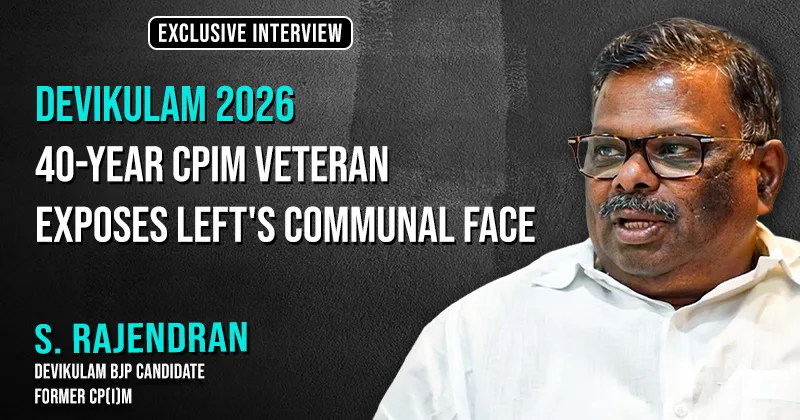
S. Rajendran, three-time CPIM MLA from Devikulam — the heart of Kerala’s plantation belt, a region where the red flag has flown longer than most people can remember — joined the BJP just a few months ago.
S. Rajendran is now contesting as the BJP candidate from the same Devikulam constituency in Idukki district that sent him to the Kerala Legislative Assembly three times under the CPIM label — this time taking the fight directly to his former party. And in doing so, he has handed the Left its most uncomfortable question ahead of the April 9 polls: if a man who gave the party forty years of his life has chosen to leave and chosen to fight it, what does that say about the party itself?
Watch Full Interview Here: https://www.youtube.com/watch?v=kFGENL9X5zs
The Communalism Within: The Allegation That Will Haunt the Left
There is one charge Rajendran makes that cuts deeper than any electoral statistic. Beneath the talk of neglected housing schemes and stalled welfare projects.
“As far as the party is concerned, there is no issue with policy or ideology,” he says carefully. “However, in the approach taken by some individuals who are leaders — that communalism is experienced. Within any party, within all parties today, communalism exists deep inside. It is very much active.”
3 Times for Left and Now for BJP
The same constituency that once made him its Left face now watches him contest on the BJP panel — a crossing over that is as much a verdict on the party he left as it is a bet on the one he joined. The party that built its entire political identity on opposing communalism, that has weaponised the charge against BJP for decades, carries the same tendency within its own leadership, he says. Not as an aberration. Not as an exception. But as something “very much active.”
What makes Rajendran’s crossing over significant is not just the symbolism — though a three-time MLA from a CPIM stronghold joining BJP is symbolism enough. It is the reasoning. His decision to join BJP was not made in anger or impulse. It was made, he says, after a “final evaluation.”
“When we consider all the things related to Modi’s development, why can’t we approach him to solve problems? What is the problem in accommodating the BJP?” he asks. “It is based on this final evaluation and thought that we joined the BJP.”
For Rajendran, the calculus is straightforward. Forty years of Left politics in Devikulam’s plantation belt have not meaningfully moved the needle for the workers who formed its backbone — backward and plantation communities who carried the party to victory election after election. “They haven’t seen any real improvement in their lives,” he says.
What Plantation Community Wants
For the people of Devikulam’s plantation belt, the struggles are not abstract political debates — they are daily, lived hardships that successive governments have watched and ignored. Forest officials, Rajendran says, have been encroaching upon ‘pattayam’ lands — titled agricultural lands legally belonging to farming families — and continue to do so unchecked. “People are unable to even enter their own pattaya lands,” he says. Roads that have existed since the time of kings — including the stretch from Neriamangalam to Adimali, running six to twelve kilometres through the high ranges — are being taken over, with cases filed against the very people who have used them for generations.
Every such encroachment, every such case, becomes another obstacle to development in a region already left behind.
Then there is the daily terror of the forest boundary. Wild animal attacks have claimed human lives with grim regularity. Cattle and livestock that families depend on for their livelihood are being killed. “Even just the day before yesterday, there was a death in Kallar — someone was trampled to death,” Rajendran says, his voice carrying the weight of a community that has learnt to live with tigers, leopards, monkeys, and peacocks pressing ever closer into human settlements. These are not statistics for Rajendran — they are his neighbours. And beneath all of it lies the quiet indignity of unaddressed basic rights.
Workers in the plantation sector — many holding no more than two or four cents of land — have been waiting for housing(layams) that was promised and never delivered. Caste certificates remain unprocessed. Residence rights in the labour lines remain in limbo. “There has been a discussion on this with the state BJP leadership, and there is a positive approach towards it,” Rajendran says of the housing promise. “All of that will happen.” It is a line that carries both hope and the exhaustion of a community that has heard promises before — and is now, for the first time, betting on a different party to keep them.
His message to the plantation workers of Devikulam — the men and women who stood beside him through forty years of party meetings, strikes, rallies, and elections — is direct. He does not ask them to abandon their instincts. He asks them to look at the evidence.
Even if the LDF and UDF join together…
“For the common man, there is no caste or religion. He only has his hunger, shortcomings, faults, and difficulties in front of him. He will accept whoever helps him.” The Congress, he argues, had its decades of national power and failed to deliver — no four-lane roads, no railways, no serious pension intervention. The LDF is hemmed in at the state level, unable to drive national legislative change. “Even if the LDF and UDF join together, they won’t be able to make any legislative changes in the state,” he says.
The INDI alliance, he believes, has a limited horizon. “Within 10 years, whatever needs to be finished and whatever needs to be given to people should be done.” Why wait for a political formation whose future is uncertain, when a government with a proven track record of delivery is already in power at the Centre?
There is a line Rajendran returns to that cut to the heart of his forty-year journey and the decision that ended it. “How far did we reach in 40 years with this ideology? Where will the next generation reach with this?”
It is not a rhetorical flourish. It is the question of a man who gave the best decades of his life to a cause and found, at the end of it, that the cause had been captured by people more interested in consolidating power than delivering change. A man who concluded, after everything, that the worker deserves better than slogans — and that better, right now, wears saffron.
Idukki’s Devikulam will answer on April 9.