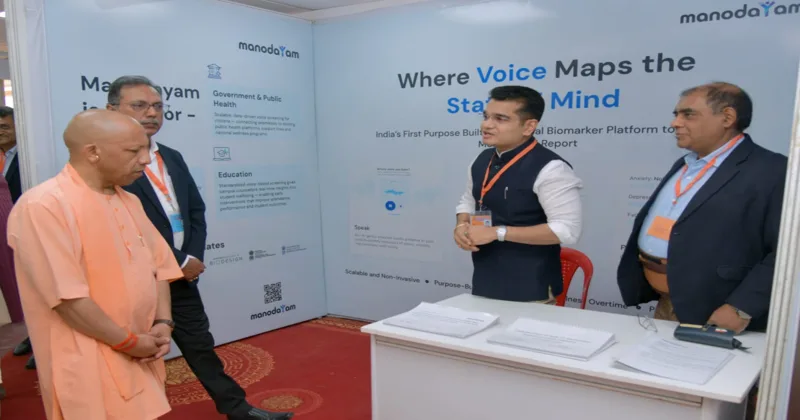
Gorakhpur which is associated with religious heritage, railway headquarters and fertiliser plants has added a new identity to its profile of India’s national information technology centre. Chief Minister Yogi Adityanath inaugurated the 71st centre of Software Technology Parks of India (STPI) at the Gorakhpur Industrial Development Authority (GIDA) campus, marking what officials and technology observers are calling a pivotal moment for eastern Uttar Pradesh economic future.
This inauguration was the culmination of years of groundwork from the MoU signed between STPI and Uttar Pradesh Electronics Corporation (UPLC) that set aside 14,500 square metres(3.58 acres) of GIDA land for the project, to the construction of a modern facility designed to plug Gorakhpur into the same ecosystem that has made Bengaluru, Hyderabad and Pune global IT destinations. Chief Minister Yogi Adityanath credited the initiative directly to the vision of Prime Minister Narendra Modi. In a post on X before the inauguration, he said the centre was “a key milestone in strengthening Uttar Pradesh’s digital and startup ecosystem,” adding that the facility would “play a crucial role in advancing technology-driven development in the state.”
Uttar Pradesh CM Yogi Adityanath shared a post on social media, " Today, the inauguration of the Gorakhpur Centre of Software Technology Parks of India (STPI) was held at the Gorakhpur Industrial Development Authority (GIDA)…"@CMOfficeUP | @myogioffice | @myogiadityanath |… pic.twitter.com/zRlLaB2f1M
— United News of India (@uniindianews) March 26, 2026
What is STPI and why does it matter?
Software Technology Parks of India is a premier science and technology organisation functioning under the Ministry of Electronics and Information Technology (MeitY), Government of India. Established in 1991 with just three centres in Bengaluru, Bhubaneswar and Pune, STPI’s founding mission was straightforward to accelerate Indian software export growth by providing companies with high-speed data communication, statutory services and a supportive infrastructure framework.
More than three decades later, the organisation has grown into one of the most consequential drivers of India’s digital economy. According to data on STPI’s the organisation now operates 68 centres across India through 14 jurisdictional directorates. The exports generated by STPI-registered units have grown from ₹52 crore in 1992-93 to ₹10,69,270.59 crore in 2024-25 a figure that represents approximately 50 per cent of India’s national software exports and 3.2 per cent of the country’s GDP. STPI-registered units has achieved software exports of approximately ₹10.64 lakh crore in FY 2024–25, with the scheme having created 2.98 lakh direct jobs in non-metro cities as of March 2025.
The organisation has also evolved well beyond its export-promotion origins. It now operates 24 domain-specific Centres of Entrepreneurship (CoEs) focused on emerging technologies such as Artificial Intelligence, Blockchain, IoT, FinTech, AgriTech, MedTech, Drone Technology and Animation. Through the Next Generation Incubation Scheme (NGIS) and other startup support initiatives, STPI has backed over 1,400 startups nationwide, with a total fund outlay of ₹445.77 crore, including ₹39.86 crore in direct financial assistance to 590 startups over the past three financial years.
The Gorakhpur centre: What it offers and who it serves
The new STPI centre at GIDA is designed as a comprehensive IT infrastructure hub, equipped with modern amenities that include high-speed internet connectivity, plug-and-play office spaces, incubation facilities and support services for IT operations. The facility is intended to serve three distinct categories of users where established IT companies looking for a cost-effective presence in eastern UP, startups seeking structured incubation support and Business Process Outsourcing (BPO) units that can operate from Gorakhpur while serving clients nationally and globally.
Speaking at the inauguration ceremony held at GIDA, CM Yogi Adityanath addressed the gathering with a characteristically direct message about technology and governance. He said that technology has the power to multiply the pace of development many times over, and that avoiding it means stepping out of competition and stepping out of competition means moving toward decline rather than progress. “Humein pragati ka anusaran karna hai” he said by underlining the government intent to embrace technology as a driver of governance and growth at every level.
National mission coming to smaller cities: STPI tier-2 strategy
The Gorakhpur inauguration is not an isolated event. It is part of a deliberate, policy-driven effort by MeitY and STPI to decentralise India’s IT industry away from its traditional concentration in Bengaluru, Hyderabad, Mumbai and Delhi-NCR. According to STPI’s official website, 59 of its centres that is, nearly 87 per cent are now located in Tier-2 and Tier-3 cities. Non-metro STPI units employed 2.98 lakh people as of March 2025, while non-metro cities like Udaipur, Vizag, Coimbatore and Nagpur recorded over 50 per cent IT hiring growth in the first half of FY25.
For decades eastern Uttar Pradesh has been among India’s most persistent exporters of human capital with talented engineers, software developers and BPO workers who left for Bengaluru, Pune or Noida because the infrastructure at home did not exist to retain them. The STPI centre changes that equation.
Uttar Pradesh is growing place in India’s digital economy
The Gorakhpur STPI centre also fits within the larger arc of Uttar Pradesh technology ambitions under Chief Minister Yogi Adityanath’s nine-year tenure. The state’s startup count has crossed 50,000 under the UP Startup Policy. IT parks are being developed simultaneously in Meerut, Agra, Kanpur and Gorakhpur in coordination with STPI. Noida and Lucknow have attracted semiconductor, data centre and defence technology investments through the Global Investors Summits. The state’s GSDP, buoyed partly by the services sector’s expansion, has grown from roughly ₹13 lakh crore in 2016–17 to ₹36 lakh crore, according to figures cited by the Chief Minister in the UP Legislative Council.
What the STPI centre adds to this picture is institutional credibility. STPI’s imprimatur means that companies registered here receive access to the full suite of benefits the scheme offers a statutory support for software exports, data communication infrastructure, incubation resources, and connections to STPI’s national network of investors, mentors, and industry partners. For a startup founder in Gorakhpur, this is the difference between operating in isolation and being plugged into one of India’s most established technology promotion networks.
Employment, investment and the road ahead
Industry observers and local administration suggest the STPI centre could generate between 1,500 and 2,000 direct employment opportunities in its initial phase, covering software development, technical support, BPO services and startup ventures. These projections are consistent with the employment outcomes seen at comparable STPI facilities in other Tier-2 cities, where the PIB has documented the creation of nearly 3 lakh jobs across the network.
The facility is also expected to function as a catalyst for ancillary economic activity where demand for rental accommodation, food services, transport and retail typically rises sharply around functional IT hubs. In cities like Gorakhpur, which already has AIIMS, the North Eastern Railway headquarters, the Gorakhpur Fertiliser plant (HURL) and the Gorakhpur Metro Rail project as economic anchors, the STPI centre adds a new growth node.
Indian IT industry in its thirty-year run has been in four or five cities. The STPI Gorakhpur centre, the 71st in a network that began with three, is part of a quiet but accelerating rewrite of the story. When STPI’s registered units can generate ₹10.69 lakh crore in software exports in a single year from a network spread across 68 centres, when nearly 3 lakh direct IT jobs exist in non-metro India, and when a Chief Minister can stand in GIDA and tell an audience in Gorakhpur that technology is the path from gati (pace) to pragati(progress).