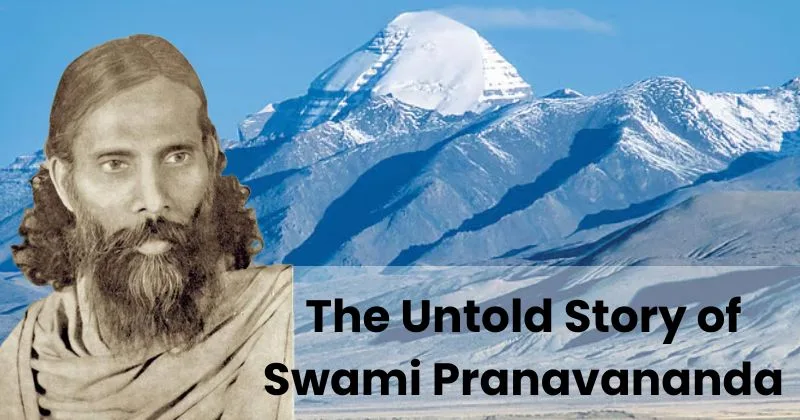
Born in 1896 in Andhra Pradesh as Kanakadandi Venkata Somayajulu, Pranavananda’s early life was far from the essence and silence of the Himalayas. Inspired by Mahatma Gandhi’s non-cooperation movement as a young Congress volunteer, he participated in the Indian Independence movement. But one decision that changed him completely was the transition in his inner self after he became a disciple of Swami Sivananda in 1926.
Swami Pranavananda: A Yogi who used to think like a scientist
Believing in the rigorous methodology made Swami Pranavananda truly extraordinary. Unlike traditional pilgrims, he spent months at a time in Tibet, carefully observing seasonal and climatic changes, studying the behaviour and patterns of Lake Mansarovar, and documenting the region’s geography and Tibetan culture in detail. At a time when modern technology was virtually nonexistent, he relied on manual measurements, meticulous observation logs, and repeated field studies.
His remarkable work includes tracing the origins of major river systems, including the Brahmaputra, Indus, Sutlej, and Karnali Rivers. At a time when the geographical understanding of these rivers was incomplete or inaccurate, his firsthand observations helped clarify their sources and provided valuable ground-level insights.
First Study of Mansarovar
Even today, Mansarovar is like magic to many, and the journey to it is the epitome of faith. Swami Pranavananda achieved his goal of studying Mansarovar in 1946.
Swami Pranavananda launched a rubber boat named “Janma Bhoomi” onto Lake Mansarovar to conduct depth measurements of the lake. Through his experiment, he conducted the first-ever study of Mansarovar. His study revealed that the maximum depth is 84 feet. This was one of the earliest systematic attempts to measure the Mansarovar scientifically, without advanced instruments, in extreme weather conditions at an altitude of more than 15,000 feet.
Recognition by the royal geographical society
Swami Pranavananda’s work led to his being honoured as a Fellow (FRGS) by the prestigious Royal Geographical Society in London. He was one of the rarest gems who got this honour for his scientific credibility as a monk.
Kailas-Mansarovar: A book that becomes a treatise for pilgrims
Swami Pranavananda published a book named Kailas-Mansarovar in 1949. This book is not just a travelogue; it includes detailed geographical observations, route and terrain analyses of the Himalayas, cultural insights, and a complete practical guide for pilgrims to Mansarivar and the Himalayas. Kailas Mansarovar is still the most authoritative work on the Himalayan region and Mansarovar.
Mansarovar: Where Science Meets Consciousness
The work of Swami Pranavananda reveals a deeper dimension of Lake Mansarovar that is beyond its identity as merely a sacred lake or pilgrimage site. Kailas Mansarovar stands as a rare geographical anomaly, a freshwater body at an extreme altitude, a hydrological mystery shaped by unique environmental conditions.
“The silence of Mansarovar is not empty; it is intensely alive,” is what pilgrims and explorers feel reaching on that altitude.
On the contrary, Rakshas Tal, a saline lake traditionally associated with darker symbolism. Pranavananda closely studied both, documenting stark contrasts in water composition, ecological behaviour, and local cultural interpretations. This coexistence of two radically different lakes in the same landscape fascinated him not only as a scientific phenomenon but also as a philosophical insight.
Why does the Swami Pranavananda story matters today?
In today’s era, people want to end the topic of spiritualism by presenting scientific facts. The talk about inner exploration is often neglected. Swami Pranavananda’s life proved that you don’t have to choose between science and spirituality, and you can master both.
He established an ashram in Pithoragarh, Uttar Pradesh (now Uttarakhand) in the Himalayan foothills, where he lived and focused on his spiritual pursuits until 1989. It is always the Himalayas and Mansarovar where outer geography meets inner consciousness.